
Antihero is the brand of the eagle and the pigeon. It’s also the brand of John Cardiel, Tony Trujillo, Jeff Grosso and Grant Taylor: skaters who go fast, fall hard and skate everything they find, from an empty pool to a San Francisco street. Its humor is dark, its graphics have bothered more than a few people and its videos look like they were shot from the van, because a lot of the time they were.
Here you’ll find Antihero’s history since 1995, who drew its logos, what happened to John Cardiel, what its decks are like, who skates for it and its videos in order.
How Antihero started
In the mid-90s Julien Stranger was one of the street pioneers in San Francisco. He and Jake Phelps, the editor of Thrasher, thought the skating of the time had become boring and predictable. In 1995 Stranger started his own brand inside Deluxe Distribution, the company of Fausto Vitello and Jim Thiebaud that already had Real and Spitfire. The story goes that the idea of Stranger having his own brand came from Thiebaud.
Stranger has never explained the brand in big words. He says Antihero is a continuation of what they were already doing, that there was no plan: it’s just skating. Phelps described it as the reflection of a slightly disenchanted way of looking at life and of San Francisco’s street spirit.
Its way of picking riders is also particular. Stranger has said they look for people who made their own way, without hopping from sponsor to sponsor, and who can stand weeks stuck in a van. Jeff Grosso explained that new guys are decided by a vote among the team.
The pigeon, the eagle and Todd Francis
Todd Francis joined Deluxe in 1993 as an artist and soon became its art director. He grew up between Venice and Santa Monica, listening to Southern California punk and looking at Raymond Pettibon’s drawings. He says he works from rage and disgust, and that Antihero comes out of the Tenderloin, one of the toughest neighborhoods in San Francisco.
The first Antihero shirts had a plane in a nosedive. Stranger, under pressure to define the brand’s image, told Francis to do something with a plane crash. Francis himself remembers them as something rushed and a bit clumsy.
Then came the pigeon. Stranger wanted it beat up and dirty, like the ones that live in any city: a bird nobody wants that survives everywhere. Francis drew it, and over the years the pigeon has been copied a ton.
The eagle came later and ended up as the main logo. The original drawing was stolen at one of Francis’s shows in London. The thief, a huge fan of the brand, felt guilty and gave it back, and today Francis has it framed and won’t sell it. He jokes that if he had to do the logo now, he’d put a tapeworm instead of a bird of prey.
Antihero graphics have a reputation for dark humor: police dogs that turn on their owner, rats, junk food, parodies of big brands. Some drew legal notices and others never went on sale because the skaters themselves didn’t want to ride them.
John Cardiel
If one skater represents Antihero, it’s John Cardiel. He skated fast, fearless and on any terrain, and gave up snowboarding in the mid-90s to focus on skating. Thrasher named him Skater of the Year in 1992 and his part in Sight Unseen (2001), the Transworld video, is among the most remembered of its era. He went into the Skateboarding Hall of Fame in 2015.
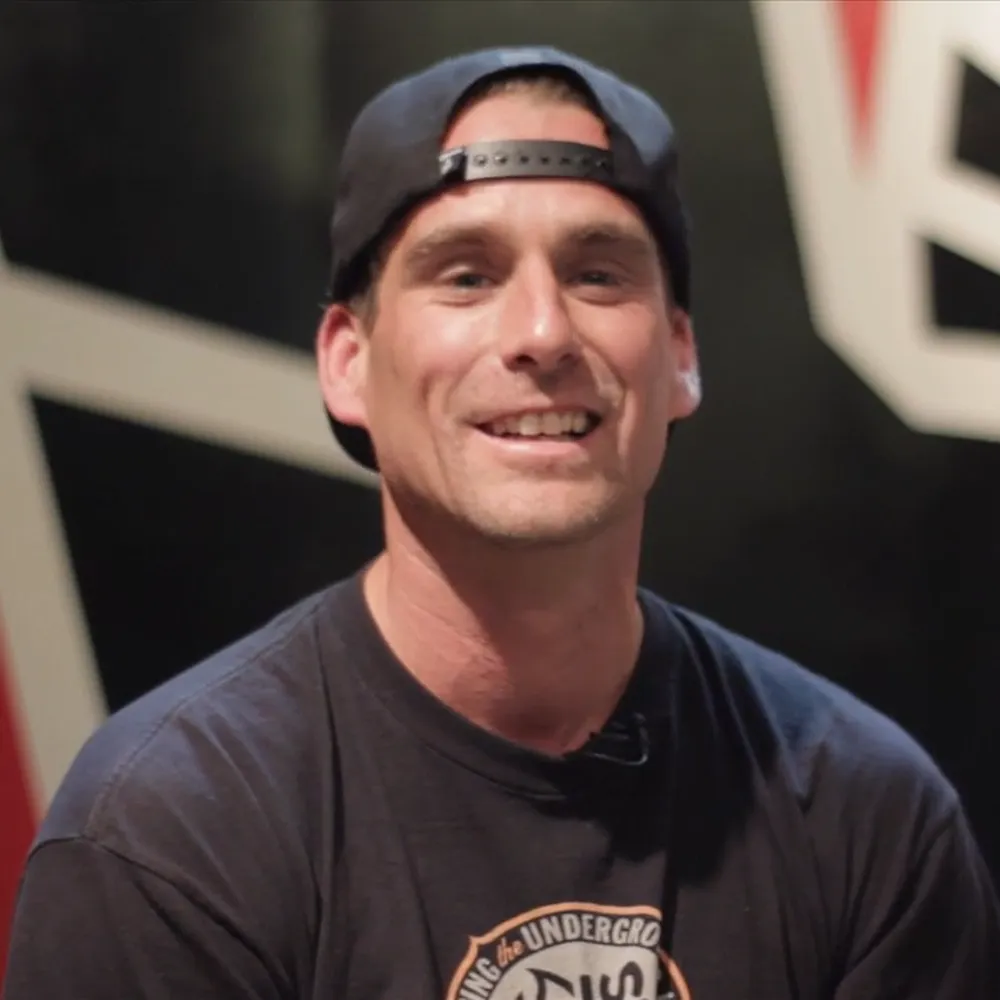
After wrapping the Tent City trip in Australia, in late 2003 or early 2004, Cardiel was talking to someone through the window of a parked van when the driver pulled off without seeing him and the trailer went over him. He suffered a spinal injury, was paralyzed from the waist down and spent five months in an Australian hospital. Mickey Reyes, of Deluxe, remembers the day Cardiel moved a toe and started shouting with joy. After a lot of rehab he walked again, and in 2005 he appeared standing on a board in an Antihero ad. Today he rides a bike, is still tied to the brand and has decks with his name on them.
The Antihero team
The early years: Julien Stranger, John Cardiel, Frank Gerwer, Tony “T-Mo” Miorana, Peter Hewitt and Andy Roy.
The 2000s: Tony Trujillo came in by sending a twenty-minute sponsor-me tape that left the whole team impressed. In 2002 Thrasher named him Skater of the Year. Brian Anderson and Max Schaaf were on the team too.
The 2010s: Jeff Grosso joined in 2011. He was an 80s vert legend, had overcome his addictions and hosted Love Letters to Skateboarding, one of the most loved skate shows on the internet. He died in March 2020. Grant Taylor, Thrasher Skater of the Year in 2011, arrived in January 2014 with an announcement saying he was already “in the van”. Raney Beres, Robbie Russo, Chris Pfanner, Daan Van Der Linden, Austin Kanfoush, Pat McClain and Byron Ortega also joined.
Today: besides veterans like Cardiel, Gerwer, Hewitt and Brian Anderson, the team has Grant Taylor, Raney Beres, Doobie, Austin Kanfoush, Cody Chapman (pro since 2025), Evan Smith, Finn Pope and Gus Gordon.
Antihero’s videos
| Year | Video |
|---|---|
| 1997 | Fucktards |
| 1998 | Cow |
| 2002 | Two Songs |
| 2003 | Cash Money Vagrant |
| 2004 | Tent City, a month in a van around Australia |
| 2006 | Bonus Footage |
| 2008-2010 | The Battle at the Berrics videos |
| 2014 | Destination Unknown |
| 2016 | Chestnut Hill and The Vickie Report |
| 2017 | Urban Mutation and Reality Breakdown |
| 2020 | Quantinium |
| 2023-2024 | Turbo Island, a tour of the UK |
Antihero has also made videos with other brands, like Beauty and the Beast, the joint tours with Girl.
If you like skate videos, here are the best skate videos of all time.
Antihero decks
- Seven plies of North American maple: the construction of almost all its decks. They tend to be a bit wider than average, with usual sizes between 7.81 and 8.75 inches. The Classic Eagle, with the eagle, is its best-selling deck.
- DBX: thinner maple veneers combined with three layers of basalt fiber. It’s lighter, thinner and stronger, and a bit pricier.
To pick your size, check our guide to choosing a skateboard deck. The wheels and trucks the team uses come from sister brands: Spitfire wheels and Independent, Thunder or Venture trucks.
Antihero vs other brands
- Real: its sister brand at Deluxe, and they share a construction. Real has a more classic image; Antihero, a rawer one.
- Baker: also a skater-run brand with a lot of personality, but very street-focused. Antihero has more weight in transition, pools and fast skating.
- Powell Peralta or Santa Cruz: they have their own reinforced constructions and more history, but a very different image.
You can compare them in the pages for Real, Baker and Santa Cruz.
Antihero trivia
- For years the team built its own obstacles on empty lots in San Francisco, often in places that were later torn down, and then moved on to another.
- Mike Carroll, of Girl, has named Julien Stranger as one of his big influences. The joint Beauty and the Beast tours came out of that relationship.
- Antihero has put out collaborations with Supreme, Volcom, Nike SB and Thrasher.
Who is an Antihero for?
For anyone who skates everything: street, pool, bowl, whatever shows up. Its slightly wider decks give stability at speed and in transition. If you’re after a narrow deck for technical street, check the size carefully. And if you like fast, no-frills skating, the kind Cardiel, Trujillo or Grant Taylor do, this is your brand.
Frequently asked questions
Who founded Antihero?
Julien Stranger, a San Francisco skater, in 1995, inside Deluxe Distribution, the same company that owns Real and Spitfire. John Cardiel has been on the brand since the beginning.
What does the Antihero eagle logo mean?
The eagle was drawn by Todd Francis, Deluxe's art director, and ended up replacing the pigeon as the main logo. Francis jokes that if he did it today he'd put a tapeworm instead of a bird of prey.
Why does Antihero have a pigeon?
The pigeon was one of the first logos: Julien Stranger wanted it beat up and dirty, like the ones in any city, and Todd Francis drew it. It's a bird that survives anywhere, which is exactly the idea of the brand.
Who owns Antihero?
Deluxe Distribution, the San Francisco distributor that also owns Real, Spitfire, Krooked and Thunder. Antihero was born inside Deluxe and has never been sold.
What happened to John Cardiel?
After wrapping the Tent City trip in Australia, in late 2003 or early 2004, a trailer ran him over while he was talking to someone through the window of a van. He was paralyzed from the waist down, spent five months in the hospital and learned to walk again. In 2005 he appeared standing on a board in an Antihero ad.
What is an Antihero DBX deck?
A deck with thinner maple veneers and three layers of basalt fiber. It's lighter, thinner and stronger than a regular seven-ply deck, and costs a bit more.
Antihero or Real?
They're Deluxe sister brands, with the same type of seven-ply deck. Antihero has a rawer, dark-humor image and a team closely tied to transition and fast skating; Real has a more classic image.
What videos has Antihero made?
Among others: Fucktards (1997), Cow (1998), Two Songs (2002), Cash Money Vagrant (2003), Tent City (2004), Destination Unknown (2014), Chestnut Hill (2016), Urban Mutation (2017), Quantinium (2020) and Turbo Island.