
Skateboard Size Calculator
Work out what skateboard deck width suits you based on shoe size, height, weight, level and where you skate. It gives you an approximate width, wheelbase and concave.
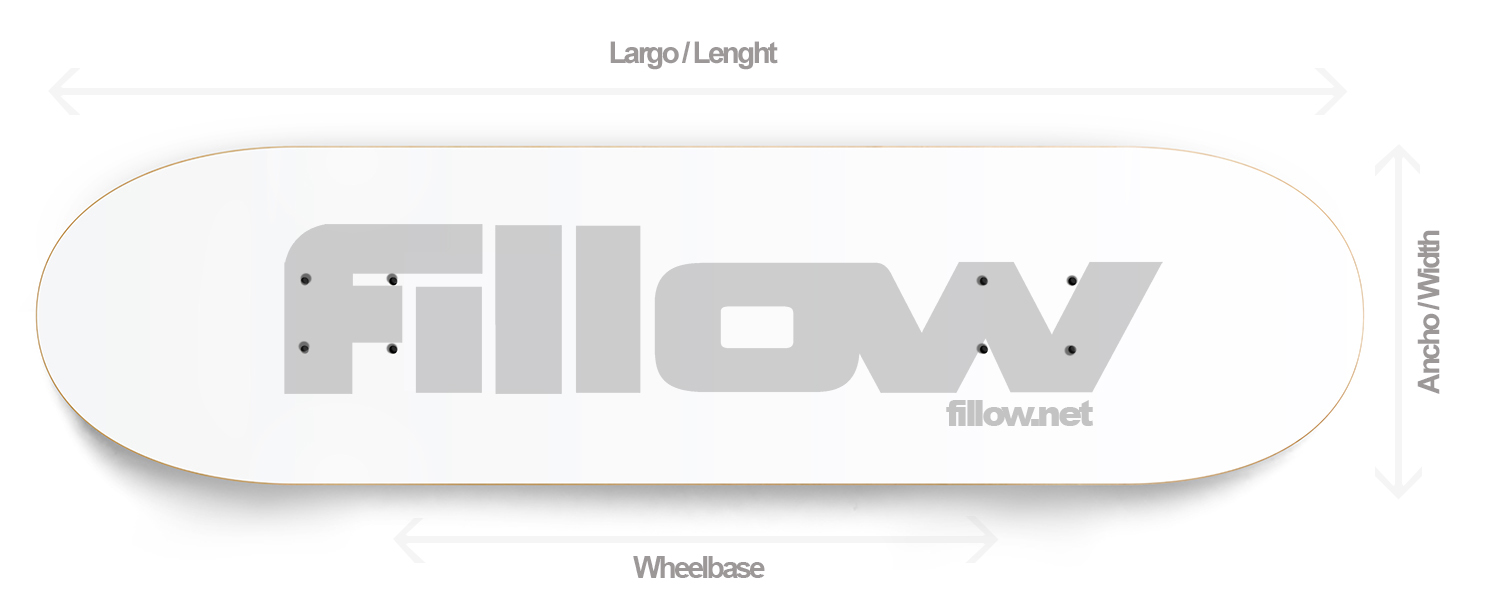
If you don’t know what deck width to pick, or you’re unsure about wheelbase or concave, this calculator points you in the right direction in under a minute. It combines your shoe size, height, weight, level and where you usually skate to give you three key parameters: width (in inches), wheelbase (the distance between the bolt holes where the trucks go) and concave (the cross-wise curve).
How the calculator works
- Enter your EU shoe size (the shoes you skate in).
- Enter your real height and weight, without rounding.
- Pick your level and where you skate most.
- The calculator crosses this data with Fillow’s experience and returns an approximate size.
The three measurements it returns
1. Width (in inches)
This is the most important number. It goes from 7.5″ (very narrow, technical street) to 8.75″ (very wide, bowl/cruising).
- Wider = stability on landings and more surface for your feet, better for transitions.
- Narrower = agility in flips, less weight, a more responsive feel.
Most skaters are between 8.0″ and 8.25″. If in doubt, 8.0″.
2. Wheelbase (in inches)
This is the distance between the sets of bolt holes where you mount the trucks. It runs from roughly 13.75″ to 14.5″.
- Longer wheelbase = more stability and control at speed. Better for bowl and park.
- Shorter wheelbase = quicker pop and tighter turns. Better for technical street.
Most modern decks have a wheelbase between 14.0″ and 14.25″. The difference between the extremes isn’t huge, but you can feel it.
3. Concave
This is the cross-wise curve that makes the deck “hug” your foot. Three typical levels:
- Low / mellow: comfortable, more freedom for your feet. Cruising, beginners.
- Medium: the balance. Works for almost everything.
- Medium-high / steep: maximum hold for technical flips. Pure street.
Concave types (in detail)
If you’re already sure about width and wheelbase, concave is what defines the “feel” of the deck:
| Type | Feel | Good for |
|---|---|---|
| Mellow (low concave) | Flat foot, freedom | Beginners, cruising |
| Medium (mid concave) | Balanced hold | All-round, the undecided |
| Steep (high concave) | Lots of grip, precise flips | Advanced technical street |
| W-concave (rare) | Double curve with a central bump | Vert, downhill, longboard |
Concave is noticed more by people who already skate. For your first 6 months, it doesn’t matter.
Size by shoe size and style (quick reference)
| EU size | Street | Skatepark | Bowl / Cruising |
|---|---|---|---|
| 36-38 | 7.5″ - 7.75″ | 7.75″ - 7.875″ | 7.875″ - 8.0″ |
| 39-41 | 7.75″ - 7.875″ | 7.875″ - 8.0″ | 8.0″ - 8.125″ |
| 42-43 | 8.0″ - 8.125″ | 8.0″ - 8.25″ | 8.25″ |
| 44-45 | 8.0″ - 8.25″ | 8.125″ - 8.375″ | 8.375″ - 8.5″ |
| 46+ | 8.25″ - 8.5″ | 8.25″ - 8.5″ | 8.5″+ |
This is the starting point; the calculator fine-tunes it with your weight and level.
Common mistakes when choosing a deck
- Copying your favorite pro’s size. What a 6’3″, 80 kg pro rides for vert won’t work for you if you’re 5’7″ and skate street.
- Sticking with “what you’ve always had” without thinking. If you’ve ridden an 8.0″ for 5 years and it has always worked, keep going. But if you’ve never chosen consciously, now is the time.
- Buying a very wide deck for stability. The extra 0.5″ won’t save you on awkward landings, and it will cost you flips for the rest of the time.
- Not looking at the wheelbase. Two decks of the same width can have very different wheelbases and ride completely differently.
Frequently asked questions
Does the brand matter if the size is right?
Yes. Construction matters: number of plies (7-ply is standard), type of glue, pressing. Brands like Powell Peralta, Element, Santa Cruz, Real, Anti-Hero or Plan B guarantee quality. Cheap blank decks (no graphic) can be just as good, but not always.
How long does a skateboard deck last?
It depends on use. For an amateur skater who skates 2-3 sessions a week: 6-12 months of real life. For pros filming lines: 1-2 weeks in some cases. You know it’s time to change when deep cracks appear or the pop is gone (a “dead” deck).
Is the calculator good for beginners?
Especially for beginners. Most people start with the first deck they grab and later realize it wasn’t theirs. The calculator saves you that mistake.
What if I skate all three (street, park, cruising)?
Pick your dominant style (what you’d do 60% of the time). For very mixed skaters, an 8.0″ with medium concave and a 14.0″ wheelbase is the “neutral Switzerland”.
What about decks in cm vs inches?
1 inch = 2.54 cm. An 8.0″ is 20.32 cm. Some manufacturers (mostly European) also print the size in cm. It doesn’t matter, the industry standard is inches.
Keep going
- Complete guide: how to choose a skateboard deck: everything the calculator sums up.
- Truck size calculator: which truck matches your new width.
- Wheel calculator: to complete the setup.
- Deck technology and materials: beyond the size.