
Let’s be honest: choosing your first deck — or your fifth — seems more complicated than it actually is. There are a ton of measurements, obscure materials and English terms everywhere. But in the end, the three things that genuinely change how a board feels under your feet are: width, shape and material. Everything else is secondary.
We wrote this guide the way we wish someone had explained it to us at 14: straight to the point, no fluff, everything you need and nothing you don’t.
Parts of a skateboard deck
Before talking sizes, it’s worth knowing what the different parts of a deck actually are. When you read “more concave” or “short wheelbase” later in this guide, you’ll know exactly what we’re referring to.
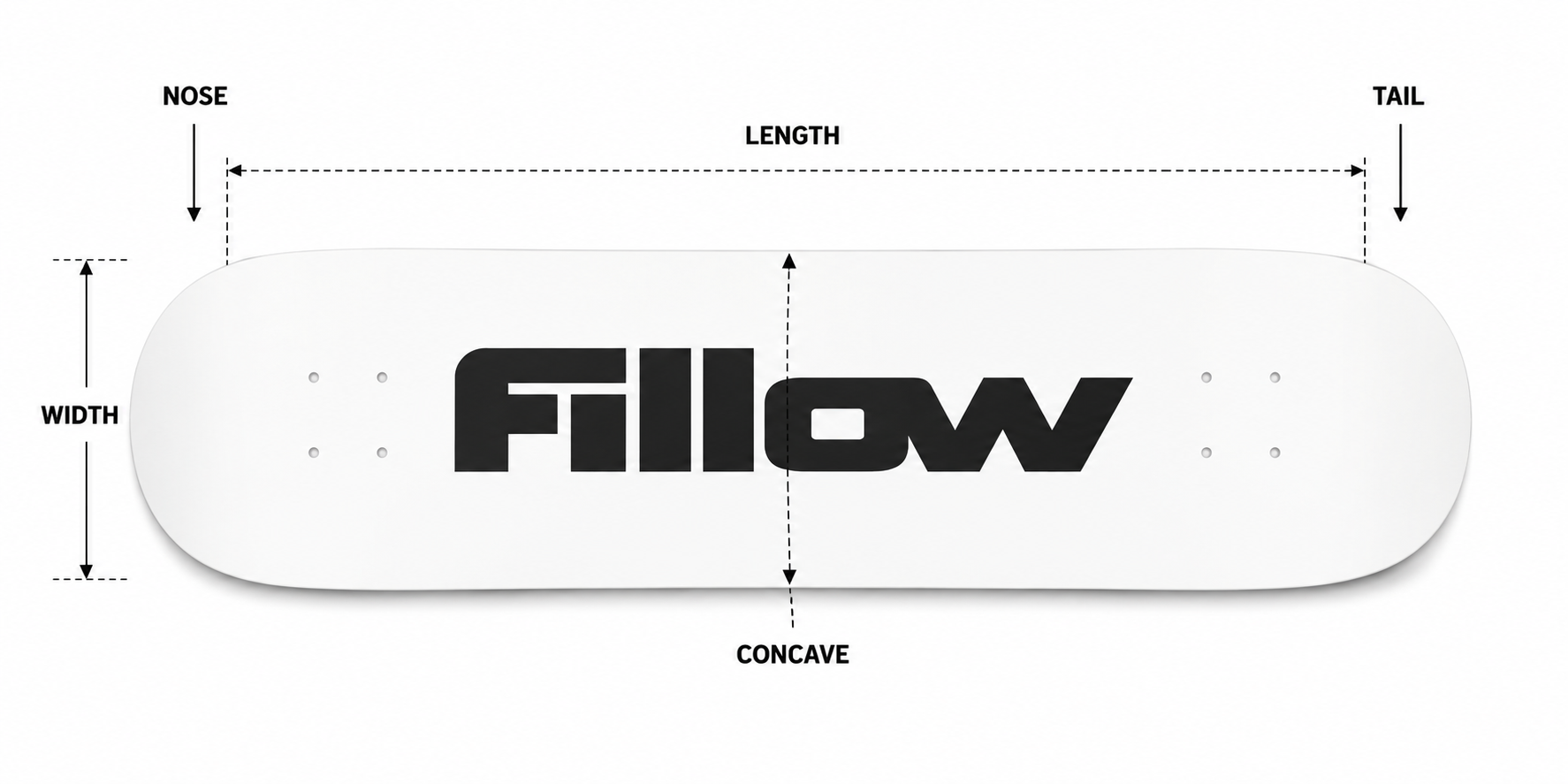
The measurements that actually change how your board skates
A skateboard deck has basically four measurements. Here they are in order of importance: you’ll choose the first two yourself; the last two come pre-decided almost every time.
Width — the number one decision
This is the measurement you’ll feel the most and the one that generates the most debate. It’s measured in inches (″) and runs from 7.5″ to 8.5″ on standard decks.
The basic rule:
- Narrower (7.5″ – 7.875″) → more agile. Better for flip tricks and technical street skating.
- Wider (8.0″ – 8.5″) → more stable. Better for park, bowl, ramps and taller skaters.
The most common sizes on the market are 7.75″, 7.875″, 8.0″, 8.125″, 8.25″ and 8.5″. Every quarter inch (6 mm) changes the character of the deck more than you’d expect.
Length — you almost never choose this
We’ll save you the debate: length is not something you choose on purpose. Standard decks measure between 31″ and 32.5″ (79–82 cm). The difference is negligible and depends on the model. Forget length and focus on width.
Concave — subtle but important
Concave is the cross-sectional curve of the deck: what your foot feels when you plant your sole on it. The key rule is simple:
More concave = more foot grip. The deck “hugs” your foot and responds fast. Good for flip tricks and technical skating. Less concave = flatter and smoother. Your foot sits more freely. More comfortable over long sessions, but you lose flip response.
In practice you’ll find three types on the market:
- Low (mellow): almost flat. Very comfortable, low grip, a “wide” feeling underfoot. Designed for cruising and transition/ramp skating, where flow is everything and you don’t want a deck that catches your foot on every carve.
- Medium: the industry standard. 90% of the decks you buy come like this. Balances grip and comfort. If you don’t know what to pick, go medium. Works well for everything: street, park and bowl.
- Steep: a pronounced curve. Your foot locks in tightly, which you’ll feel in flip tricks and fast technical moves. The trade-off is more fatigue over long sessions and it can feel aggressive at first. Ideal for pure technical street.
Summary table:
| Type | Foot grip | Best for |
|---|---|---|
| Low (mellow) | Low, flat feeling | Cruising, ramp, vert, bowl |
| Medium | Balanced | 90% of skaters · street, park, bowl |
| Steep | High, ‘hugs’ the foot | Technical street, flip tricks, fast tech |
If in doubt, medium. Over time you’ll figure out whether you prefer more or less.
Wheelbase — the detail most people ignore
The distance between the two sets of mounting holes where the skateboard trucks bolt on. Standard range: 13.5″ to 15″.
- Short wheelbase (13.5″ – 14″) → more rotation, snappier response for tricks.
- Long wheelbase (14.5″ – 15″) → more stability for speed and bowl.
Most mainstream decks come with 14″ – 14.5″, which is versatile for everything.
Find your recommended size
Put in three pieces of data and we’ll point you in the right direction. This is just a starting point. For more precision, use the full calculator afterwards.
The most popular all-rounder size. Works for street, park and bowl. When in doubt, this one.
Full calculatorPopsicle, cruiser, oldschool: which one is right for you?
Before picking your width, you need to be clear on the deck shape. There are three main types and most skaters end up with the wrong one simply because they didn’t know the difference. Each shape is built for a different purpose, so the decision is quick once you know what you want to do.
Popsicle (street)
The classic symmetrical shape with a kicktail at nose and tail. Built for tricks: ollies, flips, switch. This is 95% of the decks you see out there.
Park / Bowl
A wider or slightly shaped (asymmetrical) popsicle. For park, bowl and ramps. More stability and surface area underfoot.
Cruiser / Oldschool
A wider shape, sometimes without a front kicktail. Built for cruising and getting around. Less versatile for modern tricks.
Materials and construction
Not all decks are made the same. There are several materials on the market and each has its own trade-offs: weight, pop, durability and price. The good news is that for 90% of cases there’s a clear answer, so we’re not going to overcomplicate it.
This table covers the options you’ll encounter:
| Material | Weight | Pop | Durability | For whom |
|---|---|---|---|---|
| 7-ply Canadian maple | Medium | Good | Good | 90% of skaters. The default choice. |
| Maple + fibre (fibreglass or carbon) | Low–Medium | Very good | High | Heavy street skaters, people who snap boards often |
| Hybrids (bamboo, composites) | Low | Springy | Medium | Cruising, mixed use, riders who prioritise lightness |
| Everslick / slick bases | Medium | Good | Very high on base | Frequent grinds, rough spots |
The key detail: Canadian maple (not Chinese)
Budget decks use Chinese maple, which is softer and loses pop faster. Decent decks use Canadian maple (roughly 15% harder). The product description should say “Canadian Maple”. If it doesn’t, be suspicious.
The process: cold press vs hot press
- Cold press: the veneers are pressed cold for several hours. Result: more pop, more durability. This is the premium process used by serious brands.
- Hot press: heated pressing, faster. Cheaper, but the glue degrades sooner and the pop doesn’t last as long.
Fibre reinforcement: is it worth it?
Decks like the Powell Flight, Almost Impact or Element Helium have fibre layers between the maple veneers. They’re lighter, have more pop and last 2–3 times longer. But they cost $25–$50 more.
It’s only worth it if:
- You skate street hard (3+ sessions per week)
- You’re taller/heavier and snap decks regularly
For beginners or casual use, a solid 7-ply Canadian maple deck is more than enough.
5 quick signs that a deck is good
Whether you’re in a shop or browsing online and you’re unsure about a deck, check these five things in order:
- Does it say “Canadian Maple”? If not, be suspicious.
- How many plies? 7 is standard. 5 is cheap beginner territory. 9 is premium for heavier riders.
- Does it have some weight to it? A decent deck weighs between 1.3 and 1.8 kg (about 3–4 lbs). If it feels like cardboard, it is cardboard.
- Is the brand a skate brand? Element, Almost, Enjoi, Habitat, Plan B, Powell, Baker, Anti-Hero, Polar, Magenta, Santa Cruz, Globe, Toy Machine, Zero, Jart (Spanish skate brand)… if none of those names ring a bell, be suspicious.
- Is the price realistic? A decent deck costs $50–$90. If it’s $25 AND it’s not a proper skate brand, don’t expect it to last.
How much does a decent deck cost
These are the price ranges you’ll encounter, organised by tier. Saves you time when browsing catalogues online:
| Tier | Price (deck only) | Typical brands |
|---|---|---|
| Skate shop house brands | $35–$55 | No logo or shop logo |
| Mid-range | $55–$80 | Enjoi, Almost, Habitat, Element, Globe, Plan B, Toy Machine |
| High-end | $80–$110 | Powell Peralta (Flight), Baker, Anti-Hero, Polar, Magenta, Heroin |
| Premium | $110+ | Loaded, Welcome, Hopps, independent brands |
Deck only or a full complete?
- Complete skateboard (everything pre-built): better to start. No stress picking components and the value is reasonable. Element, Almost or Enjoi have completes for $90–$130 that are perfect to get going.
- Deck only (you pick every component): better once you know what you like. Better final quality for the same total price, but it takes some knowledge.
If this is your first deck, read this
This is what we recommend when someone walks in and says “it’s my first deck, I have no idea.” If that’s you, start here.
The safe choice
- Width: 7.875″ to 8.125″
- Shape: popsicle (the classic symmetrical shape)
- Material: 7-ply Canadian maple
- Concave: medium
- Brand: any skate-specialist brand. If names help: Element, Almost, Enjoi, Habitat, Plan B, Globe, Toy Machine. But honestly, any proper skate brand delivers enough quality.
- Price: $55–$80 for a deck alone or $90–$130 for a complete.
7 extra tips that actually matter
-
Don’t start with a dirt-cheap deck. You’ll struggle, blame the deck when it’s actually your technique, and quit. To be clear: a skate shop house brand is fine to start on (a step below the top brands, but good enough). What’s NOT fine is a toy store or supermarket board — those aren’t real skateboards.
-
Don’t fixate on the graphic. The graphic is gone in two weeks. But if you’ve got two decks that both tick your boxes, pick the one with the graphic you like or the brand that feels like you — skateboarding is identity, not just equipment.
-
Buy quality grip tape too (Mob, Jessup) if you’re going custom. Cheap grip tape loses traction in two sessions.
-
Choose skateboard trucks that match your deck’s price point, from a specialist brand like Independent, Thunder, Venture, Krux or Tensor. Cheap trucks are the worst part of any budget complete.
-
Pads aren’t for losers. Helmet at minimum if you’re skating park or bowl. Elbow and knee pads save you from real injuries.
-
Your first decks will break fast. That’s normal — it’s not your fault and it’s not the brand’s fault. Learning hurts your wallet (and sometimes your feet).
-
Don’t swap decks every time you have a bad session. The deck is rarely the problem. Stick with ONE deck for months before changing size.
Decks by rider type: kids, women, tall skaters
There are no separate “kids’ decks” or “women’s decks” as a distinct product category, but the right size does change depending on your profile. Here are the typical ranges:
Kids (ages 5–12)
- Ages 6–8: 6.5″ – 7.0″ deck (micro size). Brands: Birdhouse or Element youth.
- Ages 9–12: 7.0″ – 7.5″ deck (mini). Brands: Almost Mini, Element Mini.
- Ages 13+: standard adult decks work fine (7.5″ – 8.0″).
Adult women
Same criteria as everyone else: it depends on height, weight and foot size. The average size lands around 7.875″ – 8.0″. There’s no such thing as a “women’s deck” — that’s pure marketing.
Tall skaters (6’1″/1.85 m+)
Better to go 8.25″ – 8.5″. It gives you the stability you need without constantly fighting your stance.
Skaters with large feet (US 11/EU 44+)
Bigger foot, wider deck. US 11–12 (EU 44–46) → 8.25″+. US 13+ (EU 47+) → 8.5″ minimum.
Care and maintenance
A well-looked-after deck lasts 2 to 4 times longer than a neglected one. Here’s the essentials:
What KILLS your deck
- Water. Skating wet warps the veneers, breaks down the glue and kills the pop in a single session. If it’s raining, don’t skate — or dry your deck thoroughly as soon as you’re done.
- Leaving it in the sun. Extreme heat loosens the glue. Never leave it in the car in summer.
- Resting it wrong. Always store it face-down (grip tape up) when not in use, not resting on its edge.
- Over-tightening the hardware. You’ll crush the veneers and kill the pop.
When to replace it
- Dead pop: it doesn’t respond to your ollie the way it used to
- Chipped nose or tail: the tips are rounded off and peeling layers
- Bald grip tape: it no longer grips your foot properly
- Cracks around the mounting holes: dangerous — it can snap under your feet
How long it lasts, in real numbers
| Use | Average lifespan |
|---|---|
| Regular street skater (3+ sessions/week) | 2–4 months |
| Casual park skater (1–2 sessions/week) | 4–8 months |
| Cruising / commuting | 1–2 years |
| Fibre-reinforced decks (Powell Flight, etc.) | 2–3× longer than standard |
Quick glossary of terms
- Ply: each individual layer of wood. Standard is 7-ply.
- Pop: the deck’s ability to “snap” when you press down the tail.
- Concave: the cross-sectional curve. Low (mellow), medium or steep.
- Camber: when the middle of the deck is slightly raised. More flex.
- Rocker: when the middle is slightly sunken. Lower centre of gravity.
- Kicktail: the upward angle at the nose and tail.
- Mounting holes: the 8 holes where the skateboard trucks bolt on.
- EFP (Effective Foot Platform): the flat area between the trucks where you plant your feet.
- Rails: the long side edges of the deck.
- Wheelbase: the distance between the two sets of mounting holes where the trucks bolt on.
- Cold press / Hot press: pressing methods. Cold = better quality.
- Cross-laminated: when the veneers alternate grain direction. More resistance.
- Blank: a deck with no graphic or visible branding. Usually made by serious brands at a lower price point.
What next?
You know how to choose a deck. Here’s what’s left:
- Try the full deck size calculator → gives you the exact size based on height, weight, style and level.
- Learn how to choose skateboard trucks → trucks should be slightly narrower than your deck.
- Learn how to choose skateboard wheels → hardness and diameter depending on surface.
- Complete skateboard build guide → if you’re putting a whole setup together from scratch.
- Deck reviews → analysis of specific models.
Still have questions this guide doesn’t cover? Hit us up via contact. We answer everything.
Ready to buy?
If you want to skip the back-and-forth, here are two clear paths. If you'd rather fine-tune, head back to the sections above.
Conversation
Your name will be public. Your email stays private. Comments are reviewed before publishing.