
Vans is the shoe brand most tied to skateboarding history. It started in 1966 in California, and skaters adopted it almost from the beginning for a practical reason: its waffle sole gripped the board like no other. Out of that came the Era, the Old Skool, the Sk8-Hi and the Half Cab, four of the most copied shoes ever.
This page focuses on Vans and skateboarding: its skate models, its tech, its team and its videos. If you want the full history of the brand, check our article on the history of Vans.
Why skaters picked Vans
Paul Van Doren worked at a vulcanized shoe factory when, in 1966, he opened his own store in Anaheim with his brother Jim and two partners. On the first day they sold a dozen pairs. With no money for advertising, he made the sole twice as thick as the competition’s, in pure rubber, so they would last longer.
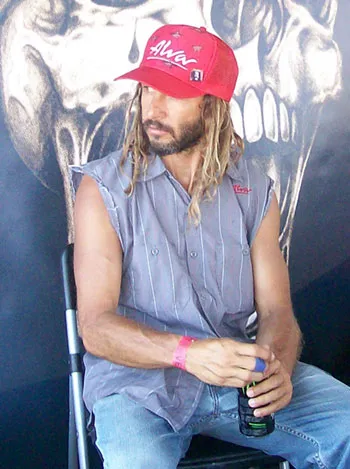
That rubber sole, with its narrow, sticky waffle pattern, is what drew California skaters in the late 60s and 70s. It gripped the board, the narrow last fit the boards of the time and the price was low. Tony Alva remembers that a store in Los Angeles would sell him single shoes when he only wore out one.
Vans skate models
| Model | Year | What it has |
|---|---|---|
| Authentic (#44) | 1966 | The original: thick canvas and waffle sole |
| Era (#95) | 1976 | Ankle padding and heel counter. Came out as “Off the Wall” |
| Old Skool (#36) | 1977 | The first with leather and the side stripe |
| Slip-On (#98) | Late 70s | No laces. Became famous in the movie Fast Times at Ridgemont High (1982) |
| Sk8-Hi (#38) | 1978 | High top to protect the ankle |
| Caballero | 1989 | High, with the dragon on the side |
| Half Cab | 1992 | The Caballero with the high top cut down |
The Era: the first skate shoe
In 1976, Tony Alva and Stacy Peralta, two of the Dogtown Z-Boys, suggested that Vans improve the Authentic for skating. The result was the #95, which came out under the name Off the Wall, with ankle padding, a heel counter and thicker canvas. Today it is called the Era, and Vans presents it as the first skate shoe in the world. The slogan Off the Wall came with it.
The Old Skool and the side stripe
In 1977 came the Old Skool, the first Vans with leather panels and the first with the side stripe, the jazz stripe. Alva says they got rid of the metal eyelets and added an extra layer of canvas because skaters pulled on the laces so hard they ripped the eyelets out. Today it is the base of the whole skate line.
The Sk8-Hi
In 1978 came the Sk8-Hi, with a high top to protect the ankle from board hits, especially in pools. It is still one of the favorites for bowl and ramp.
Steve Caballero and the Half Cab
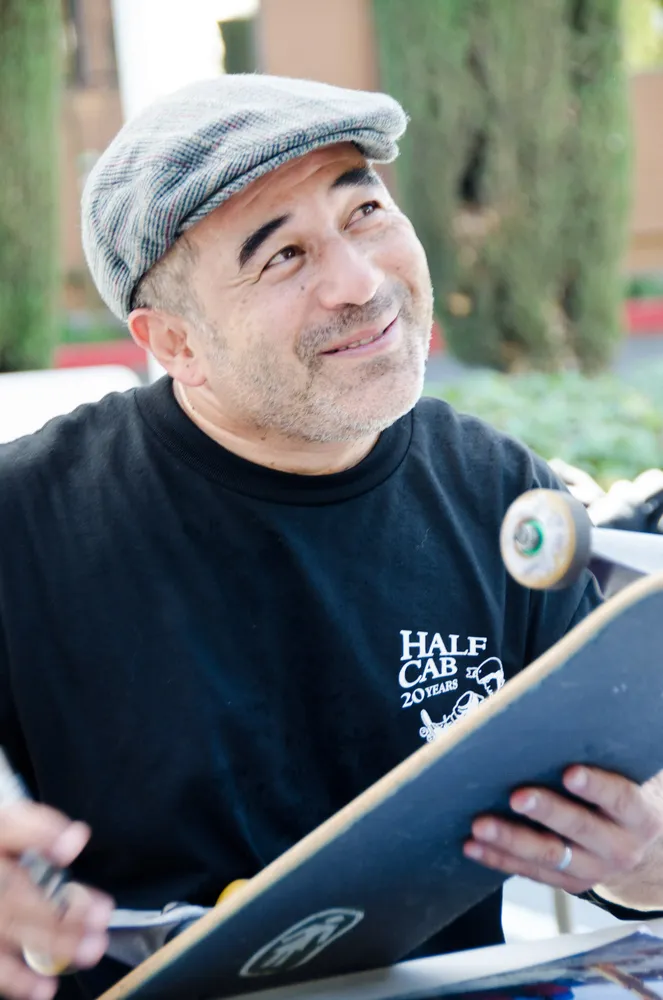
Between 1985 and 1987 Vans barely supported skateboarding, and Steve Caballero skated in other brands’ shoes. In 1988 he signed with Vans, and in 1989 the Caballero came out, a high-top shoe with a dragon on the side.
Lots of skaters cut down the high top of the Caballero to get more mobility for flips. Caballero did it himself, with duct tape and sometimes sewing it, and suggested that Vans make it that way. In 1992 the Half Cab came out: a mid top, with the words “Half Cab” and the silhouette of Caballero doing the trick that gives it its name. It is the signature shoe that has been in Vans’ catalog the longest.
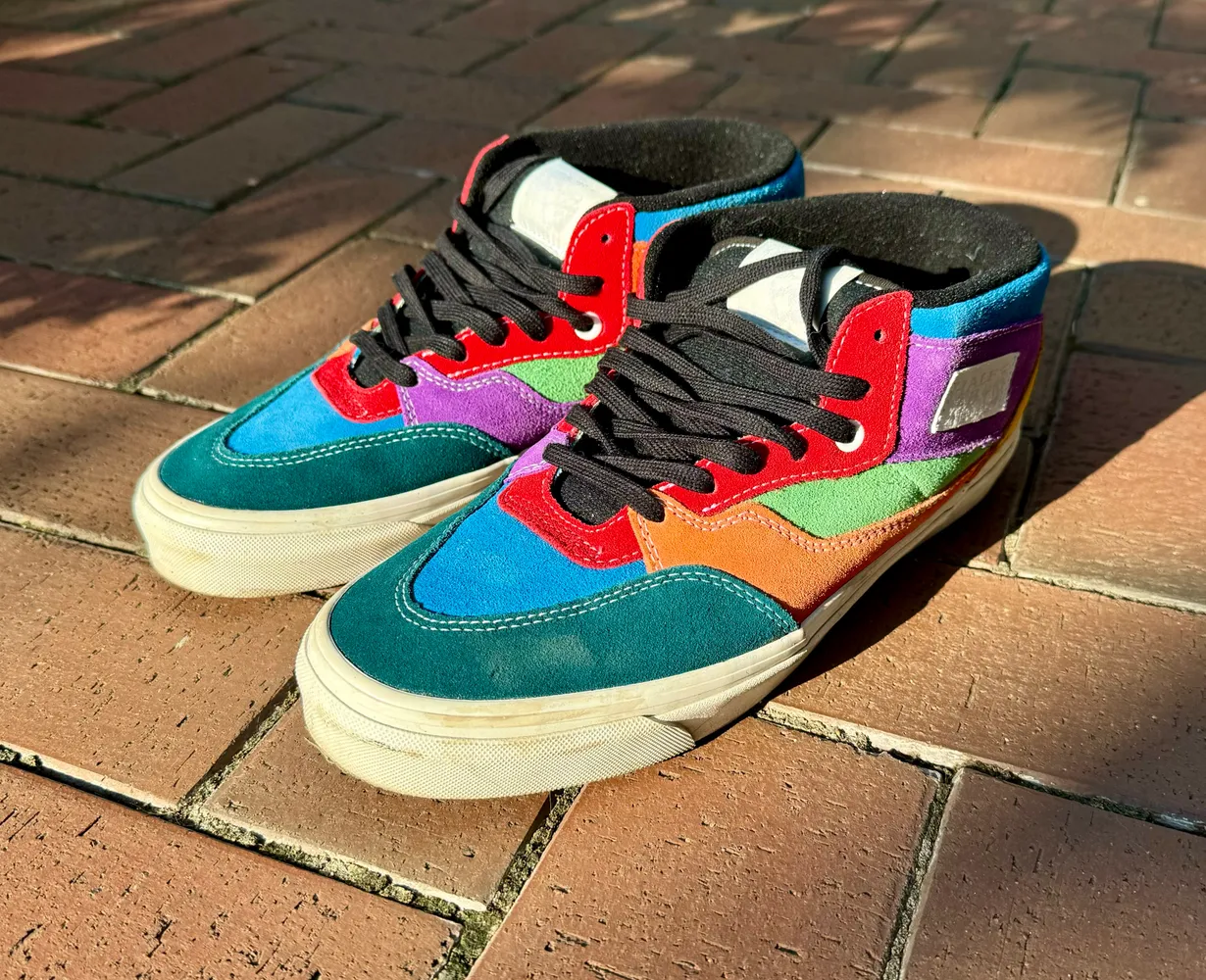
You can find how to do the trick on our half cab page, and Caballero’s story on the page for Powell Peralta.
The 90s and Geoff Rowley’s rescue
In the mid 80s Vans tried to sell shoes for every sport and in 1984 went bankrupt. Paul Van Doren took the reins again and in 1988 the family sold the company. In the 90s Vans followed trends, started manufacturing in Asia and partly dropped the vulcanized sole and the side stripe: production of vulcanized shoes went from about six million pairs a year to under one.
In 1999 it signed Geoff Rowley, from Liverpool, who wanted a vulcanized shoe like the old ones, with the stripe and the classic logo. Almost nobody inside the company backed him, except Steve Van Doren, Paul’s son. The shoe came out, it worked, and Vans went back to its roots. The following year Thrasher named Rowley Skater of the Year.
Vans skate tech
Skate Vans, now called Skate Classics (formerly Pro), look a lot like the regular ones on the outside, but they have:
- DuraCap: a layer of rubber under the fabric in the areas that wear out most, like the toe, where you rub the grip tape.
- PopCush: a cushioned insole that keeps its shape and doesn’t pack down with use. UltraCush used to be used.
- SickStick: sole rubber with more grip that lasts longer than the original.
- WaffleCup (2026): a new sole that combines the support of a stitched sole with the feel of a vulcanized one. It debuted on the Skate Era and reached the Half Cab and Old Skool in fall 2026.
Propeller and Vans events
In 2015 came Propeller, Vans’ first full-length video in almost 50 years of history. Greg Hunt directed it over five years, a good part on 16 mm film, and it premiered at the Orpheum Theatre in Los Angeles. It has parts by Anthony Van Engelen (who that year was Thrasher’s Skater of the Year), Tony Trujillo, Geoff Rowley, Chris Pfanner, Elijah Berle, Gilbert Crockett, Rowan Zorilla, Kyle Walker, Pedro Barros, Jason Dill and Andrew Allen.
Vans has also organized or sponsored:
- Vans Pool Party, since 2005, at the Combi Bowl in California.
- Vans Park Series, between 2016 and 2019, the first world park skating circuit.
- House of Vans, spaces with a skatepark, music and art. The London one, in the tunnels under Waterloo station, opened in 2014 and closed in 2022.
- Warped Tour, the punk music tour that carried its name from 1996.
The Vans team
- 70s: Tony Alva and Stacy Peralta.
- Since 1988: Steve Caballero.
- Since 1999: Geoff Rowley.
- Since 2005: Anthony Van Engelen, who came over from DC, and Tony Trujillo.
- Propeller generation: Elijah Berle, Gilbert Crockett, Rowan Zorilla, Kyle Walker, Pedro Barros, Chris Pfanner, who is now Vans’ team manager in Europe, and Andrew Allen.
- Today: Curren Caples, with his own shoe since 2025, Pedro Delfino, Dick Rizzo, Daiki Hoshino, Shiloh Catori and Una Farrar, plus veterans like Alva and Rowley.
Who owns Vans?
Vans belongs to VF Corporation, which bought it in 2004 for 396 million dollars. Before that, in 1988, the Van Doren family had sold it to an investment fund, and in 1991 it went public. VF also owns The North Face and Timberland. Paul Van Doren died in May 2021, at 90.
After a sales peak in 2022, Vans spent several years selling less and VF launched a plan to relaunch it. In 2026, with the 50 years of Vans Skateboarding, the brand bet on skating again with the new Skate Era and the WaffleCup sole.
Vans vs. Nike SB
It is the most searched comparison. Skate Vans are vulcanized, thin and have lots of board feel, and they have more history in skateboarding than any other brand. Nike SB has similar models, like the Janoski, but also shoes with a stitched sole and Zoom Air, like the Dunks, with more cushioning. There’s a comparison in the best skate shoes.
Which Vans should you pick for skating?
- If you want board feel: Authentic or Era, in the Skate version.
- If you want an all-rounder: Old Skool Skate, the base of the lineup.
- If you skate bowl or ramp: Sk8-Hi, which protects the ankle.
- If you want something in between: Half Cab.
- If you jump a lot: the new WaffleCup, with more support.
Frequently asked questions
Are Vans good for skateboarding?
Yes, especially the ones from the skate line (Skate Classics), which have reinforcements and better insoles. Their vulcanized sole is thin and flexible, with lots of board feel. The weak spot is that they wear out fast where you rub the grip tape doing ollies and flips.
What is the difference between regular Vans and skate Vans?
The skate ones (Skate Classics, formerly Pro) have DuraCap, a rubber layer that reinforces the areas that wear out most, the PopCush insole and SickStick rubber on the sole. On the outside they look almost the same as the regular ones, but they hold up a lot longer when you skate.
Old Skool, Sk8-Hi or Half Cab for skating?
The Old Skool is low and all-round, the base of the lineup. The Sk8-Hi is high and protects your ankle from board hits, and is very popular for bowl and ramp. The Half Cab is a mid: it protects a bit more than the low without losing mobility.
Who made the Vans Era?
It came out in 1976 under the name Off the Wall, from ideas by Tony Alva and Stacy Peralta, two of the Dogtown Z-Boys. It added padding at the ankle and a heel counter. Vans presents it as the first skate shoe in the world.
Why is it called Half Cab?
Skaters used to cut down the high top of the Caballero shoe to get more mobility. Steve Caballero did it himself and suggested that Vans make it that way. It came out in 1992 and was called Half Cab after the trick, the half cab, whose silhouette is on the side.
Who owns Vans?
VF Corporation, which bought it in 2004 for 396 million dollars. VF also owns The North Face and Timberland, among others.
Where are Vans made?
Since the 90s, Vans has mostly manufactured in Asia. Before that it made them in its own factories in California.
How can I tell if Vans are fake?
Check that the stitching is even, that the waffle sole has a deep, well-defined pattern and that the heel label is properly placed. Even so, fakes keep getting better: the safest thing is to buy from official stores or skate shops.