
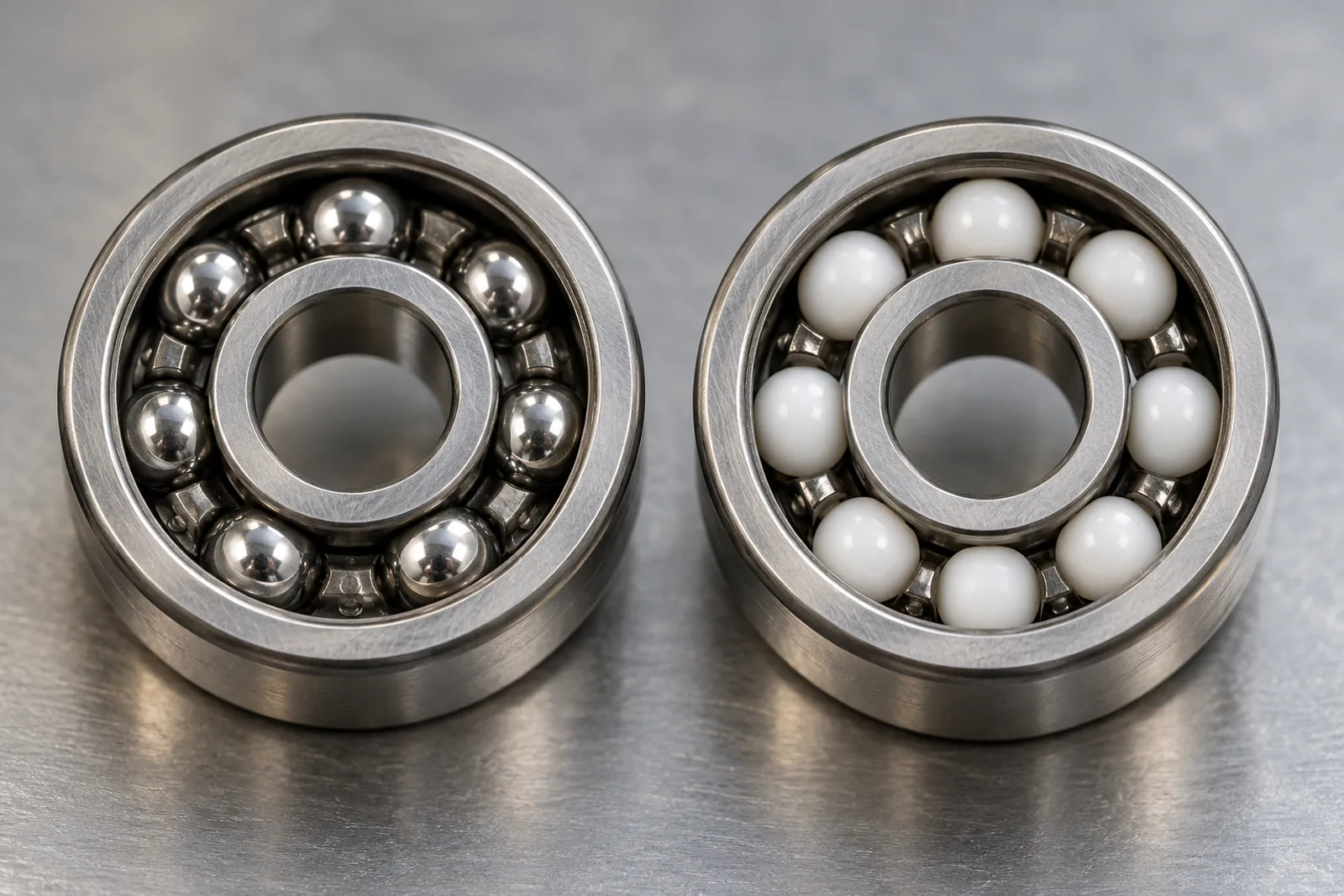
Every time bearings come up in a skate shop, the same debate starts: steel or ceramic. On one side, €25 Bones Reds that half the scene rides. On the other, €110 Swiss Ceramics that promise to roll faster, last longer and never rust. Does four times the price give you four times the performance? No.
We have spent years fitting, cleaning and wrecking both types at Fillow. Here is the comparison without the marketing, so you can decide whether ceramics are for you or whether good steel bearings are enough and you can keep the rest of the money for decks and wheels.
How a bearing works (the quick version)
Before comparing materials, it helps to know what you are holding. Every skateboard bearing (they are all size 608, whatever the brand) has 5 components:
- Balls (6 or 7): the spheres that roll. They are the main part. They can be steel or ceramic.
- Outer race: the track the balls roll on from the outside.
- Inner race: the track they roll on from the inside.
- Cage or retainer: the piece that keeps the balls separated and evenly spaced.
- Shields (1 or 2): the covers that protect from dust and water.
When we talk about a “ceramic bearing” in skateboarding, we almost always mean only the balls. The races are still steel, because pure ceramic would be brittle under the vertical impacts of skating. That is why they are technically called hybrid ceramics, and every Bones Swiss Ceramics, Bronson Ceramic or Andale Ceramic you will buy is a hybrid.
Full ceramic bearings (ceramic races too) exist, but they aren’t suitable for skateboarding: they are very expensive (€300+), made for aerospace or turbines, and they break with a single badly landed grind.
Steel: what it is and why it still leads
95% of the bearings on the market are steel, and for good reasons.
Types of steel in skateboard bearings
Not all steel is the same. From worst to best:
- Plain carbon steel: cheap generic bearings (€5-10 a set). They rust quickly, the balls are imperfect and they roll badly.
- Chrome steel (AISI 52100): the industry standard. Used in Bones Reds, Mini Logo, Bronson G2, Andale. A good balance of price and performance.
- Swiss steel: a premium alloy with fine heat treatments and rounder, more polished balls. Used in Bones Swiss, Modus Premium, FKD Gold. The top of steel.
- Titanium-coated steel: a layer of titanium over the steel to reduce friction. Honestly, more marketing than real difference.
Advantages of steel
- Unbeatable price: a set of Bones Reds (€25) or Mini Logo (€15) lasts years.
- Resistance to vertical impacts: when you land a trick from height, 50-100 kg of your weight multiplied by the force of the impact goes into the balls. Steel deforms and recovers. Ceramic resists, but its limit is more brittle.
- Available everywhere: every skate shop on the planet has steel bearings. If you break one in the middle of a trip, you replace it in 5 minutes.
- Skate culture: half the world rides Bones Reds. The community, the reviews, the tutorials: everything is made with these in mind.
Disadvantages of steel
- They rust: with humidity or water, you get rust spots on the balls within weeks. Once a bearing has rusted it is finished, with no way back.
- More friction than ceramic: in absolute terms, steel rolls worse. The difference is real even if it is small.
- More weight: each steel ball weighs more than a ceramic one. Across 6-7 balls times 8 bearings, we are talking about grams. Small.
- They generate more heat: at high sustained speeds, steel builds up temperature. For a normal street session it doesn’t matter; for downhill longboarding it does.
Ceramic (Si3N4, Cerbec): what it is and why it costs so much
When you say “ceramic bearings” in skateboarding, you almost always mean silicon nitride (Si3N4) balls. It is the material Boeing and NASA use for turbine bearings, and the one Bones, Bronson and others put in their top models.
What silicon nitride (Si3N4) is
A ceramic compound of silicon and nitrogen fired at 1,700°C. Its properties:
- 40% lighter than steel.
- 50% harder (Vickers scale: about 1500 HV vs about 700 HV for steel).
- Much lower friction coefficient against steel.
- Low thermal conductivity: it doesn’t build up heat.
- Chemically inert: it doesn’t rust or react with water, salt or most chemicals.
High-end ceramic bearings use Cerbec balls (the premium Si3N4 brand made by Saint-Gobain). Bones Swiss Ceramics use them. When you see “Cerbec” on a bearing box, you know the balls are industrial quality.
Advantages of ceramic
- Less friction: Si3N4 balls roll more smoothly against the steel races. Slightly higher sustained speed.
- The balls don’t rust: even if you fall in water, the balls won’t rust. The races will, but the core of the bearing stays intact.
- Lighter: 40% less weight per ball. Across the whole set, about 4-6 grams. Almost imperceptible.
- They handle heat better: key in downhill longboarding or high sustained speeds.
- Longer lifespan: with good maintenance, 8-12 years easily. Reds last 5-8.
- Smoother sound: they roll more quietly. A cosmetic point, but a real one.
Disadvantages of ceramic
- Price: €70-110 a set vs €25 for Reds. Four times the price for a 5-10% improvement.
- Brittle under extreme impacts: although harder, ceramic balls are more fragile. A bad landing from a high drop can crack them.
- The races are still steel: all commercial ceramic hybrids have steel races, cages and shields. That means the steel parts still rust.
- They damage the races in the long run: ceramic balls are harder than the steel of the races. Over the years they mark the tracks. That is why they need better-quality races, and why you mostly see them in premium models.
- Inflated marketing: many brands sell “ceramic” that isn’t real Si3N4.
Comparison table: steel vs ceramic
Premium steel vs premium ceramics
| Parameter | Steel (Bones Reds/Swiss) | Ceramic (Bones Swiss Ceramics) |
|---|---|---|
| Price per set of 8 | €18-50 | €90-130 |
| Weight per ball | ~0.7 g | ~0.4 g |
| Hardness (Vickers) | ~700 HV | ~1500 HV |
| Friction coefficient | Standard | 20-30% lower than steel |
| Ball rust resistance | Low-medium | Total |
| Race rust resistance | Low-medium | Low-medium (still steel) |
| Heat build-up | Medium-high | Very low |
| Vertical impact resistance | High | Medium-high |
| Lifespan with maintenance | 5-8 years | 8-12 years |
| Lifespan without maintenance | 2-3 years | 3-4 years |
| Real speed in street | Reference | +1-3% |
| Real speed in downhill | Reference | +5-8% |
| Availability | Total | Limited |
| Sound | Normal | Smoother |
The takeaway from this table: ceramic is objectively better in almost everything, but how much better depends a lot on how you use it. In lab numbers, the difference is clear. In your Saturday street session, you will notice more improvement from replacing old wheels with new ones than from going from Reds to Ceramics.
When paying the extra is worth it (90% of the time it isn’t)
To the point. These are the only cases where we recommend paying the extra.
It is worth it if…
- You ride downhill longboard: rpm are high and sustained here (3,000-6,000 rpm vs 500-1,500 rpm in street). Ceramic’s lower friction and low heat build-up really matter.
- You are a professional bowl or vert skater: high sustained speeds, long transitions. You notice the difference.
- You live in an extremely humid climate (coast, constant rain): the balls’ rust resistance cuts down on maintenance.
- You have the budget and want the best without second-guessing: a legitimate reason. If you can afford €110 on bearings without blinking, go ahead.
- You are a skateboard mechanics nerd: if you love engineering, ceramics have a “jewel” quality that is fun to own.
It is NOT worth it if…
- You skate street, park or cruising: at street speeds, Bones Reds (€25) or Bones Swiss (€50) give you 95% of the performance.
- You are a beginner or intermediate: you will notice a better-quality deck, softer wheels or precise trucks much more. Bearings are not the bottleneck.
- You skate occasionally: if you skate 2-3 times a month, cheap, well-maintained bearings will be more than enough.
- You don’t do maintenance: if you don’t clean your bearings, it doesn’t matter what you fit. You will destroy them in 1-2 years anyway. It is better to invest in learning maintenance than in ceramics.
- You have €100 and are choosing between a new deck or ceramic bearings: new deck, every time.
The “twice as fast” myth: is it true?
Probably the most repeated phrase in any ceramic review: “they roll twice as far”. It is false.
What has been measured:
- In a timed test rolling down a controlled ramp, Swiss Ceramics roll between 3% and 8% further than Bones Reds with identical weight and push. That is lab data.
- In a real street session, the difference is imperceptible for 99% of skaters. Too many other factors weigh more: the condition of the wheels, how tight the trucks are, the ground, your pushing technique.
- The supposed “double lifespan” is closer to the truth, but only if you do maintenance. Without maintenance, a well-used ceramic lasts 50-80% longer than steel. With maintenance, both reach their limit.
Where does the myth come from? Two places:
- 90s marketing: when the first ceramics for skateboarding appeared (the original Bones Swiss Ceramics, 1995), the difference from the average steel of the time was big. Today steel has improved a lot and the gap has closed.
- Unfair comparisons: many reviews compare premium ceramics against cheap steel bearings. Of course ceramics win. Compare €100 ceramics against €25 Bones Reds and the difference is tiny.
Conclusion: if someone tells you “ceramics roll twice as far”, they either haven’t tried one or want to sell you one.
Maintenance: ceramics don’t rust but they do get dirty
Another myth to clear up: “ceramics don’t need maintenance”. False again.
Ceramic balls don’t rust, correct. But the bearing still fills up with:
- Dust and sand that gets in past the shields.
- Old lubricant residue that polymerises and turns into paste.
- Trapped moisture that rusts the steel races (which are steel, remember).
- Lint, hair and rubber fragments from the truck pads.
All of that works as an abrasive. And since ceramic balls are harder than the steel races, they wear the tracks faster if they run dry with dirt in them.
The recommended routine for ceramics is the same as for steel:
- Full clean every 6-12 months (isopropyl alcohol, drying, Speed Cream).
- After a wet session or one in extreme dust: clean immediately.
- Always use spacers.
- Visually check the balls once a year for wear.
If you want to learn to do it properly, we have a step-by-step tutorial on cleaning skateboard bearings. It applies to ceramics in exactly the same way.
Ceramic models on the market (the ones worth it)
If after reading all this you still want ceramics, these are the ones we recommend:
Bones Swiss Ceramics
Price: €100-130 a set. The absolute standard. Cerbec Si3N4 balls, Swiss steel races. Used by Daewon Song, Tony Hawk on his demo boards and half the pro bowl scene. They come with Speed Cream and spacers. If you pick one, pick this.
Bones Ceramic Super Reds
Price: €60-70 a set. Entry-level ceramics. The same Cerbec balls as the Swiss Ceramics, but with races and cages from the Reds line (more standard steel). A sweet spot for trying ceramics without spending €110. The difference from Swiss Ceramics: they last somewhat less over time, but the rolling feel is the same.
Bronson Raw Ceramic
Price: €75-90 a set. Bronson’s bet. Good ceramics with mirror-polished races and double shielding. They handle water and dust better than mid-range Bones. A good option if you skate in harsh conditions.
Modus Ceramic
Price: €80-95 a set. The pro brand from Tum Yeto, made in Switzerland. Very high quality, premium packaging with an aluminium box. Less common in Spain but an excellent product.
Andale Ceramic
Price: €70-85 a set. The brand of Mike Carroll and Rick Howard. Good ceramics but aimed more at durability than pure speed. If your thing is cruising and constant skating more than technical tricks, they fit.
What we don’t recommend
- Any generic ceramic under €60: probably low-grade zirconium oxide.
- Chinese brands with “ceramic” in the name sold on marketplaces without Cerbec or declared Si3N4.
- Full ceramics (ceramic races as well): they are not for skateboarding.
For a fuller comparison of models (including steel options), we have the best skateboard bearings on the market covered in detail.
Conclusion: who they are for and who they aren’t
After all this, the short answer is:
For 90% of skaters: premium steel bearings. Bones Reds (€25) or Bones Swiss (€50) are the rational choice. They give you 95% of the performance of €110 ceramics for a fraction of the price. Use the money you save on a better deck, decent wheels, grip tape that doesn’t peel off, or simply more sessions.
For the other 10% (downhill, pro vert, unlimited budget, product enthusiasts): premium ceramics. Bones Swiss Ceramics or Bronson Raw Ceramic are real investments. You notice the difference, they last longer, and they give you that marginal extra that counts in their context.
What you should not do:
- Buy cheap ceramics expecting premium performance. It doesn’t work that way.
- Choose ceramics as your first set “because they’re better”. Your technique, your board and your maintenance matter much more.
- Skip maintenance because “they’re ceramic and don’t need it”. False. The same care as steel.
And one last piece of advice: the best bearing in the world, poorly maintained, rolls worse than a cheap one that is well maintained. Before spending €100 on ceramics, make sure your cleaning routine is up to date.
Where to go next
- Best skateboard bearings on the market: a full comparison of steel and ceramic models.
- Bones bearings guide: the whole Bones catalogue explained and compared.
- How to clean and maintain skateboard bearings: the tutorial to read before spending on ceramics.
Conversation
Your name will be public. Your email stays private. Comments are reviewed before publishing.