If you ask whether skateboarding on the pavement is illegal in the UK, the usual answer points to a law from 1835. The Highway Act was written when the traffic in question was carts and horses, and no UK law says “skateboarding” in so many words. The result is a grey area that most skateboarders live in without trouble, and a patchwork of local rules that can still get you moved on or fined.
This guide covers the Highway Act 1835, the Highways Act 1980 and the Anti-social Behaviour, Crime and Policing Act 2014, and compares them with the rules in Spain, Germany, France, Italy and Portugal. This mostly covers England and Wales. Scotland has different legislation.
Is skateboarding legal in the UK? What the law says
There is no single law that makes skateboarding on public streets illegal, and none that clearly allows it. A skateboard is not a motor vehicle, and the legislation has no specific category for it. Three things shape what you can do:
- The Highway Act 1835, section 72. An old offence of riding on a footpath. It is applied to skateboards by analogy, if at all.
- Public Spaces Protection Orders (PSPOs). Local rules made by councils.
- Obstruction and general conduct rules, like section 137 of the Highways Act 1980.
What the Highway Act 1835 section 72 says
Section 72 says that if any person shall “wilfully ride upon any footpath or causeway by the side of any road” they commit an offence. The penalty was updated by the Criminal Justice Act 1982 to level 2 on the standard scale, which means a maximum fine of 500 pounds, on top of any damages. The Highway Code relies on this section when it tells cyclists not to ride on the pavement.
Skateboards are not named, and the law does not say whether section 72 applies to someone on a skateboard. That is why it is a grey area. Scotland has its own roads legislation, the Roads (Scotland) Act 1984.
How to find out what your council says
This is the practical bit. Search for “[your town] PSPO” and “public spaces protection order skateboard”, and look on your council’s website, usually under community safety or anti-social behaviour. The order itself lists the area covered (a map is often included), the behaviour banned and the penalty. If you can’t find it, ask the council’s licensing or community safety team directly.
Also look for signs on the spot. In many town centres a PSPO is signed at the entrances to the area it covers.
Can you skateboard on the pavement?
Strictly, this depends on whether section 72 covers a skateboard, which the law leaves open. What matters more in practice is whether your council has a PSPO covering skateboarding there. Some councils have orders that name skateboards in town centres or pedestrian zones and others have nothing at all, so it depends on the council.
Beyond that, even if a place is not covered, the basics apply: pedestrians come first, and anyone you startle or hit is a bigger issue than a technical offence. Skateboarding fast through a crowded pavement is the situation most likely to turn into a complaint.
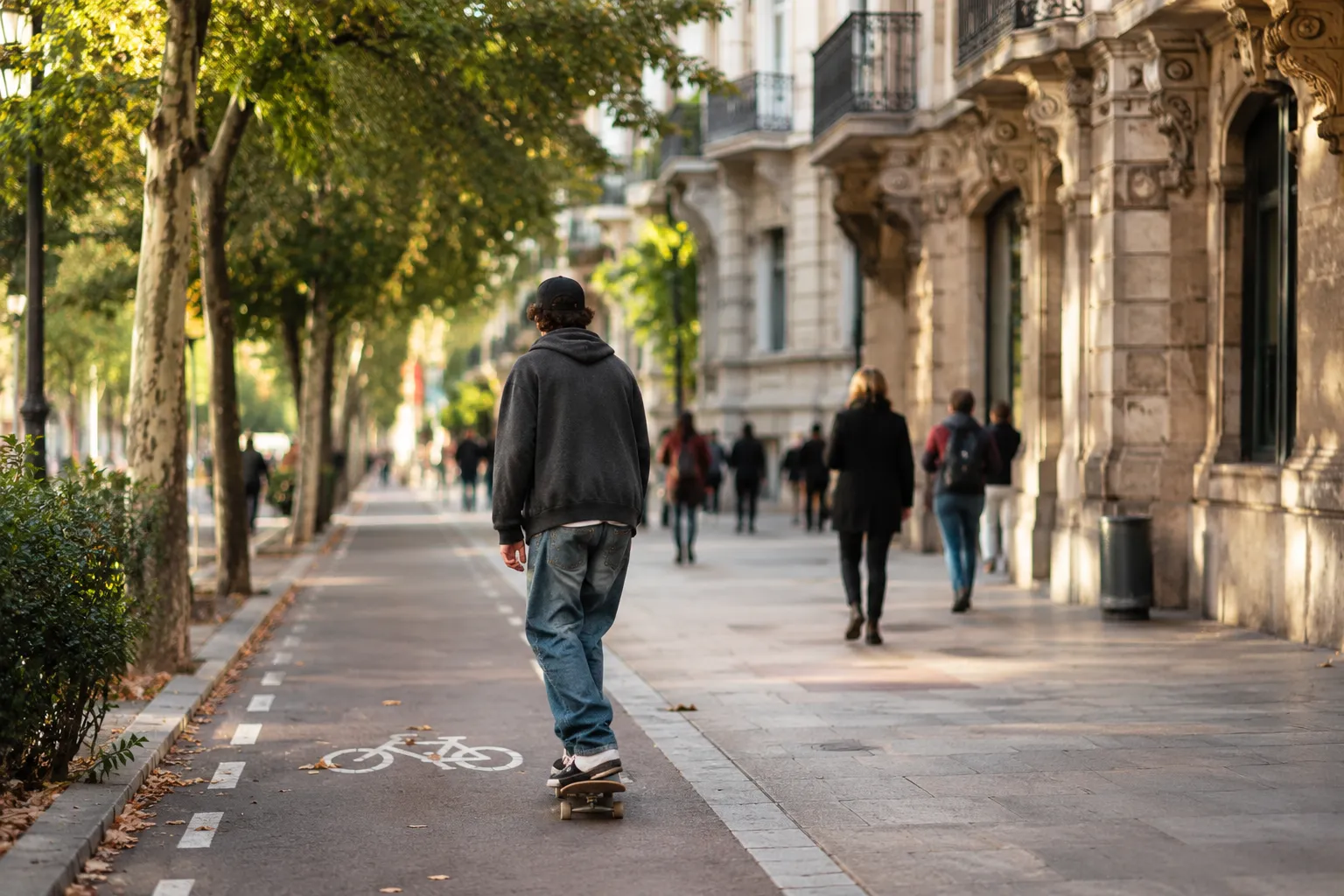
Can you skateboard on the road or in a cycle lane?
No UK rule specifically bans skateboards on the carriageway, and none specifically allows them. The same goes for cycle lanes. That is different from several European countries, which are very specific (see the table below).
In practical terms, the road is where the serious injuries in skateboarding come from. The data in our guide to falling safely shows that the most serious cases are linked to collisions with vehicles and head injuries. Legal grey area or not, a road with traffic is the riskiest place to ride. Local signs, such as pedestrian zones or banned areas, override any general assumption.
Fines: what applies
| Rule | What it does | Penalty |
|---|---|---|
| Highway Act 1835, s.72 | Riding on a footpath beside a road | Level 2, up to 500 pounds |
| PSPO breach (Anti-social Behaviour, Crime and Policing Act 2014, s.67) | Breaking a local order without reasonable excuse | Court: level 3, up to 1,000 pounds. Fixed penalties are set locally, often around 100 pounds |
| Highways Act 1980, s.137 | Wilfully obstructing free passage along a highway | Up to 51 weeks’ imprisonment or a fine |
The first two are the ones that matter for skateboarding. Section 137 is about obstructing a highway, so it is more likely to come up with a group blocking a path than with someone cruising along it. It is a rule that exists, not something skateboarders commonly face.
At night and with a helmet: is anything required?
For a non-powered skateboard, there is no legal requirement for a helmet, lights or reflective clothing. That is not the same as a recommendation. Doctors advise a helmet, and the evidence and what to buy are in our guide to skateboard helmets and pads. At night, something reflective and a front light make you much easier to spot, particularly if you are anywhere near traffic.
What about electric skateboards?
This is where the law is much clearer, and stricter. The government’s guidance on powered transporters (updated July 2020) says that powered transporters such as e-scooters, Segways and hoverboards are motor vehicles, and that it is an offence to use them on the pavement. Using one on private land with the owner’s permission is lawful.
Electric skateboards are not named on that information sheet, so they fall under the general definition rather than being named. The government’s separate e-scooter page says privately owned e-scooters cannot legally be used on roads, pavements or in parks, and that only rental schemes in official trials are allowed. If you ride an electric board, the safe assumption is private land only.
Squares, private spaces and street furniture
Squares, plazas and public buildings are where skateboarding and the law collide most often, and it is mostly decided by owners and councils, not by a national law.
- Public space owned by a council. A PSPO may cover it. The wording will say which area and which behaviour.
- Private land, such as shopping centre forecourts, business parks and car parks, belongs to the owner, who can ask you to leave.
- Deterrent street furniture, the “skate stoppers” fixed to ledges and benches, is a design choice by whoever manages the space. It is not a law, even though it tells you what they would prefer.
One well-known UK example is the Southbank Undercroft in London. The Long Live Southbank campaign in 2013 and 2014 led to a binding agreement with Lambeth council about free use of the space for skateboarding. It shows that a spot can move from threatened to protected through negotiation, though it is not a rule for other places.
If you would rather skip the question entirely, our skatepark directory lists places where skateboarding is the whole point. And the skatepark etiquette guide covers the code that no law writes down.
Minors, damage and liability
For a skateboarder of any age, the general rules of civil liability apply if you damage someone’s property or injure someone. The amounts depend on the case. In practice, check whether your home contents insurance or a separate public liability cover includes damage to third parties, and to look for exclusions for sports or wheeled activities. A call to your insurer will clear it up in five minutes.
If you are a parent, it is worth reading the policy too. For younger skaters, a skatepark is both the safer and the less contentious place to learn, and our guide to skateboarding for adults has useful advice for those starting later.
Common myths
“Skateboarding in the street is illegal in the UK.” There is no general offence. There is an old footpath rule that does not name skateboards, and local PSPOs.
“The Highway Act means you cannot skate on the pavement.” It says you cannot “wilfully ride upon any footpath or causeway by the side of any road”, and it does not name skateboards.
“A PSPO is a national law.” It is a local order, so one town can have one and the next town may not.
“Electric skateboards are like normal skateboards, just faster.” Legally they are not. Powered transporters are treated as motor vehicles.
“Skate stoppers mean skateboarding is banned there.” They are a design choice, not a legal rule.
How does the UK compare? Six countries side by side
If you travel with your board, the rules change a lot from one country to the next. This summarises the rules in six countries, as of November 2026. Local rules always apply on top.
| Country | Non-powered skateboard | Pavement | Road | Cycle lane | State-level fine | Helmet |
|---|---|---|---|---|---|---|
| United Kingdom | No specific category; not a motor vehicle | Grey area: Highway Act 1835 s.72 (up to 500 pounds) by analogy | No specific ban | No specific rule | Local PSPOs | No |
| Spain | No legal definition. Town halls regulate where it can go (art. 155.1) | Depends on the town. Article 152.1 bans “any type of vehicle” | No express state ban in the current text; depends on the bylaw | Depends on the bylaw (Barcelona allows it) | None specific | No for non-powered |
| Germany | Not a vehicle; pedestrian rules apply (StVO section 24) | Yes, at walking pace | Only if there is no pavement or verge | No (StVO section 31) | 5 euros for the road when a pavement exists | No |
| France | Treated as a pedestrian (R412-34 II 1) | Yes, at walking pace | No | No | First-class contravention | Not compulsory |
| Italy | ”Acceleratore di andatura” (art. 190 of the Codice della Strada) | Banned only if it creates danger | Banned | Not stated | 26 to 102 euros | No for skateboards |
| Portugal | Treated as a pedestrian (art. 104 d) of the Código da Estrada) | Yes, as a pedestrian | Only in pedestrian exceptions | Compulsory where one exists, if a skateboard counts as a “similar means” (art. 78(5); 30 to 150 euros) | 10 to 50 euros for a pedestrian out of place (by analogy) | Not compulsory |
Spain. A reform in force from 1 October 2026 (Royal Decree 518/2026) added an urban traffic section to the Reglamento General de Circulación. It says pavements are for pedestrians and bans “any type of vehicle” there (art. 152.1), while article 155.1 leaves it to each town hall to regulate where skateboards and skates can go. Barcelona allows human-powered vehicles like skateboards on pavements and cycle lanes by bylaw, but limits skateboarding as sport to signed areas and parks. Whether a skateboard counts as a “vehicle” under 152.1 is not settled by any authority.
Germany. Section 24 of the StVO says that non-motorised means of movement such as inline skates and scooters are not vehicles and that pedestrian rules apply. Skateboards are not named but are treated by analogy. So you skate on the pavement at walking pace, and on the road only if there is no pavement or verge. Section 31 bans “Sport und Spiel” (sport and play) on the road, the verge and cycle paths, which covers tricks. Lawyers are not unanimous, since some treat a board as a sports device with no place on the public highway.
France. A ministerial reply in the National Assembly (January 2022) states that non-motorised personal mobility devices are “small vehicles without a motor” and their users count as pedestrians. That means the pavement at pedestrian pace, crossings and pedestrian lights, not the road. Not following this is a first-class contravention. Bordeaux is an interesting story: from 23 banned streets and squares in 2016 to a skateboarding master plan approved in December 2019, with anti-skate devices gradually removed from 2020.
Italy. Article 190 of the Codice della Strada bans boards and skates on the carriageway. On pedestrian areas it is banned only if it creates danger for others. The fine is 26 to 102 euros, so Italy is the odd one out: road banned, pavement not.
Portugal. The Código da Estrada equates to pedestrians those using scooters, skates “or other similar means of movement without a motor”. A skateboard fits by analogy. The pedestrian rules in article 99 then apply, with a fine of 10 to 50 euros for a pedestrian out of place. There is also a specific rule that hardly anyone mentions: article 78(5) says that people using skates, scooters “or other similar means of movement” must use cycle lanes wherever they exist, with a fine of 30 to 150 euros. It does not name skateboards, but a skateboard fits that description.
If you care more about safety than about the law, our guides on how to fall without getting hurt and skateboarding for adults may help.
Conversation
Your name will be public. Your email stays private. Comments are reviewed before publishing.