
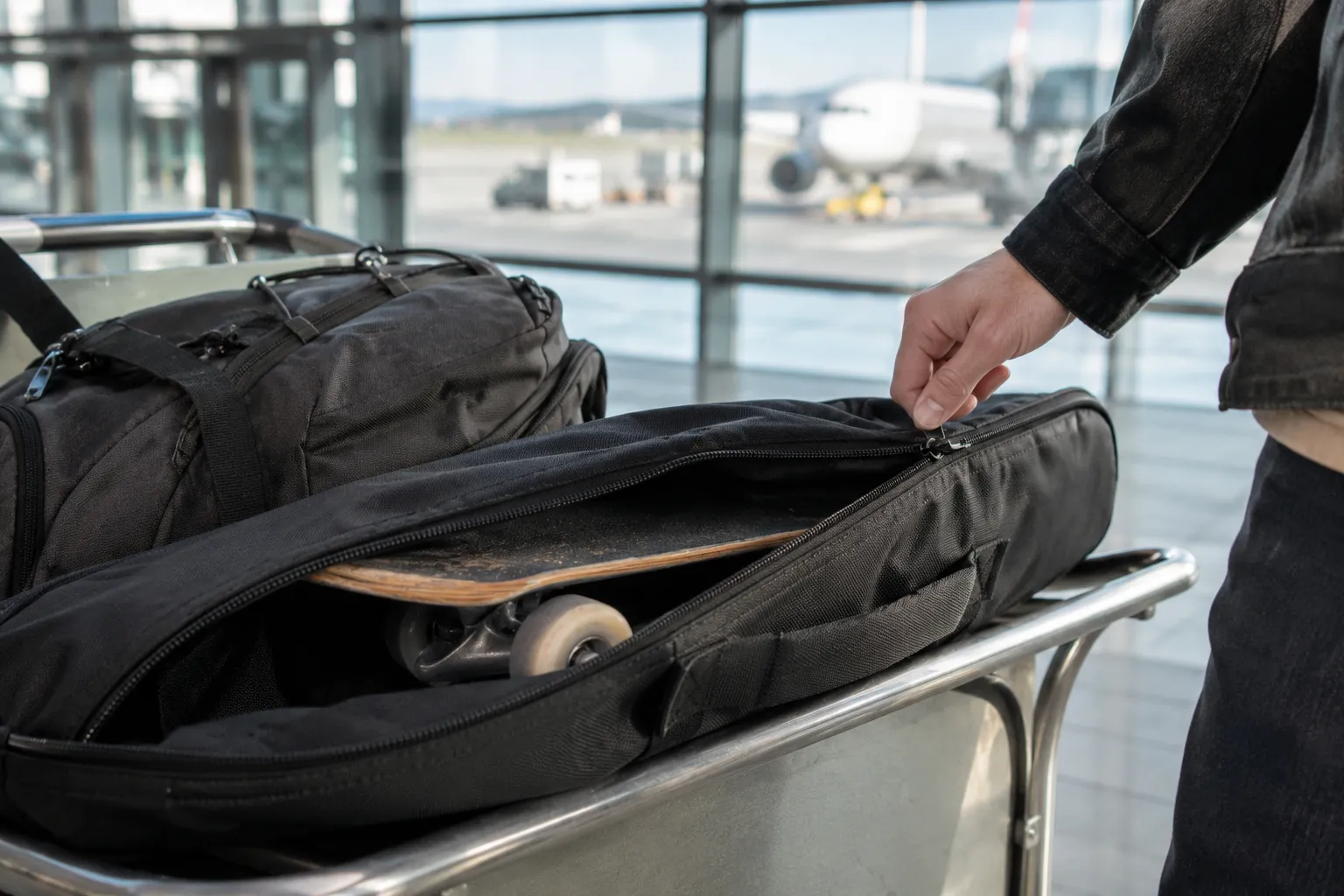
A street skateboard is around 80 cm long, and the biggest cabin bag a low-cost airline lets you carry is roughly 55 by 40 by 20. That is most of the story: the board doesn’t fit, so what you really have to decide is how to check it in and what it will cost. Everything else (airport security, your skate tool, the battery if it’s electric) is detail worth sorting out before you get to the airport.
The data is from November 2026. Almost no airline names skateboards, so in many cases the rule comes from the general baggage policy. Baggage fees are dynamic: use them as a guide and check when you book.
Can you take a skateboard in the cabin or does it go in the hold?
The short answer is that if the board doesn’t fit your ticket’s cabin size limit, it goes in the hold. There is no separate rule for skateboards: airlines apply the one they use for any large object. What differs is how they classify it and what they charge.
Sizes are in this range. British Airways sets a 56 cm length limit for cabin items, and typical low-cost cabin sizes are around 55 by 40 by 20 cm. ITA Airways allows musical instruments in the cabin up to 55 by 40 by 23 cm. A street deck of 8 or 8.25 inches is close to 80 cm, and tilting it doesn’t make it fit.
What can fit is a small board, such as a mini cruiser or a penny board, in a big backpack. If you take one that way, bear in mind that on a full flight staff may ask you to check it at the gate, and it helps to board early so you aren’t left without overhead space.
One thing gets confused a lot: getting through security is not the same as the airline letting you take it in the cabin. They are two different filters, security and baggage. Security is rarely a problem; baggage is where it’s decided.
What airport security says
In the European Union, the list of items banned in the cabin comes from Regulation 2015/1998, Annex 4-C. Its category of blunt instruments names baseball and softball bats, batons and martial arts equipment, among others. Skateboards are not named.
That doesn’t mean you can walk through with the deck by default. Airlines can be stricter than the regulation, and the practical criterion in Europe is cabin size rather than the prohibited list. A security officer can also decide on the spot, as at any airport.
In the US, TSA rules allow skateboards in carry-on and checked baggage, with the final call left to the officer. That holds for US security screening, not for flights within Europe or your airline’s cabin policy.
Airline rules and fees (November 2026)
The table summarises the airline policies. Where we write “not detailed”, the policy doesn’t mention skateboards. Prices are approximate, from November 2026, and nearly all airlines change them by route, date and channel.
| Airline | Cabin | How it’s checked in | Approx. price | Note |
|---|---|---|---|---|
| Ryanair | Only if it fits the cabin size | Sports equipment, max 20 kg | 40 or 45 euros/pounds each way (sports equipment) | Doesn’t name skateboards. You choose a category when booking |
| Vueling | Not detailed | Special baggage, up to 32 kg and 2.70 m | Per special baggage rate | Doesn’t name skateboards. Added during or after booking |
| easyJet | Not detailed | Small (20 kg) or large (32 kg) sports baggage | In its fees table | Skateboards aren’t on the list. For unlisted items, contact customer service |
| Wizz Air | Possible with a fee | Special baggage, paid | Per special baggage rate | Doesn’t name skateboards. Add when booking |
| Eurowings | Not detailed | Sports baggage up to 32 kg | Per sports baggage rate | Doesn’t name skateboards. Register early |
| Iberia | Not detailed | Special baggage, own category with skates and scooters | Around 60 to 66 euros in Spain, airport only | The only one that names skateboards |
| TAP Air Portugal | Not detailed | Sports baggage, up to 32 kg and 158 cm in total | From 45 euros extra, online | Doesn’t name skateboards. Book up to 24 hours before |
| British Airways | No: 56 cm limit | Hold, in a bag or inside the suitcase | Counts as an extra item | Electric ones banned in cabin and hold |
| Lufthansa | Not detailed | Sports baggage, register up to 72 h before | Paid at the airport | Doesn’t name skateboards. Longboard and shortboard mean surfboards |
| ITA Airways | Not detailed | Special baggage | Per special baggage rate | Doesn’t name skateboards. Longboard in its list is a surfboard |
With any other airline (Air France, KLM, Jet2, Volotea…) the general rule applies: if it fits the cabin size limit, it can fly with you; if not, it goes in the hold as sports or special baggage. Ask before booking.
How to use the cards
Each card summarises an airline’s policy: what its policy says, what it doesn’t say and roughly what it costs. They are grouped as low cost, traditional and security and batteries. You can search by name or filter by tag.
Low cost
Ryanair
It lets you carry any sports equipment on board as long as it fits within your cabin bag allowance. A full-size skateboard (around 80 cm) doesn't usually fit, so in practice it is checked in. If it doesn't fit, you can also buy an extra seat in the name EXTRA ITEM SEAT, with no baggage allowance.
Its list of large items that can't go in the cabin (fishing rods, golf clubs, bikes, surfboards, snowboards, skis...) doesn't name skateboards. In its fees table (as of November 2026), "sports equipment" is 40 or 45 euros or pounds per item each way and "large sports item" is 60 or 70, with a 20 kg maximum. The table doesn't label which column is which, and skateboards aren't classed in either: the sports equipment category is the one for medium-sized items, but check when you book.
Vueling
Vueling's special baggage policy doesn't mention skateboards anywhere. The categories it lists are golf, bicycle (no e-bikes), musical instrument, surf, ski, snowboard, kitesurf and sporting weapon.
Special baggage isn't included in any fare: it's added during or after booking, up to 32 kg and 2.70 m long, and must be packed, labelled and protected. At some airports, such as Barcelona, it comes out on different belts from suitcases. The price depends on the route.
easyJet
Its sports equipment policy distinguishes small (up to 20 kg) from large (up to 32 kg) and lists golf, bicycles, skiing, snowboarding, surfing, diving and others. Skateboards aren't on that list. For items not listed, customer service is the route.
It's added when booking or later online, and check the price in its fees section. Note it doesn't add sports baggage weight to your suitcase's (no pooling), so it's counted separately.
Wizz Air
Sports equipment can go in the hold or as cabin baggage in the overhead locker, with an extra fee. It doesn't name skateboards.
The price depends on the route. It's best to add it when booking because space is limited.
Eurowings
Eurowings accepts sports baggage up to 32 kg and recommends registering it early, because if the hold is full it won't be carried. It's handed in at the oversize baggage desk. Its policy doesn't mention skateboards, and the price depends on the route.
Traditional airlines
Iberia
It is the only airline that names skateboards: its special baggage category lists "skates, skateboards, scooter, bowling, bodyboard, windsurf, hang glider" and is cheaper than golf, skiing or surfing.
That category can't be paid for online, only at the airport. In the Spain zone it is around 60 to 66 euros; for Europe the fee is much higher (130 to 143 euros, so check it). If you connect between zones, the dearer zone's fee applies. On flights operated by Air Nostrum it is only paid at the airport.
TAP Air Portugal
TAP treats sports baggage within the hold allowance if it weighs up to 32 kg and the sum of height, length and width is no more than 158 cm. An online extra costs from 45 euros, and has to be booked up to 24 hours before the flight.
It doesn't name skateboards. A deck with trucks and wheels is well under 158 cm, so in principle it would fit, but if in doubt, ask its contact centre.
British Airways
It is the most explicit. Traditional skateboard decks can't go in hand baggage because of their length, since they are typically over the 56 cm limit for cabin items. They must always go in the hold, in a protective bag or packed in your suitcase. Each piece packed separately counts as an extra item towards your allowance.
You have to tell it about sports equipment through its chat after booking. And electric skateboards aren't allowed in the cabin or in the hold, because of the unstable nature of lithium batteries.
Lufthansa
Its sports baggage form has to be filled in at the latest 72 hours before the flight, and payment is made at the airport when checking in. Its list of types doesn't include "skateboard". "Longboard" and "shortboard" do appear, but in that context they are surfboards, so don't take them as proof it accepts skateboards.
ITA Airways
Its special baggage policy doesn't mention skateboards. "Longboards" appears under windsurfing and surfing, not as skateboards. In the cabin it allows musical instruments up to 55 by 40 by 23 cm and 8 kg, a size that gives an idea of where the limits are.
Air France, KLM, Jet2, Volotea and others
With these airlines the general rule applies: if the board fits the cabin size limit, it can fly with you; if not, it goes in the hold as sports or special baggage. Ask before booking and keep the reply.
Security and batteries
Airport security
The EU list of items banned in the cabin (Regulation 2015/1998, Annex 4-C) names baseball and softball bats, batons and martial arts equipment, but not skateboards. Airlines can be stricter, and the practical criterion in Europe is cabin size.
In the US, TSA rules allow skateboards in carry-on and checked baggage, with the officer making the final decision. That rule doesn't apply to flights within Europe.
Skate tool and other tools
EU rules ban tools in the cabin with a blade or shaft longer than 6 cm that could be used as a weapon. A typical skate tool has a shaft that, depending on the model, may be around or over that length. Nothing official settles it, so the prudent thing is to put it in checked luggage.
Electric skateboards and batteries
British Airways bans them in the cabin and the hold. With other airlines, policy depends on the airline. The usual thresholds are up to 100 Wh without permission, 100 to 160 Wh with airline approval and over 160 Wh not allowed in the cabin or the hold. Loose lithium batteries always travel in the cabin.
Many commercial electric skateboards exceed 160 Wh or have a built-in battery, which probably leaves them unable to fly (that is our own inference). Ask the airline before you buy a ticket.
Nothing matches those filters.
How much does it cost and how do you book it?
The published fees give a fairly steady range across Spain and Europe: between 40 and 70 euros each way on the airlines that publish a price. Ryanair charges 40 or 45 for sports equipment, and 60 or 70 if it treats it as a “large sports item”, always with a 20 kg maximum. The lower amount is usually the one for adding it online when you book. TAP lists it from 45 euros as an online extra, booked up to 24 hours before.
Iberia is the odd one out. Its category “Skates, skateboards, scooter, bowling, bodyboard, windsurf…” is cheaper than golf, skiing or surfing, but it can’t be paid for online, only at the airport. In the Spain zone it is around 60 to 66 euros; for Europe the fee is much higher (130 to 143 euros, so check it). And if you connect between zones, the dearer zone’s fee applies.
Vueling adds it as special baggage during or after booking, with a maximum of 32 kg and 2.70 m in length, and says it must be packed, labelled and protected. At some airports, such as Barcelona, special baggage comes out on different belts from suitcases, so don’t wait at the usual one.
To avoid surprises, look first at your airline’s sports or special baggage section. If skateboards aren’t there (they usually aren’t), write to customer service and ask for the answer in writing. Book the baggage before going to the airport when you can, because where there are two prices the desk one tends to be higher. And don’t leave it to the last day: Eurowings warns it won’t carry sports baggage if the hold is full.
Checked as special baggage or taken apart in a suitcase
There are two ways to take a skateboard in the hold, each with pros and cons.
As sports or special baggage. You register it with the airline, pay the fee and take it to the desk, usually the oversize one. It is the clearest option and holds the fewest surprises: if there’s a problem, you know which category it’s in. The downside is you pay extra and it sometimes comes out on a separate belt, which at some airports adds waiting. It is more exposed to knocks, so a bag is worth it.
Taken apart in a checked suitcase. If you’re paying for a normal suitcase anyway, you can remove the trucks and wheels and pack everything inside, with the deck wrapped in clothes. You don’t pay the extra, but the suitcase has to be big enough for a deck of around 80 cm, and you have to watch the weight. The risk is the deck snapping or bending if the case takes a knock, and the trucks marking your clothes.
If you’re unsure, this is our rule: for a short trip with just the board, special baggage and a bag; for a long trip with a suitcase, taken apart and well wrapped.
How to pack a skateboard so it arrives in one piece
The ideal is a padded skateboard or longboard bag. If you don’t have one, bubble wrap or clothes work, always with wheels and trucks covered so they don’t rub the deck or the rest of your things.
Taking the trucks off is optional. It reduces bulk and protects the deck, but means rebuilding the board when you arrive. If you decide to, keep nuts and bolts in a labelled bag and cover the trucks with a T-shirt or sock. If you’d rather not touch anything, protect the wheels with tape or wrapping and leave the trucks on. To put it back together, our guide to building a complete skateboard walks you through it, and if you want to know what you are taking apart, skateboard parts explained covers each piece. The truck entry in the dictionary is quick if you only need the term.
Bearings deserve a minute too. If you’ll go a while without skating, or are heading somewhere damp, it’s a good time to clean them, and to review the overall state with the skateboard maintenance guide. Some people prefer to carry wheels and bearings in the cabin backpack, which is a reasonable option if you don’t want to risk losing them.
Label the bag on the outside with your name and phone number. Writing “fragile” doesn’t guarantee careful handling, so don’t count on it. And take a photo of how it looks before handing it over, in case you need to claim for damage.
The skate tool: cabin or hold
This is the question that comes up most. EU security rules ban tools in the cabin with a blade or shaft longer than 6 cm that could be used as a weapon, such as screwdrivers or chisels. A typical skate tool combines 9/16 and 1/2 inch sockets with a shaft that, depending on the model, may be just under or over that 6 cm.
Nothing official says whether a particular skate tool passes. So the prudent option, and what we would do, is put it in checked luggage, or with the board if you check it separately. That way there’s no argument at security and no risk of having it taken from you.
Electric skateboards and batteries
Take more care here, because the lithium battery is what worries airlines. British Airways is plain: electric skateboards are not allowed on its aircraft, in the cabin or in the hold, because of the instability of lithium batteries.
With other airlines it depends on their policy. The usual thresholds are up to 100 Wh without permission, 100 to 160 Wh with airline approval and above 160 Wh not allowed in the cabin or the hold. Loose lithium batteries always travel in the cabin, never in the hold, so if your board has a removable battery, ask the airline how it wants it carried.
Many commercial electric skateboards exceed 160 Wh or have a built-in battery, which probably leaves them unable to fly, although that is our own inference. If you have one, write to the airline before buying a ticket and keep their reply.
What to do if they refuse it at the gate
It happens now and then. With almost nobody regulating it in writing, a board can get through in the cabin on the way out and be challenged on the way back: it’s down to whoever is on duty that day, and checking it wrapped in a bag and bubble wrap is the usual way out.
If it’s refused in the cabin, you’ll normally be told to check it in, with the fee. What works best is arriving with time to spare, having the bag to hand and not arguing. And if you say it isn’t sports equipment to avoid the fee, there’s no guarantee: the airline can still charge it. Better to be clear from the start.
What about trains and coaches?
There’s little written. Trenitalia allows one large item per passenger and its list of exceptions doesn’t name skateboards. Spanish Renfe is more flexible on commuter lines. In general, a small skateboard in a bag is tolerated in practice on trains and coaches, though no company puts it in writing. If in doubt, ask staff before boarding.
Keep exploring
- Skateboard maintenance guide, to get it ready before the trip.
- Skateboard parts explained, to know what you’re taking apart.
- How to clean skateboard bearings.
- How to build a skateboard, to put it back together on arrival.
- What is a truck? in the dictionary.
Conversation
Your name will be public. Your email stays private. Comments are reviewed before publishing.