In Swedish fracture data for 2015 to 2023 there are nearly 3,000 skateboarding fractures, and half of them (49.7%) are in the forearm. It isn’t the most common injury in every dataset, but it’s the one that keeps turning up once someone reaches hospital. This guide brings together what we know about the typical skateboarding injuries: how long they take to heal, when not to wait and see, and how to get back on the board without a relapse.
We’re not doctors and this doesn’t replace one: if in doubt, get seen, and in an emergency call 999 (or 111 for non-emergency advice in the UK).
What do skateboarders injure? What the numbers say
It depends who you ask, and that isn’t a detail. Swedish data (2015 to 2023, 2,995 skateboarding fractures) gives this split: forearm 49.7%, hand 13.9%, ankle 9.3%, tibia 7.9% and collarbone 5.6%. Some 24% of those fractures were operated on, 58% were in adults (16 or over) and 42% in children. Compared with snowboarding, skateboarders had more lower-limb fractures.
A survey of 197 Spanish skateboarders, with an average of almost ten years of experience, looks at something else: injuries of every kind, not just fractures. 87.8% had been injured at some point. By area, 69.7% were in the lower limbs, 22.0% in the upper limbs and 7.7% in head and trunk. The ankle accounts for 39.3% of injuries, the knee 13.9% and the wrist or forearm 9.9%. By type, sprain 39.6%, fracture 22.9%, muscle or tendon 12.4%, bruise 7.4% and wound 3.7%.
It’s an online survey, so it relies on what each person remembers and chooses to report. Even so, one figure matches what a lot of people say: 67 of the 272 injuries were repeats, and the ankle was involved in 70.1% of them. By severity, measured in days off the board, 16.2% were mild (1 to 7 days), 29.6% moderate (8 to 21) and 54.2% severe (more than 21). Skateboarders with more than three years’ experience had more severe injuries.
In the US, a study of insurance records from 2010 to 2022 puts skateboarding as the vehicle with the most injuries, with a peak at ages 15 to 19, and the forearm as the commonest fracture. What makes the most common injury change from one study to another is the population. Emergency departments mostly see kids who land on their hands; the survey captures adults with battered ankles. Fall technique and prevention are in how to fall skateboarding without getting hurt, so we won’t repeat them here.
How to use this article, and when to go to A&E straight away
You can read the article from top to bottom or jump to the injury that worries you in the cards below. Each card sums up how it happens on a board, the warning signs, a rough timeframe and when people usually return. We don’t diagnose, give doses or recommend drugs: that’s for your doctor or pharmacist.
One rule everyone repeats: some signs aren’t for checking at home. Go to A&E if you hear a crack, the area has changed shape, there’s tingling or numbness, or the skin is blue, grey or cold. The table below sums up the most common injuries.
| Injury | Rough timeframe | When to go to A&E |
|---|---|---|
| Ankle sprain | Mild about 2 weeks, severe 6 to 12 | Can’t put weight on it beyond a few steps, a crack, deformed foot, tingling |
| Broken ankle | 6 to 8 weeks or more | Pain over the bone, can’t put weight on the foot |
| Broken wrist (radius) | Cast 4 to 6 weeks, demanding sports 3 to 6 months | Deformity, severe worsening pain, numb or pale fingers |
| Scaphoid | Several weeks, up to 6 months in difficult cases | Wrist pain that lasts more than a day after landing on the palm |
| Collarbone | Adults 6 to 8 weeks, children 3 to 4 | Bone showing, fast swelling, difficulty breathing |
| Dislocated shoulder | 6 to 12 weeks, up to 16 for some sports | Odd-shaped shoulder and an arm that won’t move |
| Concussion | Symptoms up to 2 weeks | Loss of consciousness, seizure, repeated vomiting, growing drowsiness |
| Elbow | Normal activity in about 4 months | Bone showing, numb fingers |
| Knocked-out adult tooth | Key factor: as soon as possible | Urgent dentist |
| Graze | Starts healing within days | Bleeding that won’t stop, deep wound, signs of infection |
The times are rough ranges and can vary with age, severity and treatment. If your doctor gives you different ones, go with theirs.
Upper limb: wrist, elbow, shoulder and hand
Broken wrist (distal radius)
How it happens. You land on an outstretched hand. It's the classic mechanism: in Swedish data, the forearm accounts for 49.7% of skateboarding fractures. Falling onto an outstretched hand is the most common cause of a distal radius fracture.
Warning signs. Immediate pain, swelling, bruising and sometimes a visible deformity. Go to A&E straight away if the pain is severe and getting worse, if it hurts to gently stretch the fingers, if the wrist is badly deformed, or if your fingers go numb or pale. Without an X-ray it's hard to tell a fracture, a dislocation and a bad sprain apart.
How long it takes. Expect a cast or splint for about 4-6 weeks, around 3 months to heal enough for everything, and up to a year for full recovery. Demanding activities usually wait until 3-6 months, and stiffness can last for months.
Back on the board. Only once the orthopaedic team signs you off and you have your movement and grip strength back. Before gaps or ramps, stick to easy flat riding.
Scaphoid fracture
How it happens. Also from landing on the palm. The pain sits in the anatomical snuffbox (the hollow at the base of the thumb, on the back of the hand) and gets worse when you pinch, grip, push or pull. Sometimes the pain is mild and looks like a sprain.
Warning signs. Wrist pain that lasts more than a day after a fall deserves a doctor. It may not show on the first X-ray: if it's suspected, the wrist is immobilised for 2-3 weeks and the scan is repeated, or an MRI is ordered.
How long it takes. It heals slowly, with immobilisation for several weeks or up to 6 months in difficult cases. Badly managed, it can end in non-union, bone death or arthritis.
Back on the board. When the orthopaedic doctor allows it. Until then, no pushing or pulling with that hand.
Elbow: fracture and direct blow
How it happens. A direct fall onto the elbow, or onto a straight arm with the elbow locked. The triceps can even pull off a fragment of the olecranon (the tip of the elbow).
Warning signs. Sudden severe pain, not being able to move the elbow, swelling or bruising at the tip, a feeling of instability. A&E if there's an open wound with bone showing, tingling or numb fingers, or poor circulation in the hand.
How long it takes. If the fragments are lined up, surgery usually isn't needed: a splint for about 2 weeks, then a brace allowing gentle movement. Most people return to normal activities in about 4 months, although full healing can take more than a year and some stiffness is common.
Back on the board. With medical clearance and nearly full extension back. Elbow pads help with direct blows (the only data on this comes from inline skating).
Shoulder: dislocation and AC joint separation
How it happens. A direct fall onto the shoulder (the most common cause of an AC joint separation) or with the arm forced back or up (dislocation).
Warning signs. If you can't move the arm and the shoulder looks the wrong shape, go to A&E as soon as possible. Don't drive yourself, don't try to put it back, and support the arm in a sling. Putting it back is done by a doctor, usually with anaesthetic or sedation.
How long it takes. Expect 6-12 weeks for a dislocation and up to 16 to return fully to some sports. The risk of dislocating again goes up after the first time. For an AC separation, most are treated without surgery, even in professional athletes, although a bump may remain. There are no clear timeframes for it.
Back on the board. After the strengthening physiotherapy your medical team sets.
Collarbone
How it happens. A fall onto the shoulder or onto an outstretched arm. In Sweden, 5.6% of skateboarding fractures.
Warning signs. Severe shoulder pain, swelling or bruising, a change in the shape of the shoulder. Go to A&E if the bone is poking through, if there's heavy bleeding, if swelling grows fast, or if you have difficulty breathing, chest pain or cough up blood.
How long it takes. 6-8 weeks in adults and 3-4 in children, with a sling for 2-3 weeks. Surgery is rare and kept for very serious cases.
Back on the board. There's no set timeframe for sport, so it depends on what your doctor says after a recheck.
Hand and fingers
How it happens. Fingers get trapped between the ground and the board or your body in a fall. In Swedish data, the hand accounts for 13.9% of skateboarding fractures.
Warning signs. A crooked finger, pain when you make a fist, swelling that doesn't go down, or fingers that don't respond. Get an X-ray if you can't close your hand or it looks deformed.
How long it takes. It depends on the bone and whether it has moved. We don't have a reliable skateboarding-specific figure, so ask the orthopaedic team for timeframes.
Back on the board. Get your grip strength and movement back first, because it's the hand you catch yourself with and the one that picks up the board. In children, the growth plates in the fingers are among the most affected areas.
Lower limb: ankle, knee, shin and heel
Ankle sprain and fracture
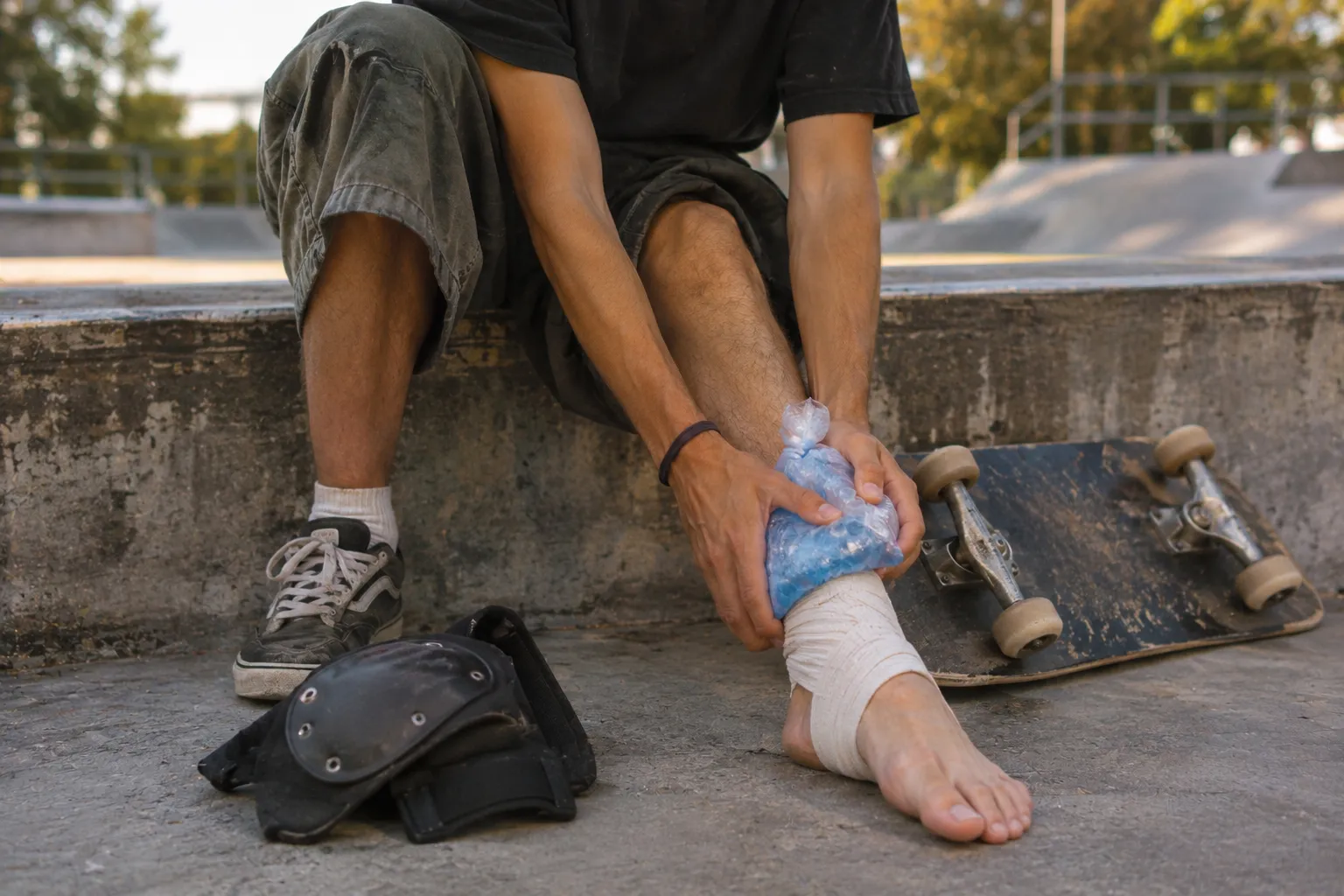
How it happens. Usually by inversion: the foot rolls inwards and the outer ligaments stretch or tear, which accounts for around 90% of sprains. On a board it happens landing an ollie with your foot half off, stepping on the board sideways, or dropping a step with your foot at the wrong angle. It's the most common injury in the Spanish survey: ankle, 39.3% of injuries and 70.1% of the repeat injuries.
Warning signs. A&E if you hear a crack, the foot sits at an odd angle, there's tingling, or the skin is blue, grey or cold. Call 111 (UK) or get checked if you can't put weight on it for more than a few steps or the pain is growing. Pain right over the bone can also mean a fracture.
How long it takes. Mild, about 2 weeks; severe, 6-12. Most people improve at around 2 weeks, but should avoid strenuous exercise for up to 8. A broken ankle, 6-8 weeks or more.
Back on the board. With rehab for movement, balance and strength. Incomplete rehabilitation is the most common cause of chronic instability.
Knee: meniscus and cruciate ligament
How it happens. A twist with the foot planted, landing with a straight knee, or a sideways fall with the knee bent the wrong way. The Spanish survey puts the knee at 13.9% of injuries.
Warning signs. A pop followed by a knee that gives way, locking or catching, swelling that builds over 2-3 days, not being able to straighten or bend it fully. A doctor assesses it with an examination and an MRI.
How long it takes. For the meniscus, about 3-6 weeks after a partial meniscectomy and about 3-6 months after a repair. A torn cruciate ligament needs an orthopaedic assessment, and the timeframe depends on whether it's operated on.
Back on the board. By functional tests, not only the calendar. Knee pads cushion knocks on the ground, but it hasn't been shown that they protect the ligaments.
Shinner: board hits your shin
How it happens. You miss a flip or a varial and the edge or truck of the board hits your tibia. There are no medical studies specific to shinners, so we're talking about what's known for bruising in general.
What it is. A haematoma is blood collecting under the skin with nowhere to go. If it's small, ice and rest are enough. See someone if the bruise hasn't healed in about 2 weeks, if there's weakness, tingling or numbness, or if the skin colour suggests poor circulation.
When it's more than a knock. If the pain is right over the bone and you can't put weight on it, ask for an X-ray: it could be a fracture or a bone bruise. A bone bruise shows on an MRI, not an X-ray, and most heal in weeks, the severe ones in months.
Back on the board. When you can put weight on it without pain and the knock isn't changing how you stand. There's no evidence that skateboard shin pads work.
Heel: bruise from a hard landing
How it happens. A flat, hard landing on the heel dropping a step or a gap. It's among the typical problems a skateboarding physio sees.
What it could be. A bruise of the heel pad or a bone bruise. Bone bruises take weeks to heal and severe ones months, and you shouldn't restart intense activity without permission because of the risk of a fracture.
Warning signs. Not being able to put the heel down after a big impact, swelling or a large bruise, or pain that carries on after a few days. An X-ray or MRI is requested.
Back on the board. When putting weight on it doesn't hurt. There is no evidence that heel cups or insoles help in skateboarding.
Head, face and trunk
Concussion
How it happens. A blow to the head, often in a fall backwards or off a ramp, even if you don't lose consciousness. In the US emergency department analysis for 2009-2018, 76.9% of head and face injuries were from simply falling off the board.
Call 999 if there's loss of consciousness without waking up, a seizure, not being able to stay awake, repeated vomiting, fluid or blood from the ears or nose, vision problems, weakness, odd speech or behaviour, or if you fell from more than a metre. Also unequal pupils and a headache that keeps getting worse.
At home. An adult should stay with you for at least 24 hours, with no alcohol or drugs and no driving until you've recovered. You don't need to stay awake if you're sleepy.
How long it takes. Symptoms usually last up to 2 weeks, and you should avoid contact sports for at least 3. If they last longer than 2 weeks, see your GP. The return is gradual (see the article).
Broken or knocked-out tooth, nose and jaw
How it happens. The board or the ground hits your face. In the US emergency department analysis for 2009-2018, among facial fractures the nose accounted for 29% and the jaw for 18%.
A knocked-out adult tooth. Hold it by the crown without touching the root, rinse it gently with milk, saline or saliva if it's dirty, try to put it back, bite on a clean cloth if it goes in, and see a dentist as soon as possible. If you can't put it back, keep it in milk or saliva, never in water. Baby teeth are not put back. Outcomes are better if you act within about 5 minutes and survival is reasonable up to about 60 if it's kept moist.
Nose or jaw. Severe pain, deformity, a bite that doesn't line up or bleeding that won't stop: A&E.
A chipped tooth. A non-urgent dentist appointment.
Tailbone
How it happens. Dropping onto your backside, slipping backwards or a butt slide gone wrong. A fall onto the tailbone is among the common causes of coccyx pain.
What to do. Good posture helps, as do a cushion that takes pressure off the tailbone, avoiding long periods of sitting, lying on your side and using cold or heat. We don't go into medication: if you need painkillers, talk to your doctor or pharmacist.
How long it takes. It can improve within a few weeks and sometimes lasts longer. See your GP if it doesn't improve after a few weeks, if it interferes with daily life, or if there's a fever with pain elsewhere.
Back on the board. When sitting down and standing up doesn't hurt. If the pain persists, there are physiotherapy and injection options your doctor decides on.
Lower back
How it happens. Hard landings, falls onto your back and repeated hyperextension. In the Spanish survey, head and trunk made up 7.7% of injuries. Spondylolysis, a lumbar stress fracture, is more typical of sports where the back arches again and again (gymnastics, football, weightlifting) than of skateboarding.
Warning signs. Expect lower back pain like a muscle strain, sometimes spreading to the buttocks and thighs, worse with activity. Tingling, numbness or weakness in the legs points to something more serious. After a hard fall with severe back pain, get checked by a doctor before carrying on.
How long it takes. Most people improve without surgery, with rest from whatever loads the area and physiotherapy for flexibility and strength. There are no set timeframes for skateboarding.
Back on the board. After that strengthening work and with a doctor's go-ahead.
Skin, overuse and children
Grazes and road rash
How it happens. You slide on tarmac or concrete. They're very common: soft tissue and abrasions were around 35% of injuries in a 2024 Australian series.
How to treat them. Wash your hands, rinse the wound under tap or bottled water, pat dry, clean around it with soap and water wiping away from the wound, cover it with a dressing and keep it clean and dry. Most start to heal within a few days.
Signs of infection. Dirt or pus that won't come out, growing redness, swelling and pain, fever or feeling unwell. A&E if bleeding won't stop, the wound is very deep or large, it's on the face or the palm, there's loss of feeling or something stuck in it (don't pull it out). You may need a tetanus jab or antibiotics.
Back on the board. When the wound has closed and won't reopen from rubbing. There's no reliable evidence on whether leaving it uncovered is better or worse, so we don't claim either.
Patellar tendinopathy (jumper's knee)
How it happens. From repeated use of the tendon linking the kneecap to the shin, especially if you suddenly increase how many sessions you do or rest too little. In the Spanish survey, muscle and tendon injuries were 12.4%.
Signs. A dull ache below the kneecap, stiffness, worse on stairs, when straightening the knee or squatting.
What to do. Cut back on what brings it on, and do strength and flexibility physiotherapy. If the pain doesn't improve after a few days' rest or came on sharply after a sudden movement, see someone. Progressive loading works better than complete rest and can take 12 weeks or more, so check with a physio.
Back on the board. Gradually, cutting volume if the pain is worse the next day.
Children: growth plates
Why it matters. Under-15s make up around half of skateboarding injuries. In growing children, the growth plate (cartilage near the ends of the bone) is the weakest part. These fractures are twice as common in boys as in girls and peak in adolescence.
Warning signs. Pain that won't go away, a persistent limp, swelling, warmth or tenderness next to a joint, deformity or not being able to put weight on it. A bone can slip out of alignment a week or two later, so it's monitored.
How long it takes. Almost all heal without after-effects. Very rarely a bony bridge stops growth, which is why follow-up lasts at least a year. The collarbone takes 3-4 weeks in children against 6-8 in adults.
Back on the board. With medical clearance and a helmet. More in the article, under children and adults.
Nothing matches those filters.
Ankle, knee and shin: the lower body
If you skate for years, the ankle is the star. The Spanish survey puts it at 39.3% of injuries, and sprains are the injury that repeats most. Around 90% of sprains are by inversion: the foot rolls inwards and the outer ligaments stretch or tear. The ollie puts your feet in a risky position; a 2021 study of 32 skateboarders found that professionals had better balance and a smaller inversion angle than amateurs, and that injured skateboarders had worse balance. It’s a small study, but it suggests that balance work isn’t a whim.
On timeframes, a mild sprain takes about 2 weeks and a severe one 6 to 12, and if symptoms continue at 6 to 8 weeks it’s worth thinking about an MRI. Most people improve at around 2 weeks but should avoid strenuous exercise for up to 8. One point is worth underlining: incomplete rehabilitation is the most common cause of chronic ankle instability. If your ankle has let you down twice, the likeliest explanation is that the rehab wasn’t finished.
The knee is a different story. Meniscus and anterior cruciate ligament injuries come from twists with the foot planted or landings with a straight knee. Recovery times depend a lot on the operation: roughly 3 to 6 weeks after part of the meniscus is removed and 3 to 6 months if it’s repaired. A torn cruciate is another league, and your orthopaedic surgeon sets the timeframe case by case.
The shinner (the board catching your shin) and the heel bruise are the least studied injuries but among the most common in practice. For a small bruise, ice and rest are enough; get it seen if it hasn’t healed in about 2 weeks or if there’s weakness, tingling or colour changes suggesting poor circulation. If the pain is right over the bone and you can’t put weight on it, ask for an X-ray: it could be a fracture or a bone bruise, which shows on an MRI and not on an X-ray.
Wrist and hand: radius, scaphoid and fingers
The wrist is the injury that shows up most in hospital data. Falling onto an outstretched hand is the most common cause of a distal radius fracture. The symptoms are immediate pain, swelling, bruising and sometimes deformity. Plan on about 4 to 6 weeks in a cast or splint, around 3 months to heal enough for most activities and up to a year for full recovery; stiffness improves one or two months after the cast comes off. Demanding sports tend to wait until 3 to 6 months. Some cases are back in 6 to 12 weeks.
Here are two mistakes that keep coming up. The first is thinking “if I can move my wrist it isn’t broken”. It’s hard to tell a fracture, a dislocation and a bad sprain apart, and you normally need an X-ray. The second is the scaphoid. The pain is felt in the anatomical snuffbox, the hollow at the base of the thumb on the back of the hand, and it can be mild enough to look like a sprain. See a doctor if the pain lasts more than a day. It may not show on the first X-ray: if it’s suspected, the wrist is immobilised for 2 to 3 weeks and the scan is repeated, or an MRI is requested.
The scaphoid heals slowly, with weeks of immobilisation and up to 6 months in difficult cases, and if badly managed it can end in non-union, bone death or arthritis. That’s why waiting is a bad idea. In the hand, the fingers (13.9% of fractures in the Swedish data) get hurt by being trapped against the ground or the board. The return is always the same: movement and grip strength first, ramps and gaps afterwards.
Elbow, shoulder and collarbone
A direct blow to the elbow or falling with a locked arm can break the olecranon, the tip of the elbow. If the fragments are lined up, surgery isn’t usually needed; most people return to normal activities in about 4 months, with full healing taking more than a year and some stiffness common. Elbow pads help with direct blows, although the only data we have is from inline skating (a 1996 study with an odds ratio of 9.5 for elbow injury without pads).
In the shoulder, two things need separating. An acromioclavicular (AC) joint separation, the most common one after falling sideways onto the shoulder, is almost always treated without surgery and can leave a bump. There are no clear timeframes, and we don’t give any either. A dislocated shoulder is different: if the arm won’t move and the shoulder is an odd shape, go to A&E as soon as possible, without driving yourself and without trying to put it back. Recovery takes 6 to 12 weeks and up to 16 to return fully to some sports, with a higher risk of it happening again after the first time.
The collarbone takes 6 to 8 weeks in adults and 3 to 4 in children, with a sling for 2 to 3 weeks. Surgery is rare. There’s no set timeframe for sport, so ask your doctor.
Head and face: concussion, teeth and nose
This is the part where it pays least to improvise. In the US emergency department analysis for 2009 to 2018, 76.9% of head and face injuries came from falling off the board while skating. The warning signs for calling 999 are: loss of consciousness without waking up, seizures, not being able to stay awake, repeated vomiting, fluid or blood from the ears or nose, vision problems, weakness, odd speech or behaviour, unequal pupils, a worsening headache, or a fall from more than a metre. An adult should stay with you for at least 24 hours, with no alcohol or drugs, and you shouldn’t drive until you’ve recovered. You don’t need to avoid sleep if you’re tired.
Symptoms usually last up to two weeks, and you should avoid contact sports for at least three. If they go beyond two weeks, see your GP. The usual advice is not returning within 24 hours and avoiding activities with a risk of a knock for at least 21 days after a confirmed concussion. Skateboarding isn’t a contact sport, but the risk of falling again and hitting your head is similar, so applying those times is the sensible approach.
In the face, the most urgent knock is the knocked-out adult tooth. Pick it up by the crown, not touching the root, rinsing it gently with milk or saline if it’s dirty, trying to put it back, biting on a clean cloth and seeing a dentist as soon as possible. If you can’t, keep it in milk or saliva, never in water. Results are better if you act within about 5 minutes, and reasonable survival is possible up to about 60 if it’s kept moist. Baby teeth are not put back. A broken nose or jaw, with severe pain, deformity or a bite that doesn’t line up, needs A&E.
Tailbone and back
The tailbone takes the hit in falls onto your backside and badly done butt slides. It’s among the most common causes of coccyx pain; good posture helps, a cushion that takes the pressure off, avoiding long periods sitting and lying on your side. It can improve within a few weeks and sometimes lasts longer. If it doesn’t improve, interferes with daily life or there’s a fever with pain elsewhere, see your GP.
The lower back is the least clear area. Spondylolysis, a lumbar stress fracture, shows up mostly in sports where the back arches again and again (gymnastics, football, weightlifting), and it isn’t a typical skateboarding injury. If after a hard fall you feel severe back pain, or tingling, numbness or weakness in the legs, get checked by a doctor before skating again.
Grazes and road rash
Road rash rarely makes it into the statistics, because it gets patched up at home, but anyone who skates knows it. Wash your hands, rinse the wound under tap or bottled water, pat dry, clean around it with soap and water wiping away from the wound, cover it with a dressing and keep it clean and dry. Most start healing within a few days. Watch for infection: dirt or pus that won’t come out, growing redness, swelling and pain, fever. Reasons to go to A&E are bleeding that won’t stop, a very deep or large wound, on the face or palm of the hand, loss of feeling or something stuck in it (don’t pull it out). You may need a tetanus jab or antibiotics, and a doctor decides that.
Overuse injuries
Patellar tendinopathy (jumper’s knee) is the one that raises the most questions. It’s a dull ache below the kneecap, worse on stairs or squatting, mostly when you suddenly increase how many sessions you do and rest too little. It responds better to progressive loading than to complete rest, and recovery usually takes 12 weeks or more. Ideally a physio guides you.
Children and adults: growth plates and skating at 30 and over
Under-15s make up around half of skateboarding injuries. In growing children, the growth plate near the ends of the bone is the weakest part. These fractures are twice as common in boys as in girls, peaking in adolescence, and almost all heal without after-effects. Very rarely a bony bridge halts growth, which is why there’s follow-up of at least a year. A bone can even slip out of alignment a week or two after the injury, so it isn’t a formality.
Adults have their own patterns. In the Swedish data, 58% of fractures were in adults. An Australian emergency series put 14% of patients over 30, and its authors suggested that anyone past that age should think hard about skating without protection. After 50 or 60, radius fractures raise another question, osteoporosis, because a fragility fracture almost doubles the risk of a second one. If you skate as an adult, we have a guide to skateboarding for adults.
PRICE, PEACE & LOVE and the ice debate
The traditional approach for sprains and strains is PRICE: protection, rest, ice (up to 20 minutes every 2 to 3 hours), compression and elevation for 2 or 3 days, with no heat, alcohol or massage at first, and gentle movement as soon as the pain allows. Another model proposed in 2020 is PEACE & LOVE. In the first days: protect with minimal rest, elevate, compress and educate the patient, avoiding anti-inflammatories. Afterwards: progressive loading, optimism, pain-free exercise to improve circulation, and rehab exercise. They question ice.
The two approaches agree on protecting at first, elevating and getting back to loading early, and differ on ice, complete rest and anti-inflammatories. We give no guidance on the latter: it’s a conversation with your doctor or pharmacist, and painkillers shouldn’t be used for more than 10 days in a row without consulting someone. And one thing to bear in mind: neither model is for a possible fracture.
How to get back on the board after an injury
One principle holds: go by criteria, not just the calendar. For the ankle, there are three phases (movement, balance and isometrics; strength; and return with turning), starting with straight lines and leaving turns until last, with taping or an ankle brace on return. For every injury, the rule is to have the all-clear from whoever saw you, recover movement and strength, and build the difficulty up gradually.
A scheme of our own that may help: green, when you can roll on the flat, push and turn without pain. Amber, small ramps and simple tricks if it doesn’t hurt the next day. Red, gaps, stairs and rails, only after several amber sessions with no pain or soreness the next day. If the pain is worse the day after a session, you drop back a step.
After a concussion, the usual approach is six steps of at least 24 hours each, always with medical clearance, and if symptoms return you go back a step. Recent thinking points the same way, with early light activity and a gradual return instead of strict rest, so ask your doctor.
One last tip: ask your physio for two or three exercises you can progress on your own, keep that routine going a couple of times a week and don’t let the rush to get back quickly push you, because it makes recovery worse.
Competition skateboarding: what Tokyo 2020 showed
At the Tokyo 2020 Games, the injury and illness report covered 11,315 athletes: overall injury incidence was 9%, and in skateboarding 21%, the fourth-highest sport, after boxing (27%), BMX racing (27%) and BMX freestyle (22%). Illness in skateboarding was 7%.
Myths worth dropping
“If I can move my wrist it isn’t broken”: you need an X-ray to tell. “If the X-ray is normal there’s no fracture”: in the scaphoid it may not show at first, which is why it’s immobilised and repeated. “A sprain doesn’t need rehab”: incomplete rehabilitation is the most common cause of an unstable ankle, and the Spanish data show most repeat injuries are in the ankle.
“If I didn’t lose consciousness it isn’t a concussion”: most concussions involve no loss of consciousness, and symptoms can appear hours or days later. “You have to stay awake after a knock”: you don’t if you’re sleepy. “A dislocated shoulder you can put back yourself”: don’t move the arm and go to hospital. “A broken collarbone always needs surgery”: surgery is rare. “Wrist guards and knee pads guarantee I won’t get hurt”: the evidence is indirect and they don’t protect equally in very hard impacts.
“Stretching prevents injuries”: a 2014 meta-analysis of 25 trials found no effect from stretching (relative risk 0.963) against 0.315 for strength training. It isn’t specific to skateboarding, but it points to strength. If you want more on prevention and kit, our guides to helmets and pads for skateboarding and how to fall go further.
Keep exploring
- How to fall skateboarding without getting hurt: technique, data and what to do afterwards
- Skateboard helmets and pads: what to buy and what protects
- Skateboarding for adults: starting at 30, 40 or 50
- Skateboarding for beginners: a complete guide
- Skateboarding health benefits: what the science says
- What a bail is, in the skateboarding dictionary
Conversation
Your name will be public. Your email stays private. Comments are reviewed before publishing.