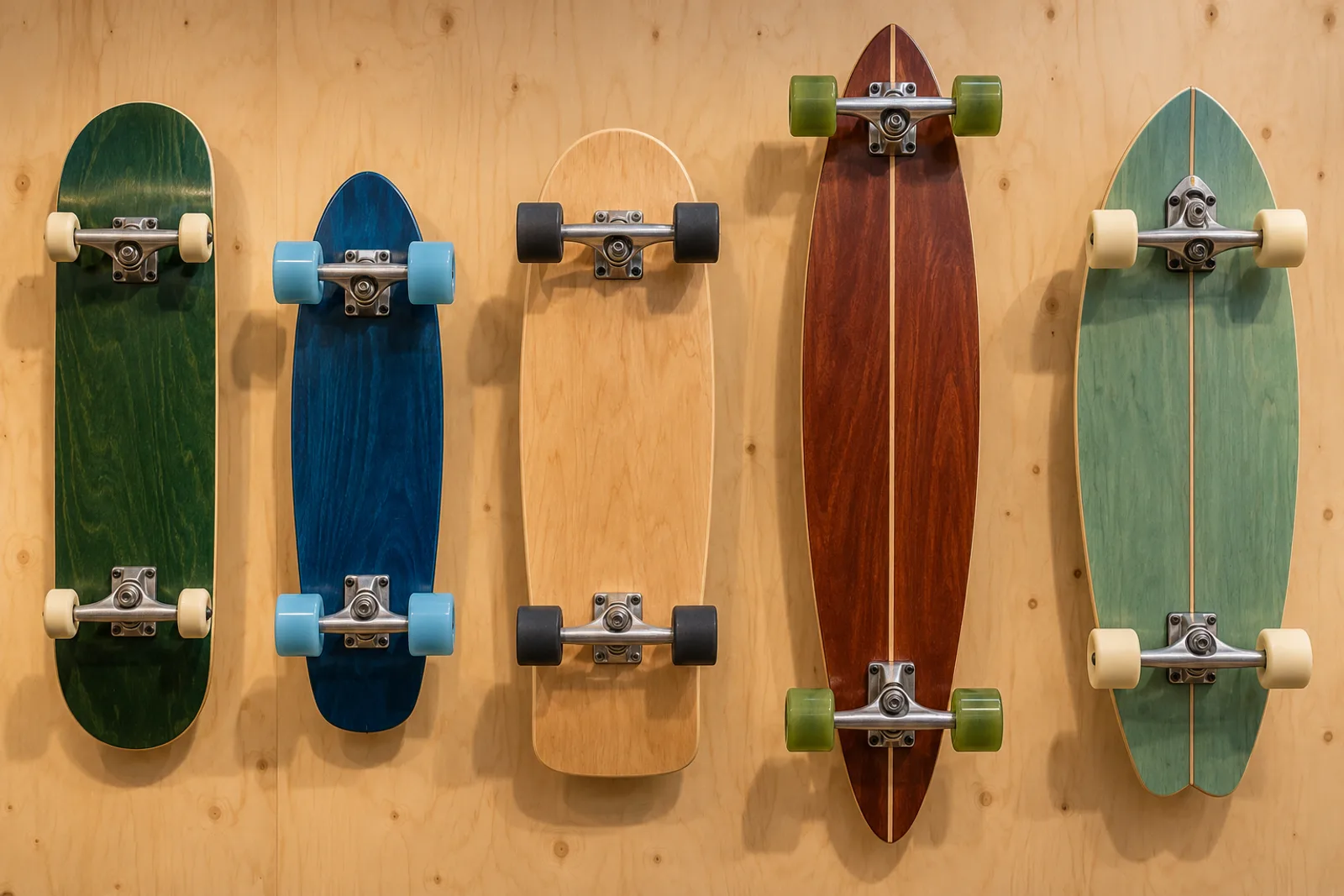
Saying “skateboard” in 2026 is like saying “car”: there are sports cars, off-roaders, city cars and electric ones, and choosing wrong ruins the experience. Under the skateboard umbrella you will find popsicle, cruisers, longboards in four subtypes, surfskates, mini cruisers, old school boards, vert boards and electric ones. Each was born to solve a different problem, and the difference between choosing well and being frustrated is knowing what it was designed for.
In this guide we sort them all, with real sizes, wheels, trucks, ideal terrain, recommended level and approximate price. No “best board on the market” and no sponsored lists: just what you need to decide which one fits you.
Summary table: the 6 families at a glance
Before going into detail, this is what you will see:
| Type | Typical length | Width | Wheels | Ideal for | Level |
|---|---|---|---|---|---|
| Popsicle (street/park) | 31-32″ | 7.5-8.5″ | 52-56mm / 99A | Tricks, street, park, bowl | All |
| Cruiser | 28-32″ | 8-10″ | 60-70mm / 78-85A | City, short distances | Beginner-intermediate |
| Mini cruiser (Penny) | 22-27″ | 6-8″ | 55-65mm / 78-83A | Portable, very short rides | Intermediate |
| Longboard | 36-50″ | 9-10″ | 65-80mm / 78-85A | Distance, downhill, dancing | All |
| Surfskate | 28-32″ | 9-10″ | 65-70mm / 78A | Slalom, surf simulation, fitness | Beginner-intermediate |
| Old school / fish | 28-32″ | 8.5-10″ | 56-65mm / 92-99A | Pool, bowl, retro style | Intermediate-advanced |
If you already know what you want, jump to the matching section. If not, keep reading: the order goes from the most common to the most niche.
1. Popsicle skateboard (classic, street and park)
This is the board you picture when someone says “skateboard”. A symmetrical deck with a kicktail at both ends, 7.5-8.5″ wide, with small hard wheels. It is called “popsicle” because its silhouette looks like an ice lolly stick: rounded ends and the same shape at both ends.
Typical sizes and specifications
| Component | Specification |
|---|---|
| Length | 31-32.5″ (79-83 cm) |
| Width | 7.75″ to 8.5″ (most at 8.0-8.25″) |
| Wheelbase | 14-14.5″ |
| Construction | 7 plies of Canadian maple with PVA glue |
| Wheels | 52-56mm diameter, 99A-101A hardness |
| Trucks | 129-149mm (Independent, Thunder, Venture, Ace) |
| Bearings | ABEC-5 to ABEC-9 / Bones Reds or Swiss |
| Complete weight | 2.3-3.2 kg |
| Price | €90-180 (decent complete), €180-280 (premium) |
What it is for
Everything you associate with skateboarding in the competitive sense: ollie, kickflip, heelflip, curb grinds, slides, dropping into ramps, bowl transfers, street lines. If you have watched the X Games or Olympic skateboarding, 95% of what you saw was done on a popsicle.
Who it is for
- Anyone who wants to learn “real” skateboarding (tricks).
- Beginners with patience: the initial curve is harder than on a cruiser, but in the long run it is the most complete board.
- Skaters of all levels: professionals and amateurs ride the same format.
Reference brands
- Decks: Baker, Element, Plan B, Girl, Chocolate, Polar, Antiz, Real, Toy Machine, Krooked.
- Trucks: Independent, Thunder, Venture, Ace.
- Wheels: Spitfire, Bones, OJ, Ricta.
2. Cruiser: the board for everyday errands
A cruiser is basically a popsicle adapted to the real street: a slightly wider deck, big soft wheels and higher trucks. The key difference isn’t the shape of the deck but the hardness of the wheels (78A-85A instead of 99A+), which absorb the vibration of the asphalt.
Typical sizes and specifications
| Component | Specification |
|---|---|
| Length | 28-32″ (71-81 cm) |
| Width | 8.0-10″ |
| Shape | Variable: popsicle, short pintail, double-kick |
| Wheels | 60-70mm diameter, 78A-85A (soft) |
| Trucks | 139-159mm, usually high (riser pads optional) |
| Price | €100-200 (Globe, Arbor, Dusters), €200-350 (premium) |
What it is for
Short and medium urban trips (500 m to 5 km): going to work, to a café, to university, running errands. They also work for relaxed rides on bike lanes or seafront promenades. Some cruisers with a tail (rear kicktail) allow manuals, kickturns and basic mini-tricks.
Who it is for
- Anyone who wants a board for getting around, not for tricks.
- People who already skate and want a comfortable second board for daily use.
- Beginners focused on transport rather than technical skill.
Advantages and limitations
In its favour: very comfortable on bad asphalt, easy to learn, rolls over paving slabs and cracks without punishing you, keeps its speed from a single push.
Against: no good for serious tricks, the soft wheels wear faster if you skate a lot, and it takes up the same space as a popsicle without its technical versatility.
Reference brands
Globe, Arbor, Dusters, Landyachtz, Loaded (short range), Carver (Greenroom shape), Z-Flex.
3. Longboard: distance, downhill and dancing
Longboard is the broadest family in skateboarding, to the point that within longboards there are more differences than between a popsicle and a cruiser. The name “longboard” describes any board above about 36″ made for something other than tricks.
General sizes
| Component | Specification |
|---|---|
| Length | 36-50″ (91-127 cm) |
| Width | 9-10.5″ |
| Wheelbase | 24-32″ (much longer than a popsicle) |
| Wheels | 65-80mm, 78A-85A hardness |
| Trucks | Reverse kingpin, 150-180mm (Paris, Caliber, Bear, Randal) |
| Construction | Maple, bamboo, fibreglass or carbon |
Within longboards there are four main subtypes with very different geometries and purposes:
3.1 Cruising / carving longboard
The most common and most versatile. A typical pintail (teardrop) or drop-through shape (trucks mounted through the deck to lower the centre of gravity). It is 38-42″ long, with big soft wheels and wide, stable turns.
- What for: getting around, medium to long distances (5-20 km), comfortable commuting.
- Who for: complete beginners who don’t want to step onto something “technical”. It is the easiest board in the world to get started on anything with wheels.
- Price: €130-280 (Loaded Dervish, Arbor Axis, Landyachtz Drop Cat).
3.2 Downhill longboard
Rigid, flat boards with pronounced concave so your feet stay anchored on descents at 60-100 km/h. Topmount or drop-deck shape, long wheelbase (28-32″), medium-hard wheels (80A-85A) so you can slide in a controlled way.
- What for: going down mountains, closed roads, competition downhill.
- Who for: skaters with previous experience. It is the only discipline in skateboarding where a full-face helmet and gloves with slide pucks are not optional.
- Price: €200-500 for the board plus €150-300 for protection.
3.3 Freeride longboard
A hybrid between downhill and cruising, made for controlled slides at medium speed (30-50 km/h). A symmetrical deck with gentle kicks at both ends, double drop or drop-through, 70-75mm wheels with an offset core so they slide more easily.
- What for: learning to slide, controlled descents, technique.
- Who for: intermediate-advanced. It is the natural step after cruising if you like speed but don’t want the risk of pure downhill.
- Price: €180-380.
3.4 Dancing longboard
The longest boards on the market: 42-50″. Made for walking along them while they roll, doing cross-steps, pivots, manuals and moves inspired by surfing and classic Hawaiian style. The shape has gentle kicks at both ends for turns and manoeuvres.
- What for: dancing, freestyle longboarding, social media content (it is very photogenic).
- Who for: intermediate-advanced, people with good balance.
- Price: €200-450 (Loaded Bhangra, Loaded Tarab, Dusters Cody Lockwood).
4. Surfskate: simulating surf on asphalt
A surfskate looks like a cruiser, but it has a radically different front truck: it pivots much more (45-60° vs the 20-30° of a normal truck) and lets you generate speed by pumping with your body, without pushing with your foot. The feeling is very close to surfing a wave, hence the name.
Typical sizes and specifications
| Component | Specification |
|---|---|
| Length | 28-33″ |
| Width | 9-10.5″ |
| Front truck | Special: Carver C7/CX, YOW Meraki, SmoothStar |
| Rear truck | Standard reverse kingpin |
| Wheels | 65-70mm, 78A |
| Price | €150-220 (Yow, Slide), €250-400 (Carver, SmoothStar) |
What it is for
Replicating surf on dry land: tight slalom, cutback simulations, top turns, off-the-lips. Also as cross-training for surfers and as a very fun board for neighbourhoods with smooth asphalt and gentle slopes.
Who it is for
- Surfers who want to train between waves.
- Skaters who already know how to skate and want a different feeling.
- Beginners focused on fun rather than tricks (you don’t ollie on a surfskate).
If you want to go deeper, we wrote a specific comparison: surfskate vs skateboard vs longboard.
Reference brands
Carver (US, the original), YOW (Spain, top value in Europe), SmoothStar (Australia, the most extreme simulation), Slide, Quiksilver-Carver.
5. Mini cruiser and Penny board
Penny board is an Australian brand that became synonymous with mini cruisers. Very short boards (22-27″), usually plastic, made to carry in a backpack and ride very short stretches.
Typical sizes and specifications
| Component | Specification |
|---|---|
| Length | 22″ (classic model) or 27″ (“Nickel”) |
| Width | 6-7.5″ |
| Material | Injection-moulded plastic, or maple in premium versions |
| Wheels | 55-65mm, 78A-83A |
| Trucks | Specific 3-3.25″ |
| Price | €50-100 (original Penny), €80-150 (wood versions) |
What it is for
The last mile: from the metro to home, from the car to the office, from campus to class. They fit in a normal backpack and weigh little. They aren’t made for long distances or for tricks.
Who it is for
- Students and commuters with very short trips.
- Experienced skaters who need a portable board.
- Not recommended as a first board for complete beginners: the narrow base (about 6″) makes them unstable and demands good balance from the first minute.
Real limitations
- Unstable above 20-25 km/h.
- Bad asphalt is very noticeable because of the short base.
- Cheap plastic models (under €40) usually come with terrible trucks and wheels and break quickly.
6. Old school and fish
Boards with the silhouette of the 70s-80s: a flat or barely raised nose, a wide tail with a pronounced kicktail, a narrow waist. The “fish” variant has the tail split into two points (it looks like a fish tail, hence the name).
Typical sizes and specifications
| Component | Specification |
|---|---|
| Length | 28-32″ |
| Width | 8.5-10″ |
| Shape | Asymmetric, tail much wider than the nose |
| Concave | Very mild or almost flat |
| Wheels | 56-65mm, 92A-99A (medium-hard) |
| Price | €130-250 (Powell-Peralta, Santa Cruz, Dogtown) |
What it is for
Pool, bowl, transition and retro style. Old school boards were born to skate empty pools in the 70s in California and are still the best option for bowl skaters who prefer the classic feel to modern popsicle geometry.
Who it is for
- Bowl and pool skaters with some experience.
- Fans of classic skateboarding (Tony Alva, Stacy Peralta, Dogtown).
- Not recommended for learning flatground: the asymmetry makes modern flips harder.
Reference brands
Powell-Peralta, Santa Cruz, Dogtown, Z-Flex, Vision, Sims.
7. Vert: boards for the big ramp
Although “vert” is more a discipline than a type of board, boards made for vert have their own features. They are wider popsicles (8.5″-9″), with a longer wheelbase and slightly stiffer construction to handle the impacts of 3-4 m halfpipe descents.
| Component | Specification |
|---|---|
| Width | 8.5-9.0″ |
| Length | 32-33″ |
| Wheels | 56-60mm, 99A-101A |
| Trucks | 149-169mm |
| Price | Like a premium popsicle: €180-300 complete |
Who for: advanced transition skaters who ride big halfpipes (Vans Park Series type parks). If you skate small bowls or mini ramps, a standard 8.25″ popsicle is more than enough.
8. Electric skateboard (e-skate): a category of its own
The e-skate isn’t really a sport skateboard: it is personal mobility in the shape of a longboard. It has a motor in the rear wheels (or all four), a battery and a remote control, and usually reaches 25-45 km/h with a range of 15-40 km.
Key facts
- Weight: 6-10 kg (vs 2-4 kg for a normal longboard).
- Speed: 25 km/h, limited by law in many countries (including Spain for VMPs).
- Range: 15-40 km depending on the battery.
- Price: €400-900 entry-level (Backfire, Meepo, Exway Flex), €1000-2500 premium (Evolve, Boosted discontinued, OneWheel GT).
Who it is for
- Pure commuters with daily trips of 5-15 km and good asphalt.
- People who already skated and want to reduce effort over long distances.
- Not suitable as a first board: the feeling is different and the risk at high speed without knowing how to brake is real.
Legal considerations (Spain)
In Spain they count as VMPs (Personal Mobility Vehicles): they can’t ride on pavements, but can use bike lanes and roads with a limit of 30 km/h or less. A helmet is recommended, and mandatory if you go above 25 km/h.
Decision table: which type to choose for your profile
| If what you want is… | Your board is… |
|---|---|
| To learn ollie, flips, grinds | Popsicle 7.75-8.25″ |
| To go to the café and work without sweating | Cruiser 30″ |
| Relaxed kilometres along the seafront | Cruising longboard 38-40″ |
| To go down mountains at speed | Downhill longboard |
| To learn to slide | Freeride longboard |
| To dance on the board and pivot | Dancing longboard 42-46″ |
| To simulate surf without water | Surfskate |
| To carry the board in a backpack to work | Mini cruiser 22-27″ |
| To skate pools and bowls in a retro style | Old school / fish |
| A big halfpipe | Vert (wide popsicle) |
| To get to work with no effort, 10 km a day | E-skate |
If after reading this you still don’t know which way to go, our guide on how to choose a skateboard deck is a step-by-step walkthrough.
Common mistakes when choosing a type
After many conversations with people who got it wrong, these are the classic mistakes:
- Buying a Penny board as a first board “because it’s cute and cheap”. Result: a fall within 30 seconds. The base is too narrow to learn balance on.
- Buying a longboard “to do tricks someday”. No: longboards and tricks are different universes. If you want tricks, get a popsicle from day one.
- Buying a cheap popsicle (under €60) at a supermarket. Bad wood, soft trucks, bearings with sand inside. A second-hand complete from a real brand is better than a new no-name complete.
- Confusing a cruiser with a surfskate. A surfskate without a pivoting truck is just an expensive cruiser. If you are going to pay €200 for a “surfskate”, make sure it has a Carver, YOW or a real equivalent.
- Buying a cheap e-skate (under €350). Poor-quality batteries, unpredictable brakes, no spare parts. It is the category where it pays most to spend double and buy a serious brand.
If budget is your concern, work it out carefully first: the breakdown is in how much a complete skateboard costs.
To keep exploring
- How to choose a skateboard deck step by step
- Surfskate vs skateboard vs longboard: differences
- How much a complete skateboard costs in 2026
Conversation
Your name will be public. Your email stays private. Comments are reviewed before publishing.