Bronson Speed Co. is the bearing brand from NHS, the Santa Cruz company behind Santa Cruz Skateboards and Independent. It came out in 2015 with a clear idea: rebuild from scratch a component that had gone decades with almost no changes. In a few years it has made a place for itself on a ton of boards, especially with the G3 and Raw models.
Here you have who’s behind Bronson, the difference between G2, G3, Raw, 6-Ball Raw and Ceramic, what their tech means, who skates them and how to take care of them.
Who is behind Bronson?
There’s no founder with a first and last name here. Bronson is a brand of NHS, Inc., the company founded in 1973 by three surfer friends from Santa Cruz, Richard Novak, Doug Haut and Jay Shuirman. In fact, “NHS” are the initials of their last names. The company also owns Independent, Creature, OJ Wheels, Ricta, Krux, Mob Grip and Santa Cruz itself.
The brand doesn’t explain where the name comes from. What is clear is that it’s not the name of a founder or of anyone on the team.
The date is a bit messy. Sometimes 2013 is given as the birth year, but the first G3s went on sale in the summer of 2015, and 2013 fits the start of development. The brand itself says it spent about three years designing them, with the idea of “completely reinventing” a product that had barely changed in over thirty years.
Where they’re manufactured isn’t something the brand tells.
Bronson’s ranges, one by one
All of them are standard 608 size bearings, with an 8 mm axle, so they fit any board and any wheel. What changes is how they’re built inside.
| Model | Shields | What sets it apart | Who it’s for |
|---|---|---|---|
| G2 | Yes | Deep raceways, ceramic oil and shields that don’t pop off | The everyday one, for getting started |
| G3 | Yes, removable | Micro grooves, reinforced cage, Balls Out | Street and park, with good maintenance |
| Raw | No | Tungsten raceways, fiberglass-reinforced nylon cage | Anyone who wants to roll fast and cleans them often |
| 6-Ball Raw | No | Six larger balls | Downhill and speed |
| Ceramic | Yes | Silicon nitride balls | Anyone after the top of the range |
G2 and G3
The G2 is the simple range. It has deep raceways, oil with ceramic compounds and rubber shields that stay in place.
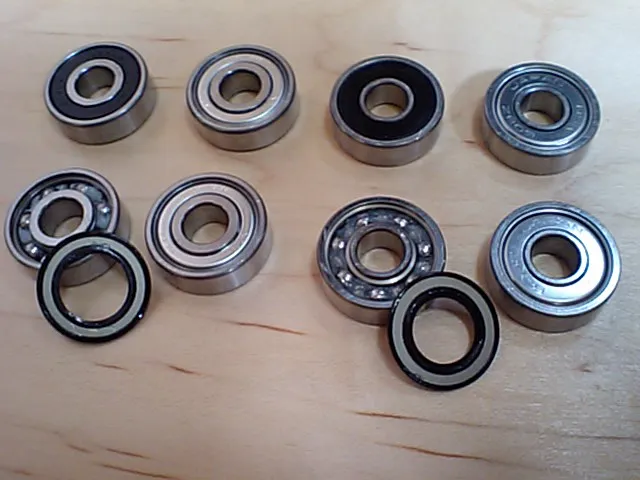
The G3 is the star model. It adds micro groove raceways, a fiberglass-reinforced nylon cage and removable rubber shields, so you can carefully take them off to clean. They leave the factory hand inspected twice, micro polished, ultrasonically washed three times and packed with nitrogen so they don’t oxidize before use.
Raw and 6-Ball Raw
The Raw are the ones most associated with Bronson. They have no shields: no shields that can pop off and no grooves for dirt to sneak into, and the raceways are coated with a dry tungsten film. The brand calls them “Audible Speed” because, being open, they sound louder, and that’s part of the appeal.
The 6-Ball Raw mounts six larger balls instead of the usual count. Bronson sells them as the fastest it has made, and the big balls take impacts better. They’re built for bombing hills and rolling fast.
Ceramic
The Ceramic have silicon nitride balls and the rest of the G3 tech, shields included. They’re the top of the range. If you’re wondering whether going ceramic is worth it, it’s explained in steel vs ceramic bearings.
Bronson’s tech, explained
- Deep Groove Raceways: deeper raceways. The balls sit lower in the channel and a side hit is less likely to damage them.
- Micro Groove Raceway Surfaces: linear micro grooves on the raceway surface, so the oil spreads better.
- Max Impact Cage: the cage that separates the balls, made of fiberglass-reinforced nylon, so it doesn’t deform from impacts.
- Balls Out Technology: keeps the shields and cage from touching the balls when there’s an impact. For it to work, on the G3s you mount them with the black-striped shields facing out from the wheel.
- High Speed Ceramic Oil: an oil with nano-ceramic compounds against wear and corrosion.
- Tungsten Coated Races: the dry film on the Raw’s raceways, which helps them get less dirty.
They’re reasonable design improvements, but the result on your board depends mostly on how you mount them and take care of them.
The Bronson team
The official team goes past sixty names, and here it doesn’t distinguish between pros and ams. Among them are Jamie Foy, Zion Wright, Aaron Homoki, David Gravette, Eric Dressen, Roman Pabich, CJ Collins, Keegan Palmer, Pedro Barros, Nora Vasconcellos, Leo Romero, Tom Schaar and Nicole Hause.
Bronson has put out pro versions with their own colors and engravings, almost always based on the G3. There are ones from David Gravette, Eric Dressen, Roman Pabich and Aaron Homoki, and a 6-Ball Raw from Chris Joslin, with eight engraved bearings: seven with Bronson’s racing flags and the eighth with the word “G-Ma”, for his grandmother.
There are also European skaters: Italy’s Jacopo Carozzi and Martino Cattaneo, and France’s Vincent Milou and Victor Pellegrin. There are no Spanish skaters on the list.
Bronson videos
The brand has its own channel with short team videos and product tests, and NHS has an R&D lab that tests the bearings.
Bronson compared to Bones and other brands
- Bones Bearings: Bronson’s big rival. In use they’re very similar: same size, shields and oil. Bronson stands out for its deep raceways and for giving the Raw a central role; Bones has more steps in its range. If you want to compare them, check our Bones page and the Bones bearings guide.
- Sister brands: Bronson shares an owner with Santa Cruz, Independent and Ricta. You can pair them with any other wheel and truck brand.
- Steel or ceramic: what changes price and behavior the most is the ball material. It’s better if you check it out in steel vs ceramic.
For a wider view, we have our comparison of the best skateboard bearings.
How to take care of your Bronsons
- G2 and G3: carefully remove the shields (on the G3s they’re designed for that), clean with solvent, dry well and lube before putting them back together.
- Raw: they have no shields, so you clean them directly. They need it more often, especially if you skate in dust or water. If you leave them without maintenance, they rust and get noisy.
- Spacers and washers: they help align the bearings and keep the axle nut properly tightened.
- Store them dry: moisture is what ruins them the most.
The full guide is in how to clean skateboard bearings. If you don’t know what ABEC is, check the definition in the dictionary.
Who are Bronsons for?
- If you’re starting out: a G2 or a G3 is more than enough. With good spacers and a bit of cleaning they’ll last you months.
- If you skate street and park: the G3 is the balance. The shields protect from dust and you can clean them.
- If you want to roll as fast as possible: the Raw and the 6-Ball Raw, accepting that you have to take more care of them.
- If you want the top of the range: the Ceramic, although the improvement for most skaters is small.