
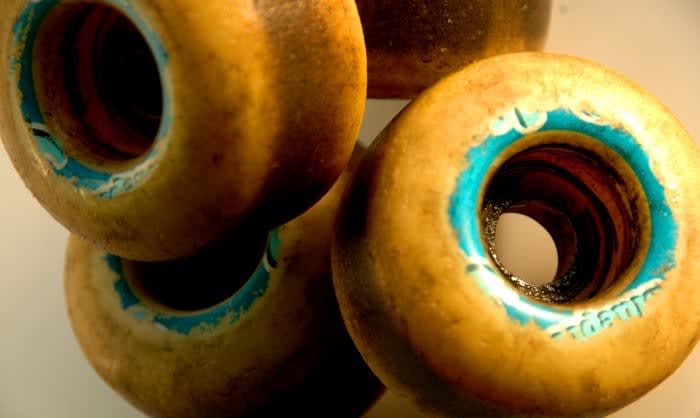
The wrong wheel ruins any setup. You can have the best skateboard deck in the world, the best Independent skateboard trucks, and a set of $80 Bones Swiss bearings — if the wheels aren’t right, the board won’t roll the way it should. Too hard and you’re rattling over every pebble. Too soft and you’re glued to the ground. Too small and you’re catching every crack.
This is the real comparison of the best skateboard wheels in 2026. We’re going to break down hardness, diameter, terrain, and the 9 models that dominate the market: Bones STF, SPF, ATF, Spitfire F4 and Bighead, OJ Super Juice, Ricta Clouds, Mini Logo, and Bronson Pro.
Hardness: the A scale (78A–101A)
Hardness is measured on the Durometer A scale. Higher number, harder wheel. The practical skateboarding range goes from 78A (soft and grippy, cruiser-style) to 101A (hard as a rock, pure street). Anything labelled 83B or 84B uses the B scale — a finer measurement — which roughly equals 101A. Bones uses it because their urethane is so hard it goes off the top of the A scale.
Which hardness for what
| Hardness | Feel | Best for | Examples |
|---|---|---|---|
| 78A–83A | Soft, grippy, cushioned | Cruiser, longboard, rough asphalt | OJ Super Juice 78A, Bones ATF |
| 84A–87A | Soft but faster | Sporty cruiser, uneven streets | Ricta Clouds 86A, OJ Mini Hot Juice |
| 88A–95A | Hybrid | Beginner skater on rough ground, all-around | Bones ATF Filmer, Spitfire Soft |
| 97A–99A | Standard street/park | 80% of skaters | Bones STF V5 99A, Spitfire F4 99A |
| 101A (83B) | Hard, maximum speed | Dry skatepark, smooth flat, contests | Bones SPF, Spitfire F4 101A |
The golden rule
- Not sure? 99A. Full stop. That’s what 80% of professional skaters ride.
- Rough asphalt? Drop to 95A or switch to cruiser.
- Smooth concrete skatepark? Go up to 101A — less grip, more slide.
Diameter: 50mm to 60mm
Diameter is measured in millimetres and determines: how much the wheel weighs (and therefore how much energy it takes to move), how well it handles ground imperfections, and top speed.
Which size to choose
| Diameter | Type of skater | Pros | Cons |
|---|---|---|---|
| 50–52mm | Pure tech street | Super nimble, clean flip tricks, low centre of gravity | Catches every pebble, slow |
| 52–54mm | Standard street | Universal sweet spot, total balance | — |
| 54–56mm | Park / transition / aggressive street | More speed, handles imperfections | Heavier, flip tricks slightly less clean |
| 56–58mm | Bowl / vert / rough asphalt | Speed, stability, momentum | Tough for flat tech |
| 58–60mm | Sporty cruiser | Rolls a long way per push | You’ll need riser pads to avoid wheel bite |
| 60mm+ | Pure cruiser / longboard | Eats bumps, lots of speed | Useless for tricks |
The universal range today: 53–54mm. That’s what almost all professional skaters choose. If you’re not sure, start there.
On wheel bite
The bigger the wheel, the more likely it is to clip the deck when you turn hard (wheel bite). Above 56mm, consider adding 1/8″ (3mm) riser pads between your trucks and deck. Above 58mm, 1/4″ (6mm) risers are non-negotiable. Cruiser wheels at 60mm+ almost always need risers.
How to choose by terrain
Tech street (manny pads, ledges, stairs)
- Diameter: 51–53mm
- Hardness: 99A–101A
- Top pick: Bones STF V5 52mm 99A or Spitfire F4 52mm 99A.
- Why: light enough for precise flip tricks, slide clean on ledges, don’t flat-spot when brake-sliding.
Dry skatepark (concrete)
- Diameter: 53–55mm
- Hardness: 99A–101A
- Top pick: Bones SPF 54mm or Spitfire F4 54mm 101A.
- Why: concrete has a lot of grip. You need high hardness so the board actually rolls and you can do clean powerslides.
Bowl and vert
- Diameter: 56–58mm
- Hardness: 97A–99A
- Top pick: Bones SPF 58mm 84B or Spitfire F4 56mm 99A.
- Why: more diameter = more momentum to carry speed through transitions, more stability when loading the tail.
Rough asphalt (real city streets)
- Diameter: 54–56mm
- Hardness: 92A–97A
- Top pick: Bones ATF 56mm or Ricta Clouds 55mm 92A.
- Why: you need the wheel to absorb cracks and cobblestones. 99A will rattle your teeth.
Cruiser (getting from home to work, mixed surfaces)
- Diameter: 58–66mm
- Hardness: 78A–86A
- Top pick: OJ Super Juice 60mm 78A.
- Why: glides over anything on the ground, rolls quietly, you don’t need to push every few metres.
Top 9 models in 2026
1. Bones STF V5 (Street Tech Formula) — ~$42
Category: pure street, all-around. Hardness: 99A or 103A. Diameter: 50–58mm.
The best-selling street wheel in the world, and for good reason. The STF (Street Tech Formula) is what Bones has spent 20 years refining: urethane that resists flat-spotting (won’t go flat during powerslides) and abrasion. The V5 (2024-2025 version) tweaked the profile to slide better on ledges without sacrificing grip while pushing.
- Pros: unbeatable durability, brutal flat-spot resistance, classic profile that works with any setup.
- Cons: price ($42 is not cheap), slightly heavier than Spitfire F4.
- Buy if: you skate street and want wheels that last 18-24 months without thinking about them.
2. Bones SPF (Skatepark Formula) — ~$44
Category: skatepark, bowl, vert. Hardness: 84B (≈101A). Diameter: 52–60mm.
The SPF is the hardcore sibling of the STF. Harder, faster, more heat-resistant (important on dark concrete in direct sun, which can actually soften urethane). If you’re hitting hard concrete parks, this is the wheel. It’s not for urban asphalt or uneven surfaces — it will punish you.
- Pros: pure speed, heat resistance, ideal for long park sessions.
- Cons: brutal on your joints on rough ground; less grip on damp surfaces.
- Buy if: your typical session is 2 hours in a concrete bowl.
3. Bones ATF (All Terrain Formula) — ~$35
Category: cruiser, all-terrain, rough ground. Hardness: 80A. Diameter: 52–60mm.
The smart option for anyone who also uses their board to get around. Much softer (80A) but with a street wheel profile rather than a round cruiser shape. You can still do ollies, manuals and basic tricks, but it handles cobblestones, gravel and cracked asphalt without a fight. A favourite of many skate filmers for the smooth footage it produces.
- Pros: total versatility, handles any surface, great for beginners on rough streets.
- Cons: slower than the STF on smooth concrete parks; the extra grip works against you on powerslides.
- Buy if: you mix tricks with cruising; your local ground is mixed and imperfect.
4. Spitfire Formula Four (F4) — ~$42
Category: street, park, all-around. Hardness: 97A, 99A or 101A. Diameter: 51–60mm.
The eternal rival of the Bones STF. The Formula Four (F4) has been on the market since 2014 and is the wheel of choice for many pro skaters (Andrew Reynolds, Cardiel, Grant Taylor). Urethane that slides as well as it grips, classic profile, excellent durability. The 99A is the universal sweet spot; 101A for park; 97A for imperfect ground.
- Pros: silky slide, iconic look (the flame), pro choice, full hardness range available.
- Cons: slightly less flat-spot resistant than the STF.
- Buy if: you prefer a “slidey” feel over a “grippy” one.
5. Spitfire Bighead — ~$33
Category: street/park entry-mid, lower budget. Hardness: 99A. Diameter: 51–56mm.
The “workhorse Spitfire.” Same base urethane, less sophisticated formula than the F4, but $8-10 less per set. For the intermediate skater who wants a proper brand without paying the F4 premium. They hold up, slide decently, and the Bighead logo is one of the most recognisable in skateboarding.
- Pros: unbeatable value for a Spitfire product, classic look.
- Cons: shorter lifespan than the F4 (6-12 months, not 18-24).
- Buy if: your budget is tighter but you want a serious brand.
6. OJ Super Juice 78A — ~$33
Category: pure cruiser. Hardness: 78A. Diameter: 60mm.
The definitive cruiser wheel. 60mm diameter and 78A hardness means it devours any surface: cobblestones, gravel, cracked asphalt, potholes, anything. Iconic translucent yellow, nearly silent when rolling. NOT built for technical tricks (too big and too soft), but as a cruiser for commuting there’s nothing better at this price.
- Pros: total comfort, roll-on momentum (goes a long way per push), nearly infinite durability.
- Cons: tricks are out of the question, risers are mandatory, heavy.
- Buy if: you’re building a dedicated cruiser, or your first board is purely for getting around.
7. Ricta Clouds — ~$28
Category: cruiser-street hybrid. Hardness: 78A or 86A. Diameter: 52–60mm.
The Clouds are the ideal middle ground: soft enough to absorb rough ground, but with a standard skate wheel profile. The 86A is excellent for anyone who wants “an STF that’s a bit softer” to survive urban asphalt without giving up tricks entirely. Good value ($28 vs $42 for the Bones).
- Pros: fair price, versatility, good absorption.
- Cons: less prestigious brand (although NHS, owners of Santa Cruz, is behind it), average durability.
- Buy if: you’re an intermediate skater in a city with rough pavement, looking to straddle the cruiser/street line.
8. Mini Logo Wheels — ~$20
Category: honest entry-level. Hardness: 97A or 101A. Diameter: 52–55mm.
Mini Logo is Powell-Peralta’s budget brand. Same factory, same base urethane, without the branding or formula sophistication. For $20 you get a set of wheels that outlasts anything from a no-name Amazon brand. This is the right answer to “what cheap wheels should I buy to start?”
- Pros: unbeatable value for money, serious brand behind it, reliable.
- Cons: performs below STF/F4 level (you’ll notice they slide a bit less), generic look.
- Buy if: starter setup, tight budget, or backup wheels.
Final comparison table
All 9 wheels at a glance
| Model | Type | Hardness | Diameter | Price | Best for |
|---|---|---|---|---|---|
| Bones STF V5 | Street/all-around | 99A / 103A | 50–58mm | $42 | 80% of skaters |
| Bones SPF | Skatepark/bowl | 84B (101A) | 52–60mm | $44 | Smooth concrete, vert |
| Bones ATF | All-terrain | 80A | 52–60mm | $35 | Mixed ground, filmers |
| Spitfire F4 | Street/park | 97A–101A | 51–60mm | $42 | Pro alternative to STF |
| Spitfire Bighead | Street entry-mid | 99A | 51–56mm | $33 | Workhorse Spitfire |
| OJ Super Juice 78A | Cruiser | 78A | 60mm | $33 | Pure cruising |
| Ricta Clouds | Hybrid | 78A / 86A | 52–60mm | $28 | Rough city streets |
| Mini Logo | Entry-level | 97A / 101A | 52–55mm | $20 | Starting out on a budget |
How to keep your wheels rolling fast (maintenance)
Wheels don’t fail in isolation — the wheel + bearings + spacer system works as a unit. Here’s the bare minimum you need to do so you don’t waste money or speed unnecessarily:
Rotate every 1-2 months
Wheels wear unevenly. Most skaters always brake-slide with the same rear wheel, which creates a flat spot in one specific area. The fix is to rotate the set every 4-8 weeks:
- Both front wheels move to the back, crossed over (front-right to rear-left, and vice versa).
- Both rear wheels move to the front, crossed over in the same way.
This distributes wear evenly and doubles the lifespan of the set. Takes 5 minutes with a skate tool.
Always use spacers
Spacers (the small metal separators between the two bearings in each wheel) cost about $3 for a pack of 8, and they stop you from overtightening the axle nut. Without spacers, if you tighten the nut too much you compress the bearings and kill them within weeks. If you don’t have them, fit them now.
Occasional cleaning
Once a year, pull the wheels off, blow out the dust inside with compressed air, and take the chance to clean your bearings. The whole system noticeably gains speed.
Axle nut: not too loose, not too tight
Tighten the axle nut until the wheel spins freely with a flick but with no lateral play. If the wheel wobbles side to side, it’s too loose. If it spins sluggishly with resistance, it’s too tight. The sweet spot: it spins smoothly and the spacer is absorbing the pressure.
Brands to avoid
Not all wheels are equal, and there are plenty of no-name Chinese brands selling wheels on Amazon for $8-14 a set. Don’t buy them. The real problems:
- Bad urethane: they use cheap compounds that disintegrate within 2-3 months. You’ll see small chunks flaking off after every session.
- Inconsistent diameter: all 4 wheels don’t measure exactly the same, and that unbalances the board.
- Off-centre core: bearings don’t seat straight, and when you roll you vibrate like a washing machine.
- Urethane that’s actually soft while claiming to be 99A: the label says 99A but they’re really 88A. Sticky, slow, won’t slide.
Simple rules for spotting junk:
- No recognisable brand name: if it’s not Bones, Spitfire, OJ, Ricta, Mini Logo, Powell, Santa Cruz, Pig, Sector 9, Globe, Element, Almost or Real… be suspicious.
- Under $20 for a set of 4: everything below that is questionable.
- Amazon reviews from “beginner skaters”: they don’t count. A beginner can’t tell a bad wheel is bad because they have no reference point.
If your absolute maximum budget is $20, buy Mini Logo. Nothing beats it at that price.
When to replace them
Wheels don’t give you a day’s notice. These are the signs your set is done:
- Diameter has shrunk 4-5mm from the original. A STF that started at 52mm now measures 47-48mm.
- Visible flat spots: flat sections on the circumference (typical after lots of powerslides on dry ground).
- Urethane cracking or showing “rings” around the wheel.
- Losing grip constantly and behaving unpredictably.
- Vibrating on flat ground for no apparent reason: indicates a damaged core or internal imbalance.
- Rolling noise that doesn’t go away after cleaning the bearings.
Average lifespan by usage:
- Daily skater, streets: 8-15 months.
- Skating 3-4 sessions a week: 12-18 months.
- Weekend skater: 2-3 years.
- Occasional cruiser: 4-6 years.
When you replace them, always replace the full set of 4. Mixing a new wheel with worn ones unbalances the board. If one got destroyed before the others (bad luck, or a rock split it), use it as an excuse to swap all 4.
Where to go next
Once you’ve got wheels sorted, the logical next steps:
- Skateboard wheel size calculator — enter your style and surface, get an exact diameter + hardness recommendation.
- How to choose skateboard wheels — the long technical guide if you want to understand the science behind urethane and wheel profiles.
- Best skateboard bearings — the other half of the system: without good bearings, the best wheels won’t roll right.
- Types of skateboard — if you still haven’t figured out whether street, cruiser or longboard is your thing, start here.
The wrong wheel ruins any setup, yes. But the good news is it’s one of the easiest components to get right: if in doubt, Bones STF V5 52mm 99A, and forget about it. If your ground is rough, Ricta Clouds 55mm 86A. If you want to cruise, OJ Super Juice 60mm 78A. Three answers for 95% of situations.
Conversation
Your name will be public. Your email stays private. Comments are reviewed before publishing.