
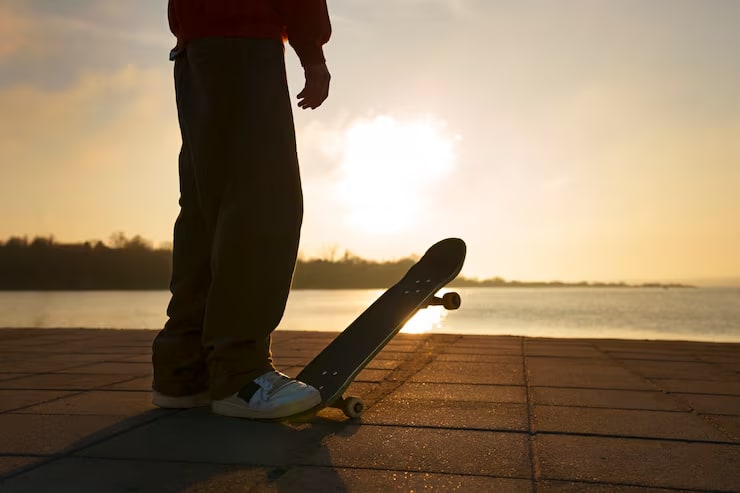
Skateboarding has a reputation for being a “lifestyle” more than a sport, and that’s meant its benefits have often been talked about in vague, mystical terms. But there’s actual data. Serious academic studies — from USC and the NIH — measuring heart rate, time in target zones, calories burned, and real psychosocial effects. This article covers what we know from evidence, what we know from experience, and what’s pure marketing.
Skateboarding as sport: what the science says
Before getting into specific benefits, one number to anchor things. The American College of Sports Medicine and the Compendium of Physical Activities classify skateboarding with a MET of 6.0. That puts it in the vigorous activity category, on par with recreational basketball or a moderate jog. It’s not a casual stroll: it’s real cardiovascular exercise when practiced consistently.
A 2020 study published in the NIH tracked adults skating at community skateparks and found:
- Average heart rate of 138.2 bpm (71.7% of predicted max).
- 70% of each session at moderate or high intensity.
- Average session length of 65 minutes, covering roughly 4.5 km inside the park.
- Typical practice frequency: 3.1 days per week.
In plain terms: a normal skatepark session comfortably meets the CDC and WHO weekly cardiovascular activity guidelines (150 minutes of moderate intensity or 75 of vigorous per week).
Physical benefits of skateboarding
1. Real calorie burn (300–575 kcal/h)
The numbers floating around are all over the place because they depend heavily on body weight and intensity. Here’s a rough breakdown:
| Body weight | Casual skating (cruising) | Moderate skating (casual park) | Intense skating (tricks, continuous lines) |
|---|---|---|---|
| 132 lb / 60 kg | ~260 kcal/h | ~360 kcal/h | ~480 kcal/h |
| 154 lb / 70 kg | ~300 kcal/h | ~420 kcal/h | ~560 kcal/h |
| 176 lb / 80 kg | ~340 kcal/h | ~480 kcal/h | ~640 kcal/h |
| 198 lb / 90 kg | ~380 kcal/h | ~540 kcal/h | ~720 kcal/h |
For context: a spin class burns ~500 kcal/h, running at a moderate pace ~600 kcal/h. Skateboarding sits in the serious burn range — not in “walk to work” territory.
2. Interval cardio (natural HIIT)
Skateboarding isn’t steady-state cardio like running — it’s interval cardio. You push hard, hit a ramp, bail, rest for 20 seconds, try again. That pattern is essentially HIIT (High Intensity Interval Training), one of the most efficient formats for improving cardiovascular capacity and burning fat.
The NIH study records heart rate climbing from ~111 bpm at rest to ~144 bpm during active movement, with higher spikes. That’s the classic HIIT curve.
3. Balance and proprioception
This is where skateboarding is almost unmatched as training. Skating demands that you process, in milliseconds, how your bodyweight sits across 4 wheels moving over changing surfaces. Few sports train proprioception — your body’s ability to know where each part is without looking — as effectively.
That has real-world applications: studies on older adults show that balance training reduces falls by up to 40%. Skateboarding, practiced consistently, keeps that ability sharp.
4. Leg, glute and core strength
Skating works:
- Quads and glutes: every push is a mini unilateral lunge. A 1-hour session adds up to 200–400 cumulative lunges.
- Calves: constantly managing balance.
- Core (abs and lower back): stabilizing your trunk through every movement.
- Adductors and abductors: adjusting leg position on the deck.
What it barely works: upper body. If you want balanced fitness, add pull-ups or push-ups alongside your sessions.
5. Motor coordination
Skating demands that you sync vision, torso, arms and legs simultaneously. Sports neuroscience research shows that complex coordination activities generate more neural connections than repetitive exercises (running, rowing machine).
That translates into a transferable skill: skaters tend to pick up other sports (surfing, snowboarding, longboarding) faster than average.
6. Functional flexibility
Skateboarding won’t make you a yogi, but it does improve ankle, hip and shoulder mobility — especially with tricks like pop shove-its or landing on transitions. The key is stretching after you skate, which about 90% of skaters skip entirely.
Mental benefits of skateboarding
This is where things get interesting, because one major academic study has added real weight to the conversation.
The USC “Beyond the Board” study
Between 2020 and 2024, the Pullias Center for Higher Education at the University of Southern California, funded by The Skatepark Project, conducted the most comprehensive academic study ever done on skateboarding and wellbeing: 5,000 skaters surveyed aged 13 to 25 across the United States, plus case studies at 5 skateparks in diverse regions.
Key findings relevant to mental health:
- Skateboarding functions as a key stress management tool and a way of coping with life difficulties (loss, anxiety, depression).
- It generates states of hyperfocused present-moment awareness — what psychology calls flow.
- It builds community across race, class and age (gender remains the most complicated aspect, historically).
- Skaters report feeling misunderstood and stigmatized by mainstream society, which paradoxically reinforces group identity.
7. Focus and flow state
Landing a trick requires blocking out the rest of the world for 3 seconds. That total concentration is called flow state — a concept from psychologist Mihaly Csikszentmihalyi — and it’s one of the mental states most consistently linked to wellbeing and life satisfaction.
Skateboarding generates flow state almost automatically: if you’re not 100% focused, you don’t land the trick. It’s meditation in motion, no cushion required.
8. Fear management and resilience
Skating teaches you to process fear actively. Dropping into a bowl for the first time means making a conscious decision with adrenaline running high. That repeated practice, according to the USC study, transfers to other areas of life: public speaking, professional risk-taking, stepping outside comfort zones.
As the study notes: the average skater bails a trick dozens of times before landing it. That normalized relationship with failure is genuinely unusual.
9. Self-esteem through progressive achievement
Learning to skate is a sequence of small, verifiable wins: today you hold your balance, tomorrow you push clean, next week a manual, in a month a low ollie. Each step is objectively measurable, which delivers the dopamine of real achievement — not the hollow dopamine of scrolling a feed.
Cognitive-behavioral psychology has been saying for decades that solid self-esteem doesn’t come from positive affirmations, but from repeated evidence that you can do difficult things. Skateboarding supplies that evidence constantly.
10. Anxiety and stress reduction
The USC study describes skateboarding as a “physical anxiolytic.” Several mechanisms are at play:
- Endorphin and serotonin release from vigorous physical activity.
- Forced cognitive disconnection (you can’t ruminate while trying a trick).
- Supportive community that reduces the sense of isolation.
- Sense of control in a modern life where that feeling is increasingly hard to find.
11. Built-in mindfulness
You don’t need a meditation app if you skate. Mental presence is baked into the sport. Every session is 60 minutes without checking your phone, without thinking about work, without stressing about the future. Just you, the deck and the ground.
Social benefits of skateboarding
12. Horizontal community
At the skatepark it doesn’t matter what you earn, what you studied or what car you drive. What matters is whether you respect the rotation, don’t snake someone’s line, and tap your deck when someone lands a trick. That kind of equality is rare in the modern world.
The USC study confirms that skateparks are among the few social spaces where mixing ages (12 to 50), races and classes is the norm, not the exception.
13. The culture of support (board taps)
When someone lands a trick, the rest of the park taps their deck on the ground in acknowledgment. It’s a wordless ritual. It doesn’t depend on knowing the person or being their friend — it’s just the code.
That culture creates an immediate sense of belonging. Show up at a skatepark in a city you’ve never visited, skate with respect, and within 30 minutes you’ll have someone to talk to.
14. Real diversity (with a caveat)
Skateboarding has historically been white and male, but that’s changing. The inclusion of women, non-binary skaters, and Latino and Black skaters has grown significantly over the last decade. Movements like GRLSWIRL, Skate Like a Girl and NYC Skate Project are reshaping the sport.
The honest caveat: there’s still ground to cover. The USC study notes that gender remains the most complicated aspect of skate culture, with real barriers that many women report when entering male-dominated parks.
15. Networking that actually works
In cities like Barcelona, Madrid, New York or London, the skatepark is a legitimate social hub. People have found jobs, business partners, relationships and roommates through the park. It’s not LinkedIn, but the connections are more real and longer-lasting.
Benefits for kids specifically
If you have children or are considering skateboarding as a family activity, a few things are worth knowing.
16. Early motor development
Between ages 5 and 12, the brain develops most of the motor patterns it will use for life. Skateboarding, with its demands on balance and coordination, is one of the sports that most stimulates that window. Kids who skate tend to show better posture, balance and overall coordination than average.
17. Frustration tolerance
Skating teaches you to fall. Literally. And not as something to avoid, but as part of the process. That lesson is valuable for a generation raised on instant dopamine: if I fail, I try again. I don’t swipe to the next app.
18. A real alternative to screens
A kid who skates spends 2–4 hours a day outside, moving, socializing face to face. It’s one of the few sports a child can practice independently, without adults organizing matches or driving them to practice.
If your kid is just starting out, check our beginner’s guide to skateboarding and get the size right with the skateboard deck size calculator.
Benefits for adults specifically
19. Cognitive anti-aging
Learning a complex motor skill as an adult is one of the exercises most recommended by neuroscience for keeping the brain plastic. Myelination — the brain’s “wiring” process — stays active throughout life if you stimulate it. Skateboarding stimulates it like few sports can.
Studies on adults learning to juggle or play new instruments show structural brain changes after just 3 months of practice. Skateboarding works the same way: every new trick is new wiring.
20. Community outside of work
Past 30, making new friends gets hard. The skatepark is one of the few places where it still happens naturally. You share something concrete (the session), no planning required, and the social barrier to entry is low.
If you’re over 30 and on the fence about starting, read our dedicated piece: skateboarding as an adult: starting at 30, 40 or 50.
Real risks (no sugarcoating)
Honestly: skateboarding has risks. This isn’t yoga.
Most common injuries
According to a 10-year Australian study published in the NIH and CDC data:
- 74% of injuries affect the limbs (hands, wrists, ankles, knees).
- 19% are wrist fractures (the most common injury from falling forward).
- 16% are facial injuries (mostly in skaters not wearing helmets).
- 11% are ankle injuries (mostly sprains).
Serious injuries (head, spine): a minority, but they exist. Almost all serious injuries share one factor: no helmet.
Comparison with other sports
| Sport | Injuries per 1,000 participants/year (US) |
|---|---|
| Basketball | 21.2 |
| American football | ~14 |
| Cycling | ~12 |
| Skateboarding | 8.9 |
| Inline skating | 3.9 |
Yes, you read that right: skateboarding has less than 50% of basketball’s injury rate and lower than cycling. Its reputation for danger is way out of proportion to the actual risk.
How to reduce the risk
- Always wear a helmet. Non-negotiable, especially in bowls, ramps or skating near traffic.
- Wrist guards. Studies in pediatric populations show they reduce wrist fractures by up to 87%.
- Knee and elbow pads for transitions and ramps.
- Proper skate shoes (vulcanized sole, not running sneakers).
- Warm up 5 minutes before skating hard.
- Know your level. Around 60% of serious injuries come from attempting tricks above your ability.
Skateboarding vs. other sports: quick comparison
| Aspect | Skateboarding | Gym | Running | CrossFit |
|---|---|---|---|---|
| Calories/h | 300–575 | 350–500 | 500–700 | 500–800 |
| Monthly cost | $0 (after initial setup) | $30–60 | $0 | $80–150 |
| Social element | High | Low–medium | Low | High |
| Injury risk | Medium | Low | Medium | High |
| Cardio | Yes | Limited | Yes | Yes |
| Balance/proprioception | Exceptional | Low | Low | Medium |
| Mental health (flow) | High | Low | Medium | Medium |
| Ongoing learning | Infinite | Limited | Limited | Medium |
Skateboarding wins clearly on the calories/cost/community/learning ratio. It loses on initial accessibility — the learning curve is steep for the first 4 weeks.
How to start getting the benefits
If you’ve made it this far and you’re convinced, here are the concrete steps:
- Get a decent deck. Not the cheapest thing on Amazon (snaps in 2 months) and not the most expensive (you don’t need it yet). Use our skateboard deck calculator to get the right size.
- Buy protective gear from day one. Helmet at minimum. Wrist guards if you’re 30+.
- Find your nearest skatepark. Our skatepark map covers the main spots across Spain.
- Skate 3 days a week, 1 hour each time. You’ll feel the cardio improvement within 4 weeks. In 3 months you’ll have basic tricks down.
- Don’t compare yourself to Instagram videos. The pros have been training for 20 years. Your progress is yours.
Conclusion: what we know and what we don’t
What science confirms with solid evidence:
- Skateboarding is real vigorous cardiovascular exercise (MET 6.0).
- It burns 300–575 kcal/h.
- It meets the CDC and WHO weekly physical activity guidelines.
- It measurably improves balance, coordination and proprioception.
- It carries a lower injury risk than most popular sports.
- The USC “Beyond the Board” study documents real psychosocial benefits: stress management, community, sense of belonging.
What we know from collective experience but lacks robust academic evidence:
- The precise effect of skateboarding on clinical anxiety and depression.
- Whether fear management skills transfer to other life areas.
- The long-term impact of skateboarding on older adults.
What is pure marketing:
- “Skateboarding will change your life” (depends entirely on the person).
- “Skateboarding is for everyone” (it’s for everyone willing to fail a lot).
- “You’ll learn in a week” (no — expect 3–6 months to get the basics solid).
Skateboarding isn’t a magic fix. It’s a demanding, fun sport with an exceptional community that improves your body and mind when you practice it consistently. If it fits your life, it’ll give you more than you expect. If it doesn’t, that’s fine — there are other sports.
But if you’re on the fence, try it. A decent deck, a week of attempts, and you’ll know if it’s for you.
Conversation
Your name will be public. Your email stays private. Comments are reviewed before publishing.