Walk into a skate shop and look at the deck wall: 30 different brands, prices from $40 to $100, and nobody telling you which ones are actually worth it. Most lists you find online are generic rankings that mix legit brands with junk, or straight-up catalogs with no opinion attached.
This article cuts through it: the best skateboard deck brands in 2026, ranked by tier based on heritage, press quality and consistency. Not every brand is here — just the ones that actually matter when you’re spending money on a deck.
What makes a skateboard deck brand good
Before the ranking, it’s worth understanding what you’re actually buying when you pay $75 for a deck. It’s not just the graphic on the bottom. What separates a top brand from a generic is:
- Wood: serious brands use 7-ply Canadian maple. That’s the professional standard. Cheap brands use Chinese maple or poplar blends — much softer and more prone to snapping.
- Pressing: cold-pressed, one deck at a time (not industrial batch machines). Keeps the concave and pop intact for months.
- Resins and glues: premium decks use food-grade epoxy resins that handle moisture and impact; cheap ones use industrial adhesives that delaminate.
- Pro team: if a brand sponsors pros who have video parts, it means they have a real factory, quality control and feedback from actual skaters. No team? Be skeptical.
- Heritage: 30+ years of making decks means refined processes, a clear aesthetic identity and consistency. A newer brand isn’t necessarily worse, but it’s harder to verify.
Those five filters cut out 70% of the market noise. The rest is finding the style that fits you.
Tier S: legends who have been doing it right for 30+ years
These brands are the backbone of skating. They’ve spent decades sponsoring the most influential pros of each generation, their decks are among the most reliable on the market, and you’ll find them in any serious skate shop anywhere in the world.
Powell-Peralta
From: Santa Barbara, California. Founded in 1978 by George Powell and Stacy Peralta.
Why it matters: the Bones Brigade (Tony Hawk, Steve Caballero, Lance Mountain, Mike McGill, Rodney Mullen, Tommy Guerrero) changed skating forever in the ’80s — and they were all on Powell. Undisputably the brand that has done the most for skate culture.
What they make today: decks with their own Flight technology (epoxy and fiber construction that lasts 3-4 times longer than a standard 7-ply), reissues of classic ’80s shapes, and the Mini Logo line (their low-cost sub-brand, same factory).
Current team: Andy Anderson, Jordan Hoffart, Brad McClain, Steve Caballero (still actively skating into his 60s).
Who it’s for: any skater who wants a deck with real heritage, maximum durability and premium construction.
Price: $70-95 for a loose deck. The Flight line sits at the top of that range.
Santa Cruz Skateboards
From: Santa Cruz, California. Founded in 1973. The oldest modern skate brand still active.
Why it matters: pioneers of bowl and vert skating. Legendary historic team: Jeff Grosso, Jason Jessee, Tom Knox, Jim Thiebaud. Jim Phillips’ graphics (the yellow hand, the Screaming Hand) are cultural icons beyond skating.
What they make today: decks with Powerply technology (extra fiber layer on top and bottom for more pop) and VX (ultra-durable premium construction). Wide catalog: classic dots, Screaming Hand reissues, signature shapes.
Current team: Tom Knox (actively back), Tom Asta, Maurio McCoy, Erick Winkowski.
Who it’s for: bowl, vert and transition skaters. Street too, but their DNA is in pools and concrete parks.
Price: $65-90. VX and Powerply lines at the top end.
Element Skateboards
From: Atlantic Beach, USA. Founded in 1992 by Johnny Schillereff.
Why it matters: a brand that combined high-level technical skating with a recognizable nature/sustainability identity. One of the few big brands with a coherent DNA beyond just the product.
What they make today: the standard line (the Section is probably the most-sold beginner deck in the world), the Featherlight line (thin fiber layers to reduce weight without losing pop), the Helium line (microscopic air chambers inside the wood — lightest deck on the market), and signature shapes.
Current team: Nick Garcia, Madars Apse, Greyson Fletcher, Evan Smith, Julian Davidson.
Who it’s for: the all-round skater who wants reliability, technology and a name every skater respects.
Price: $65-85 standard decks, $80-100 Featherlight/Helium.
Real Skateboards
From: San Francisco, California. Founded in 1991 by Jim Thiebaud (ex-Santa Cruz) and Tommy Guerrero (ex-Powell, Bones Brigade).
Why it matters: one of the most respected brands in “real” skating — the one skaters who actually skate ride. Zero corporate marketing, all team and all aesthetic.
What they make today: premium 7-ply decks pressed at DLX factory (the shared facility for Real, Anti-Hero, Krooked and Spitfire in San Francisco). Legendary graphics.
Current team: Ishod Wair (one of the best street skaters in the world), Mason Silva, Zion Wright, Justin Brock, Dennis Busenitz.
Who it’s for: the skater who wants a deck built by skaters for skaters, no gimmicks. Pure street.
Price: $70-90.
Anti-Hero Skateboards
From: San Francisco, California. Founded in 1995 by Julien Stranger.
Why it matters: the brand with the rawest, most recognizable attitude in skating. Shares the DLX factory with Real. If Real is “skater for skater,” Anti-Hero is “skater for skater who prefers grimy pools and impossible handrails.”
Current team: Tony Trujillo, John Cardiel (living legend), Daan Van Der Linden, Grant Taylor, Cory Duffel.
Who it’s for: the skater with a punk vibe who isn’t chasing perfect pop — just a solid deck to destroy spots with.
Price: $70-85.
Vans Skateboards
From: Anaheim, California. The shoes go back to 1966; Vans Skateboards (the deck line) launched in 2018.
Why it matters: even though Vans is historic as a footwear brand, their entry into the deck market — with a serious pro team (Tony Trujillo, Daniel Lutheran, Rowan Zorilla, Pedro Delfino, Elijah Berle) and premium 7-ply construction — has made them a fully legitimate deck in just a few years.
Who it’s for: fans of the brand, skaters who want a cohesive full setup (deck + Vans shoes), or anyone who appreciates their understated aesthetic.
Price: $70-90.
Tier A: high quality, proven consistency, strong scene
These brands don’t have 50 years of history, but they’ve been making top decks for 15-30 years and are a reference in their respective niches. Buying any of these is a solid decision.
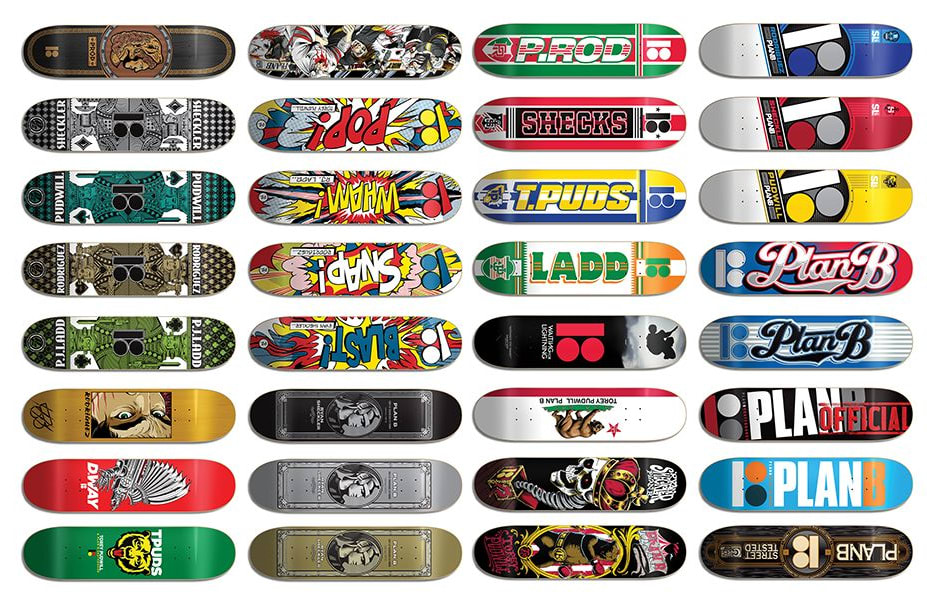
Plan B Skateboards
From: California. Founded in 1991 by Mike Ternasky, re-founded in 2005 by Danny Way and Colin McKay.
Why it matters: Plan B’s “Questionable” video (1992) is one of the most influential skate videos ever made. Re-founded with Way and McKay, it maintains a world-class team.
Team: Pat Duffy, Felipe Gustavo, Ryan Sheckler, Trevor McClung, Diego Najera.
Technology: the BLK ICE line (premium epoxy and fiber construction).
Price: $75-95.
Almost Skateboards
From: California. Founded in 2003 by Rodney Mullen (yes, that Rodney Mullen) and Daewon Song.
Why it matters: a brand with seriously proprietary technology. Their Über Light line (carbon fiber + maple) is one of the best pop-to-weight decks on the market. The Impact and Impact Plus lines add fiberglass discs at the truck mounting holes so the deck doesn’t snap on big ollie attempts.
Team: Daewon Song, Yuri Facchini, Cody McEntire.
Price: $75-100 (Über Light at the top end).
Toy Machine
From: California. Founded in 1993 by Ed Templeton.
Why it matters: immediately recognizable aesthetic (Templeton’s Toy Machine monster is a visual icon). A team of technical and creative skaters. Consistent mid-to-high quality 7-ply decks.
Team: Collin Provost, Leo Romero (a legend), Jeremy Leabres, Daniel Lutheran.
Price: $65-85.
Polar Skate Co.
From: Malmö, Sweden. Founded in 2011 by Pontus Alv.
Why it matters: the most influential European skate brand of the modern era. Handcrafted aesthetic, cinematic videos, a powerful international team. Polar changed the conversation around European skating in the 2010s.
Team: Hjalte Halberg, Aaron Herrington, Oskar Rozenberg, Roman Gonzales, Nick Boserio.
Who it’s for: the skater who values aesthetics and culture as much as the product itself. The vibe of Madrid, Barcelona, Paris.
Price: $80-100 (premium).
Magenta Skateboards
From: Bordeaux, France. Founded in 2010 by brothers Soy Panday and Vivien Feil.
Why it matters: Polar’s European cousin in terms of artistic aesthetic. Decks with alternative shapes (asymmetric, twin-tip, cruisers) and hand-painted graphics by the Pandays.
Team: Léo Valls, Jimmy Lannon, Glen Fox.
Who it’s for: skaters interested in unusual shapes, creative transition skating, an art/culture vibe.
Price: $80-95.
Birdhouse Skateboards
From: California. Founded in 1992 by Tony Hawk and Per Welinder.
Why it matters: Tony Hawk’s brand. It hasn’t just survived — it has maintained a professional-level team and a serious catalog for 30+ years.
Team: Tony Hawk (still active), Aaron “Jaws” Homoki, Clint Walker.
Price: $65-85.
Foundation Skateboards
From: California. Founded in 1989 by Tod Swank.
Why it matters: a classic California skate brand with no pretensions. Consistent catalog and always a solid team.
Team: Corey Glick, Cole Wilson, Aiden Campbell.
Price: $65-85.
Tier B: solid, but more niche or with a limited catalog
Valid brands with serious product, but a smaller catalog, more limited distribution or a very specific profile. If they match what you’re looking for, they’re great choices.
Sour Skateboards
From: Stockholm, Sweden. Founded by Erik Pettersson and skaters from the Polar circle.
Why it matters: minimalist aesthetic, legendary team photography, strong presence in the European scene. Culture stronger than the catalog.
Team: Albert Nyberg, Daniel Lebron, Simon Isaksson.
Price: $80-95.
DGK (Dirty Ghetto Kids)
From: Philadelphia / California. Founded in 2002 by Stevie Williams.
Why it matters: represents East Coast urban skate culture. Standard 7-ply decks, powerful graphics, strong connection to hip-hop culture.
Team: Josh Kalis, Stevie Williams, Marquise Henry.
Price: $60-80.
Cliché Skateboards
From: Lyon, France. Founded in 1997 by Jeremie Daclin.
Why it matters: the first European brand to break into the American mainstream. Closed in 2017 but re-launched in 2024 with a new catalog.
Historic team: Lucas Puig, JB Gillet, Andrew Brophy.
Price: $70-85.
Habitat Skateboards
From: Pennsylvania, USA. Founded in 2000.
Why it matters: nature, photography and art-inspired aesthetic. Shares visual DNA with Element but with a more niche catalog.
Price: $65-85.
Spanish and European brands worth knowing
European skating has had its own serious brands for 25 years. These are the ones every skater should know.
Jart Skateboards (Spain)
Origin: Barcelona, under the Boardriders umbrella (Quiksilver). Manufactured in the USA at PS Stix — the same factory that makes Plan B and Almost.
Why it matters: the Spanish skate brand with the most international pro team history. Has had Sergio Layos, Adrián Vega, Borja Conde and Diego Najera on board.
Price: $65-90.
Hydroponic (Spain)
Origin: Barcelona, founded in the ’90s.
Why it matters: a historic brand from the Barcelona scene. Wide catalog (decks, completes, clothing) focused on accessible pricing without dropping into junk territory.
Price: $55-80.
Imagine Skateboards (Spain)
Origin: Spain.
Why it matters: an independent Spanish skate brand with strong visual curation and European production. More niche than Jart but with a clear identity.
Price: $60-85.
Lurpiv (France)
Origin: Paris, founded in 2017.
Why it matters: one of the most interesting young European brands out there. Top French team, distinctive aesthetic, Parisian vibe.
Price: $75-90.
Polar (Sweden) and Magenta (France)
Already covered in Tier A — but worth underlining: the Polar–Magenta–Sour axis is the backbone of European auteur skating.
Brands with premium proprietary technology
If construction matters to you beyond the standard 7-ply, these are the options worth the extra cost.
Premium technologies worth knowing
Powell-Peralta Flight: epoxy construction with reinforced fiber. Lasts 3-4 times longer than a standard 7-ply and holds the concave intact for months. The one to get if you skate hard and go through decks regularly.
Element Featherlight: thin fiber layers inside the traditional 7-ply. Reduces weight by ~15% without losing stiffness. Livelier pop. Good price-to-technology balance.
Element Helium: microscopic air chambers inside the wood. The lightest brand-name deck on the market right now. Most recent technology (2018+).
Almost Über Light: maple + carbon fiber. Exceptional pop, very low weight. More expensive, but the feel is noticeably different from a standard 7-ply.
Almost Impact / Impact Plus: fiberglass discs reinforcing the truck hole area. The least likely to snap when you miss big ollies.
Santa Cruz VX: premium construction with fiber layers between maple plies. More durable than a standard 7-ply.
Santa Cruz Powerply: extra fiber layer on top and bottom. Faster pop and better delamination resistance.
For beginners: brands that deliver quality without killing your budget
Getting into skating is expensive. Deck, skateboard trucks, skateboard wheels, bearings, grip tape, shoes, helmet, pads… a full setup easily runs $150-200. Here are the brands that give you real quality without breaking the bank.
Mini Logo (the smart choice)
Who makes it: Powell-Peralta. It’s their low-cost sub-brand — same factory, same presses, same 7-ply Canadian maple. What’s different: no elaborate graphics and no assigned pro team.
Why it matters: it’s the best value for money on the market. A Mini Logo deck is essentially a Powell without the big logo.
Price: $45-60. Hard to beat.
Who it’s for: any beginner with their head screwed on, or an experienced skater who wants a daily-use deck without paying for graphics.
Enuff Skateboards (UK)
Origin: United Kingdom. A European brand designed for beginners.
Why it matters: wide catalog of complete setups (deck + trucks + wheels + bearings, pre-assembled) for $85-130, with reasonable entry-level quality. Not a Powell, but several steps above junk.
Price: loose decks $40-55, completes $85-130.
Tony Hawk Signature Series
Origin: licensed line under the Birdhouse umbrella, aimed at beginners.
Why it matters: completes for gifts or first setups. Mid-range quality (not comparable to Birdhouse pro decks), but validated — not junk.
Price: completes $75-115.
Brands to avoid
Not everything sold as “skate” actually is. Here are the red flags:
- Complete setups under $50 from discount stores, supermarkets or generic e-commerce. Low-quality wood (poplar, Chinese maple), soft trucks that bend on the first ollie, bearings that last weeks.
- Brands with no verifiable pro team. If you can’t find videos of real skaters riding that brand on YouTube or Instagram, don’t buy it.
- Counterfeits of top brands. Element, Santa Cruz and Powell are the most faked. If you see an “Element” deck for $25 on a marketplace, it’s fake — and the wood is not premium 7-ply Canadian maple; it’s a Chinese generic with a copied graphic.
- House brands from big sports chains. Some are passable for absolute beginners, but we wouldn’t recommend them to anyone who actually wants to progress — stick with Mini Logo at a similar price point.
Summary table by tier
| Tier | Brand | Origin | Price range | Vibe |
|---|---|---|---|---|
| S | Powell-Peralta | USA (1978) | $70-95 | Heritage + Flight technology |
| S | Santa Cruz | USA (1973) | $65-90 | Bowl, vert, iconic graphics |
| S | Element | USA (1992) | $65-100 | All-round + Featherlight/Helium tech |
| S | Real | USA (1991) | $70-90 | Pure street, skater for skater |
| S | Anti-Hero | USA (1995) | $70-85 | Punk, raw, grimy pools |
| S | Vans | USA (decks 2018) | $70-90 | Cohesive with footwear, top team |
| A | Plan B | USA (1991) | $75-95 | Competitive elite |
| A | Almost | USA (2003) | $75-100 | Technology (Über Light, Impact) |
| A | Toy Machine | USA (1993) | $65-85 | Templeton aesthetic |
| A | Polar | Sweden (2011) | $80-100 | European culture |
| A | Magenta | France (2010) | $80-95 | Art, alternative shapes |
| A | Birdhouse | USA (1992) | $65-85 | Tony Hawk, reliable |
| A | Foundation | USA (1989) | $65-85 | Classic Californian |
| B | Sour | Sweden | $80-95 | European minimalist vibe |
| B | DGK | USA (2002) | $60-80 | East Coast urban culture |
| B | Cliché | France (re-launched 2024) | $70-85 | Historic French skate |
| B | Habitat | USA (2000) | $65-85 | Nature aesthetic |
| ES/EU | Jart | Spain (PS Stix USA) | $65-90 | Top Spanish brand, international team |
| ES/EU | Hydroponic | Spain | $55-80 | Accessible, Barcelona scene |
| ES/EU | Imagine | Spain | $60-85 | Independent with identity |
| ES/EU | Lurpiv | France (2017) | $75-90 | Young European auteur brand |
| Beginner | Mini Logo | USA (Powell) | $45-60 | Powell quality, no graphics |
| Beginner | Enuff | UK | $40-55 deck | European beginner option |
Where to start based on budget and level
You have $45-60 and want the best for that price: Mini Logo. No debate.
You have $65-80 and want a real brand: Element Section, Santa Cruz Classic Dot, Powell-Peralta classic, Toy Machine, DGK. Any of these will give you years of use.
You have $80-100 and want premium: Powell Flight, Element Featherlight, Almost Über Light, Polar, Magenta, Sour. At this level the construction detail and durability step up another notch.
You skate hard and go through decks fast: Powell-Peralta Flight or Almost Impact Plus. An investment that pays itself back.
Culture matters as much as the product: Polar, Magenta, Sour, Real, Anti-Hero, Lurpiv. Brands with their own identity beyond the catalog.
You want to support a Spanish or European brand: Jart (Spanish skate brand), Hydroponic (Spanish skate brand), Imagine (Spanish skate brand), Polar, Magenta, Lurpiv.
You’re an absolute beginner and not sure where to start: go to a real skate shop (not a generic sports chain) and tell the staff your budget. They know what they’re talking about. Buy a real-brand deck, Independent or Thunder trucks, Spitfire wheels, Bones Reds bearings. All of that for $140-170 will last you years.
Keep reading
- Full skate brand directory — detailed profiles of each brand with team, technologies and catalog.
- Element Skateboards: brand profile — everything about Element, its history and catalog.
- Powell-Peralta: brand profile — the brand with the deepest heritage in skating.
- Santa Cruz Skateboards: brand profile — since 1973, the oldest brand still active.
- Spanish skate brands — the Spanish scene in detail.
- Skateboard deck size calculator — find the right width for your height, shoe size and style.
- How much does a complete skateboard cost — real price breakdown by component.
Conversation
Your name will be public. Your email stays private. Comments are reviewed before publishing.