
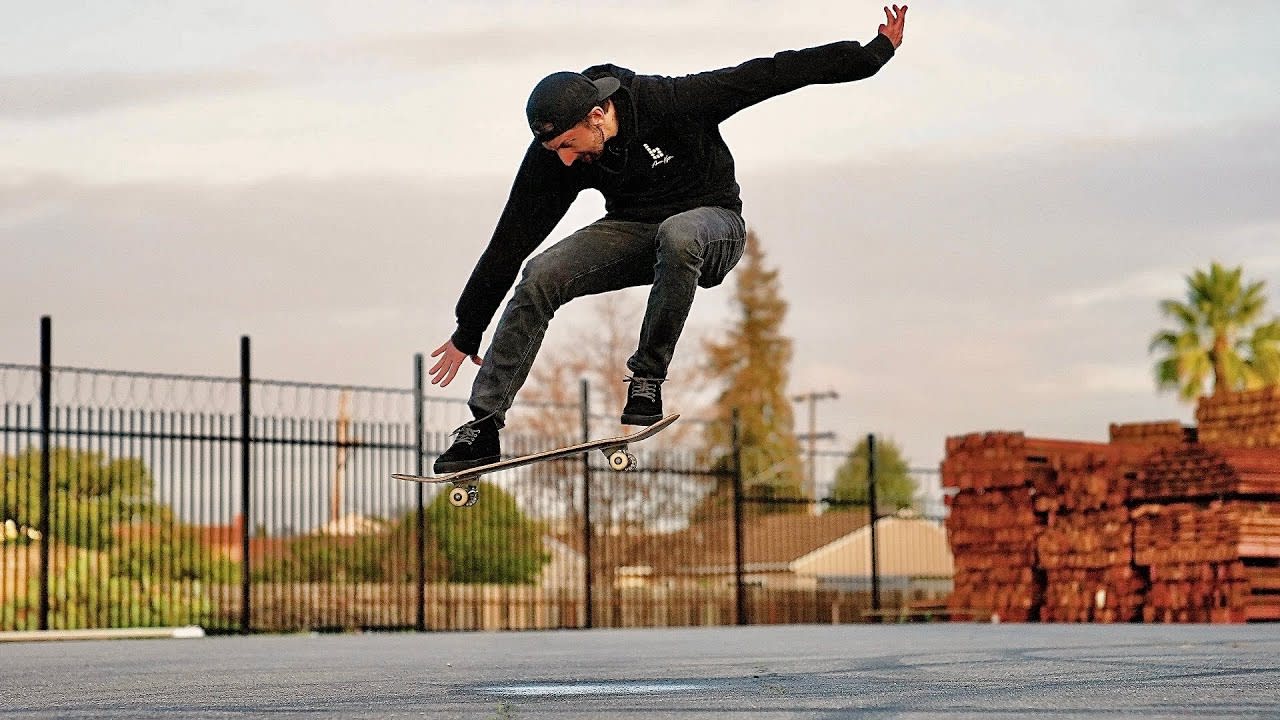
If you could only learn one trick in your life, it should be the ollie. Invented by Alan Gelfand in 1978, it’s the trick that changed skateboarding forever — before the ollie, you couldn’t jump anything with your board. Today it’s the foundation of every single other trick: kickflips, heelflips, grinds, slides… they all start with an ollie.
Despite being the base trick, it’s one of the hardest to land. Not because it’s overly complex, but because you’re trying it when your overall skate level is still very basic. The good news: putting in 30 minutes a day for 2-3 weeks, you’ll probably get your first ollie. The less good news: a high, clean, consistent ollie takes years of daily practice. But the first one is what counts.
What you need before you start
- A skateboard deck (anything works, 7.75-8.0 with medium concave is ideal).
- Skate shoes or flat-soled sneakers (Vans, Converse, Nike SB). NEVER running shoes — they’ll adapt technically, but more importantly, you’ll destroy them.
- A flat, clean surface (hard ground). Smooth asphalt or concrete.
- A helmet and pads if you’re a complete beginner. Your first ollie fall won’t kill you, but if your level is very basic, they’ll save you some pain.
Foot position
This is the foundation of the whole ollie:
- Back foot: on the tail, with the ball of your foot right on the tip of the kicktail. Toes almost hanging off the edge. That foot is going to do the snap that launches the board.
- Front foot: in the middle of the board, slightly diagonal (45° to the board’s axis). The outer edge of your foot near the rail of the board. That foot is going to do the drag that brings the nose up.
The distance between your feet matters: too close together and you have no leverage; too far apart and you lose control. As a reference: each foot’s position should be roughly 30-40 cm apart.
The mechanics in 4 phases
The ollie is a sequence of movements that happens in under half a second. You have to break it down to understand it:
Phase 1: the snap (tail pop)
You jump upward while snapping your back foot DOWN hard against the tail. The board pivots: the tail hits the ground and the nose rises. This is NOT a vertical jump — it’s a downward strike with your back foot.
Phase 2: the drag (front foot slide)
While the board is pivoting upward, you slide your front foot from its original position toward the nose. The outer edge of your shoe “scrapes” the grip tape. This drag lifts the nose and levels the board out in the air.
Phase 3: the flight
At the peak, both feet and the board are in the air. The board is level (no longer pivoting). You have to keep your feet “locked” to the board — if you separate from it, the board drops to the ground and you go somewhere else.
Phase 4: the landing
You land with BOTH feet over the BOLTS of the skateboard trucks (not over the center of the board). Knees bent to absorb the impact. The board rolls forward.
The 5 most common mistakes (and how to fix them)
1. “The board stays on the ground”
Cause: you’re jumping with both feet at the same time instead of snapping the tail first.
Fix: practice the snap on its own (without the full jump). Place your back foot on the tail and pop it down sharply WITHOUT moving your front foot. Watch the board rock like a lever. That’s the snap.
2. “The board pops but spins in the air”
Cause: your back foot isn’t centered on the tail — it’s off to one side.
Fix: check your position. Ball of the foot in the center of the tail, toes aligned with the board’s axis.
3. “I jump but can’t level the board out”
Cause: you’re not doing the drag with your front foot. You’re only popping the tail.
Fix: practice the drag on its own. Without jumping, slide your front foot from its position toward the nose, scraping the grip tape. Get that feeling into muscle memory.
4. “I land and fall forward”
Cause: you’re landing with all your weight on your back foot.
Fix: think about landing with BOTH feet at the same time. Knees bent, not locked. Center of gravity over the center of the board.
5. “The nose hits my shin”
Cause: you’re not extending your front leg enough during the drag, so the nose clips your shin on the way up.
Fix: at the moment of the jump, your front knee needs to extend outward to move your shin away from the nose’s path.
How to get more height (keep progressing)
Once you’ve got the basic ollie (~10 cm), here’s how to go higher:
- Snap harder: your back foot hits the tail with more speed. More tail speed = more height.
- Drag further: your front foot reaches all the way to the nose, not halfway up the board.
- Jump higher with your body: your own jump adds height (the 30 cm Tony Hawk gets isn’t just the board — it’s his whole body lifting the setup).
- Practice over small obstacles: a piece of paper, a broomstick, a curb. The mental block breaks the moment you start clearing things.
What’s next after the ollie
Once you’re landing consistent ollies at 15-20 cm, you’re ready for the next tricks in order of increasing difficulty:
- Pop shove it (the board rotates 180° underneath you).
- Frontside / Backside 180 (YOU rotate 180°).
- Kickflip (the board flips horizontally).
- Heelflip (the board flips the opposite way to a kickflip).
Every one of these tricks is a variation of the ollie’s mechanics. That’s why the ollie is the best investment you’ll ever make in your skate life.
Where to go next
- More tutorials: How to get moving on a skateboard · Goofy or regular: how to know.
- Gear: How to choose your first skateboard deck · Size calculator.
- Once you’ve got your ollie: Clean your bearings so your board rolls faster.
Conversation
Your name will be public. Your email stays private. Comments are reviewed before publishing.