
Modern skating has been built on moments: specific tricks that changed what anyone thought was possible. When Tony Hawk landed the first 900 at the 1999 X Games, every pro in the world raised the bar on what they were aiming for. When Tom Schaar pulled the first 1080 in 2012, same thing — different scale. Here are some of the most legendary tricks in skate history. This isn’t a ranking and there’s no particular order. The point is to spotlight the tricks that built what skating is today.
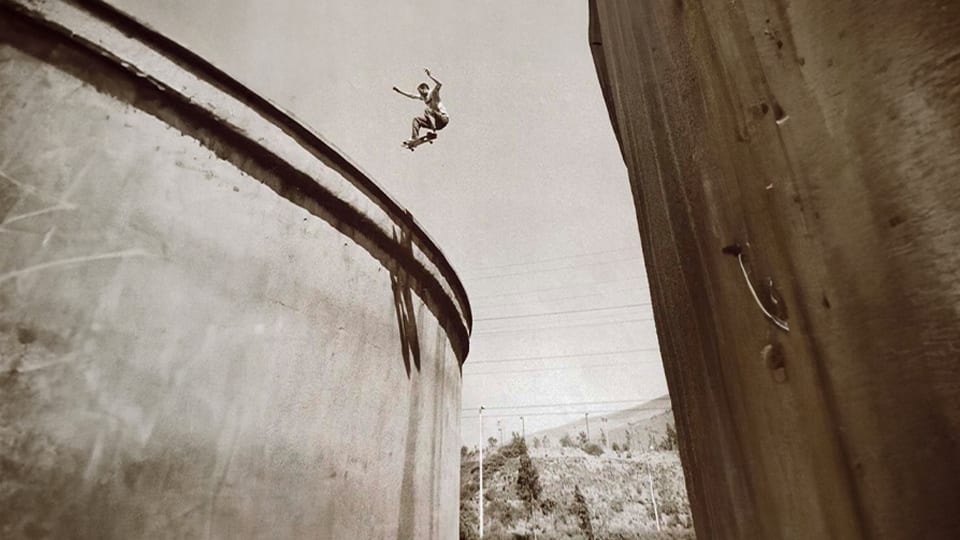
Jeremy Wray — Water Tower Ollie (1997)
Probably the most legendary ollie ever done. Wray ollied between two water towers, separated by more than 5 meters of open air and sitting over 15 meters off the ground. If he missed, the best-case scenario was a hospital trip.
He landed it on his 5th attempt. The photo ran as a Thrasher cover and it’s still one of the defining images in skating. A trick that combined technical skill with serious nerve — something modern skating has partly lost.
Watch the trick and a short documentary on it below.
Tony Hawk — The 900 (1999)
Two and a half rotations (900°) above a half-pipe. The trick Hawk chased for years, which he landed live at the 1999 X Games after dozens of failed attempts in the final session — sending the crowd completely mental.
Why it matters: up to that point, people genuinely debated whether it was physically possible. Hawk proved it was. After the 900, the ceiling in vert skating went up, and the door opened for the 1080 that would come 13 years later.
No question — one of the most iconic moments in skating.
Tony Hawk — The Loop (2001)
Hawk completed a full vertical loop — closed, like a roller-coaster loop — filmed for MTV’s Jackass alongside Mat Hoffman. It was the first time any skater had made it through an entire loop.
More of a spectacle than a technical trick, but it shifted the mental model of what’s possible on a board.
Paul Rodriguez — Switch 360 Flip, Santa Monica Triple Set (2001)
Another iconic Santa Monica gap, tamed by Paul Rodriguez with an incredible switch 360 flip.
Chris Cole — 360 Flip Wallenberg (2003)
Wallenberg in San Francisco is one of the most famous 4-stair sets in skating — not because of the stair count, but because of the size of the gap. Before Cole, nobody had landed a 360 flip there.
Cole did it. 66 attempts. His process video became one of the defining “consecration” moments of modern technical street skating. It showed the real cost of an iconic trick: pain, frustration, and eventually, the make.
Watch every single attempt below.
Bob Burnquist — The Loop of Death (2003)
A variation on Hawk’s loop, but with no top section — just the lower half of the circle with a drop into nothing instead of a closed ceiling. Far more dangerous and difficult than the original, because if you fell off, there was no structure to catch you.
Burnquist (Brazilian-American) completed it at his private ramp and opened up the line of “impossible loops” that a handful of others have attempted since.
The video quality isn’t great, but it’s enough to get a feel for how insane this was.
Bob Burnquist — Fakie to Fakie 900
Burnquist, one of the greatest mega-ramp skaters on the planet, served up this monster of a fakie to fakie 900 — the first person in the world to ever land it.
Danny Way — Great Wall of China (2005)
The most cinematic trick in skate history. Way built a mega-ramp at the Great Wall of China (around $5 million budget) and jumped clean over the wall.
The epic part: he broke his ankle on the first attempt. He went back up, took the jump, and landed a backside 360 rolling away with a broken ankle. The landing photo is one of the most iconic images skating has ever produced.
Dave Bachinski — Kickflip El Toro (2006)
El Toro Stairs is a 20-stair set in Lake Forest, California. Before 2006, nobody had put a flip trick down El Toro. The drop was considered too big.
Bachinski landed the first clean kickflip. Dozens have followed since, but he was first. A turning point in what’s considered “landable” in street skating.
Neen Williams — Heelflip Burbank 16 (2011)
Burbank 16 is a 16-stair set — big, but not extreme — in California. Neen Williams landed a heelflip with a perfect catch at the peak of the jump — the board was rotating underneath him right when he was directly above the stairs, not before, not after.
Why it matters: a perfect technical catch is what separates a skateboard trick from a trick that “just comes out”. The photograph from that moment is considered one of the cleanest ever captured.
Danny Way — Helicopter Drop-In (2012)
Way (again) jumped from a moving helicopter onto a 30-foot (9-meter) ramp and rolled away in control. Transworld cover.
Tom Schaar — 1080 (2012)
Three full rotations in the air (1080°). Tom Schaar landed it in March 2012 on Bob Burnquist’s mega-ramp in Tehachapi, California. He was 12 years old.
13 years after Hawk’s 900, the ceiling went up another 180°. And a 12-year-old kid raised it, proving the barrier had been more mental than physical all along.
Jaws vs the Lyon 25 (2015)
One of the most brutal things ever done on a skateboard.
The Lyon 25 is one of the biggest — if not the biggest — stair sets ever conquered. Back in 2002, Ali Boulala tried it multiple times and walked away. Then in 2014, Aaron “Jaws” Homoki decided to go for it, got hurt on the first attempt and spent six months recovering.
That didn’t put him off. In 2015 he flew back to France to finish the job, even bringing Boulala along as an advisor. After several attempts where he put his body on the line every single time, he finally stomped it — one of the most respected moments in skate history, and to this day one of the hard physical limits when it comes to stair sets.
Rodney Mullen
Not one specific trick, but you can’t talk about the greatest tricks in history without Rodney making the list.
Just watch.
Where to go next?
- How to land your first ollie — the trick that opens every other door.
- The most influential skaters in history — the names behind everything on this list.
- How to choose your first skateboard deck — the right setup matters.
- Goofy or regular: how to tell.
Conversation
Your name will be public. Your email stays private. Comments are reviewed before publishing.