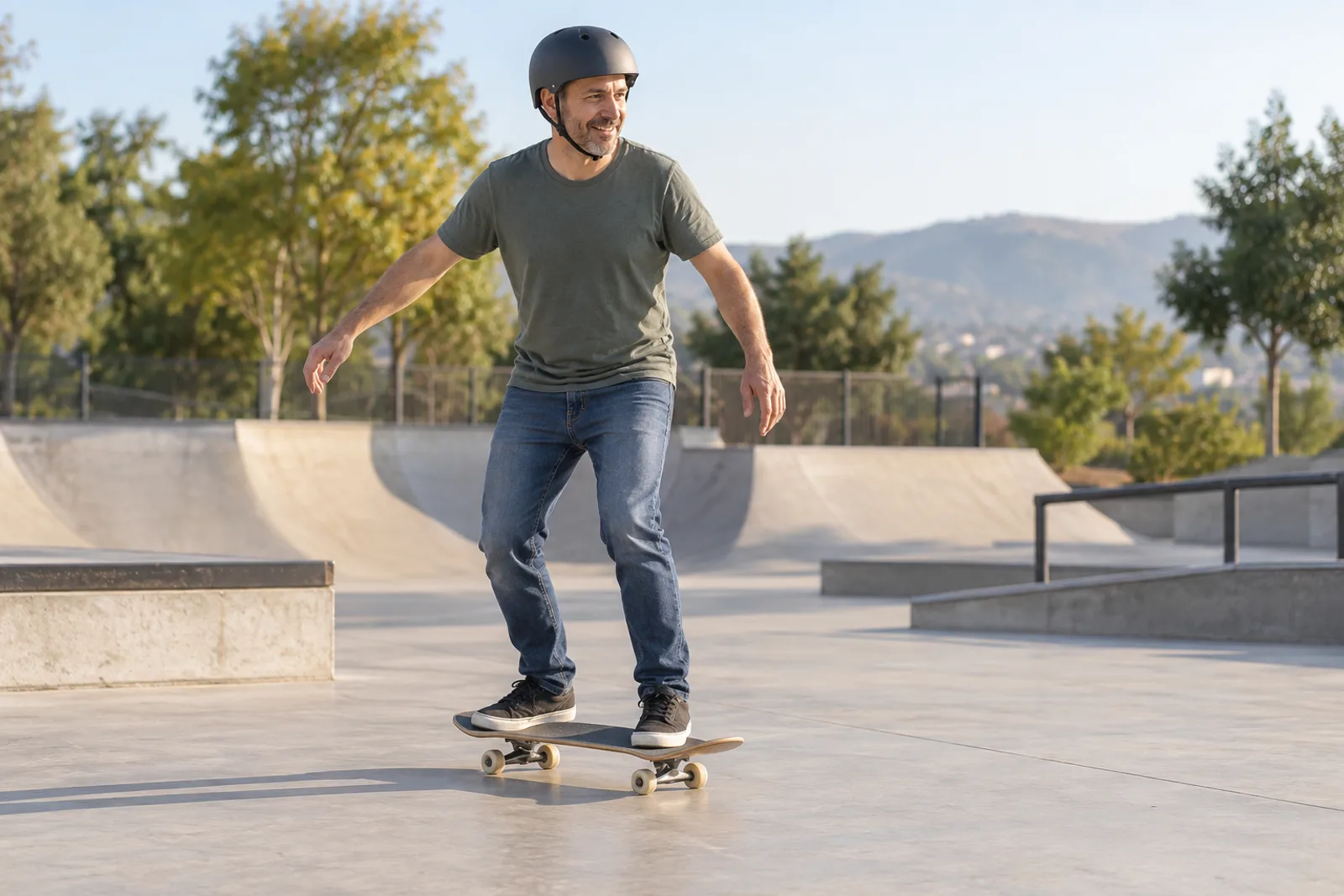
If you have made it here, it is because something has been nagging you for a while: “I want to try skateboarding, but I’m too old”. Or worse: “I skated twenty years ago, I’d love to come back, but I probably can’t anymore”. Let’s get that noise out of the way in the first minute. You are not too old. Not at 30, not at 40, not at 50.
This is not a generic motivational pamphlet. It is the guide we would have liked to read when a 42-year-old friend asks us “hey, where do I start?”.
The age myth: why it’s broken
The myth says skateboarding is for teenagers and that after 30 you will break your hip trying an ollie. The reality is different. Tony Hawk still skates vert at over 55. Steve Caballero, Lance Mountain, Christian Hosoi, Andy Anderson… The list of professionals in their 40s and 50s who still skate hard is endless.
But the most interesting part isn’t the pros. It is the thousands of anonymous people who started or came back in recent years and have built a whole ecosystem: the Old Man Army, the Old Man Skate Crew, Instagram accounts like Skate Mama or Skater Moms, Facebook groups with thousands of members where the average age is 38.
Veteran skaters repeat two sayings:
“You don’t stop skating because you get old. You get old because you stop skating.”
“The only bad skater is the one sitting on the bench watching.”
Why adults are starting now
Adult skateboarding is not a passing fad. Three factors have driven it over the last five years:
1. The post-pandemic effect. When gyms closed and people looked for outdoor, solo, cheap activities, skateboarding and longboarding took off.
2. Entry into the Olympic Games (Tokyo 2020, Paris 2024, LA 2028). Skateboarding stopped being “a rebellious kids’ thing” and became a legitimate sport.
3. The quiet adult mental health crisis. There are serious studies documenting how skateboarding reduces stress, anxiety and isolation. For many adults it isn’t a whim: it is a way of looking after their head that works better than running or the gym.
Starting as an adult vs as a kid: the real differences
What works against you as an adult:
- Slower recovery. A hard fall that a kid forgets in two days stays with you for a week.
- More fear. Your brain has learned to calculate consequences.
- Lower bone density from around 35-40.
- Less free time.
- A stiffer body.
What works in your favour:
- Your head. You can read a situation and assess risk.
- Discipline. If you decide to train 3 days a week, you go.
- Money. You can buy a decent complete setup.
- Mental patience. You know that worthwhile things take months.
- No schoolyard ego.
What type of skateboard suits an adult best?
Before you buy anything, read our article on the different types of skateboards to get the full map.
If your goal is to get around, enjoy yourself and lower your stress (most people): Start with a cruiser or a longboard. They are more stable, more forgiving, and have big soft wheels that swallow bumps.
If your goal is to learn tricks (street, park, mini ramp): Go straight to a standard popsicle, but somewhat wider than what a kid would be advised.
If your goal is cardio plus downhill (downhill, freeride): A purpose-built longboard. Read the complete longboard buying guide.
If your goal is pure urban transport: A small cruiser like a Penny, or an 8” setup with soft wheels like OJ Super Juice 78A.
How to choose the ideal setup for an adult
Wider than you think, wheels softer than they’ll tell you, and trucks slightly looser at the start.
Board width. For an adult beginner, the comfortable range is 8.25” to 8.75”. Wider means more stability. If you have big feet (EU 45+), don’t go below 8.5”.
Wheels:
- Cruiser/transport: 78A-85A, 60-66 mm.
- Mixed (street + park): 92A-95A, 54-56 mm.
- Pure park/bowl: 97A-99A, 54-58 mm.
Trucks. To start, medium bushings and slightly loose.
Bearings. Bones Reds (about 16€) are the absolute standard for value.
Protection: non-negotiable for adults
The minimum kit to start:
- Certified helmet. Triple 8, ProTec Classic, S1 Lifer. 30-60€.
- Wrist guards. Triple 8, 187 Killer Pads. 20-30€.
- Knee pads. Essential if you go to a park.
- Elbow pads. For park and transition, yes.
Optional but recommended extras:
- Impact shorts with padding on the hips and tailbone.
- Proper skate shoes (vulcanized sole or reinforced cupsole).
Learning curve: what to expect month by month
We assume 2-3 sessions a week of 45-90 minutes.
Weeks 1-2: balance and push. Getting on, finding your stance, pushing, braking by dragging your foot.
Weeks 3-4: turns and control. Carving, tic-tacs, braking with some confidence.
Month 2: mixed terrain. You can already get around the city.
Months 3-6: kickturn, manuals, first basic tricks. The ollie takes between 1 and 6 months.
Months 6-12: your identity as a skater. By now you know what you like.
Skateparks suitable for adult beginners
What to look for on your first visits:
- Smooth ground (preferably polished concrete).
- A large flat area.
- Bowls and progressive ramps.
- Quiet hours.
To find parks near you, use our skatepark directory.
Basic park etiquette:
- Watch the session for 5 minutes before dropping in.
- One person in the bowl or on the line at a time.
- If you fall, get up quickly.
- Say hi. The skate community is friendlier than it looks.
Community: where to find your people
On Instagram and social media:
- @oldmanarmy and spin-offs: the mother of all older-skater communities.
- @skatemama, @skater.moms: very active collectives of skater mothers.
- Hashtags:
#oldmanarmy,#oldmanskate,#skateover40,#skateover50.
Local groups:
- Search Facebook for “adult skaters [your city]” or “skate over 30”.
- Ask at your local skate shop.
If you’re afraid: mental strategies that work
1. Identify the specific fear. “I’m scared” is vague. “I’m scared of falling backwards” is something you can work on.
2. Practise falling. On grass or a mat, rehearse falling to the sides.
3. Micro-progression. Break the goal into small steps.
4. Visualisation. Close your eyes for 30 seconds and “see” your body doing the movement perfectly.
5. Good days and bad days. If a session isn’t flowing, stop.
Documented physical and mental benefits
Physical:
- Moderate cardiovascular work.
- Strengthening of the core, glutes, quadriceps and calves.
- Noticeable improvement in proprioception and balance.
Mental:
- Measurable reduction in stress and anxiety.
- A “flow” state during the session.
- Boost to self-confidence through progressive achievement.
To go deeper, read our article on the benefits of skateboarding.
Skaters who started late (or never stopped)
- Neal Unger, “The Dude”. Started close to 60. Now over 65 and still ripping bowls.
- Tony Hawk is still active beyond 55.
- Andy Anderson, Steve Caballero, Lance Mountain, Christian Hosoi: all over 50, all still skating.
- Dale Decker and many other veteran bowl riders.
- And the anonymous army of the Old Man Army.
Closing: the time is now
Skateboarding doesn’t ask for permission or ID. It doesn’t ask whether you have kids, a mortgage or a boring job. All it asks is that you get on the board, fall a few times and get back on.
If you hesitated while reading this, don’t hesitate any longer. Get your setup, put on your helmet, find a smooth car park and push. The first day will feel ridiculous. The second, fun. By the third, you won’t be able to stop.
Welcome to the Old Man Army. Welcome to the Skate Mama Crew.
Conversation
Your name will be public. Your email stays private. Comments are reviewed before publishing.