There was a time, somewhere in the 90s, when saying “skateboarding is going to be Olympic” would have earned you a look of contempt in any skatepark in the world. It was the opposite of what getting on a board meant: no judges, no federations, no flags, no “athletes”. Skateboarding belonged to the people who skated it, not to the IOC.
And yet here we are. Tokyo 2020. Paris 2024. Los Angeles 2028. Three editions in a row with skateboarding on the programme, 12-year-old medallists on the podium, audiences in the millions and a conversation the community still hasn’t closed: is this good for skateboarding, or is it slowly killing it from the inside? Let’s take it step by step.
How skateboarding got to the Olympic Games
The idea of putting skateboarding in the Olympics had been going around since the early 2000s, but it wasn’t until September 2015 that the International Olympic Committee (IOC) put it on a shortlist of five new sports for Tokyo: skateboarding, surf, climbing, karate and baseball/softball. Final approval came on 3 August 2016, at the IOC’s 129th session in Rio.
Behind the process, two federations were fighting for control: the ISF (International Skateboarding Federation) and FIRS (later renamed World Skate). In the end, the IOC chose World Skate as the official governing body. That decision wasn’t trivial: World Skate came from the roller sports world (inline hockey, artistic skating, roller derby), and many historic skaters didn’t like seeing their sport administered by people “from quad skates”.
Heading the new World Skate Skateboarding Commission was, among others, Gary Ream, owner of the Camp Woodward skate camps in the USA, and an international judging programme was designed to unify criteria. The Spaniard Danny Lozano took part in developing the rulebook, which partly explains the constant presence of Spanish-speaking judges at later events.
Olympic disciplines: street and park
The Olympic programme includes two disciplines, each with a men’s and a women’s category. In total: four events, twelve medals per edition.
Street
Olympic street is a “plaza” style course of about 60 × 30 metres with typical urban skating elements: stairs with 5 to 10 steps, rails (long, short, kinked), benches, hubbas, ledges and gaps. The idea is for the setting to imitate the real street without being it, because doing it in a public plaza would be logistically impossible.
Each skater gets:
- Two runs of 45 seconds each: long lines, linking obstacles.
- Five best tricks: a single attempt per trick, normally on the most impressive obstacle of the course (the big stair, the main rail).
The final score is the sum of the two best results out of the seven attempts (runs plus best tricks). This rewards consistency: landing one huge trick isn’t enough if you fall on everything else.
Park
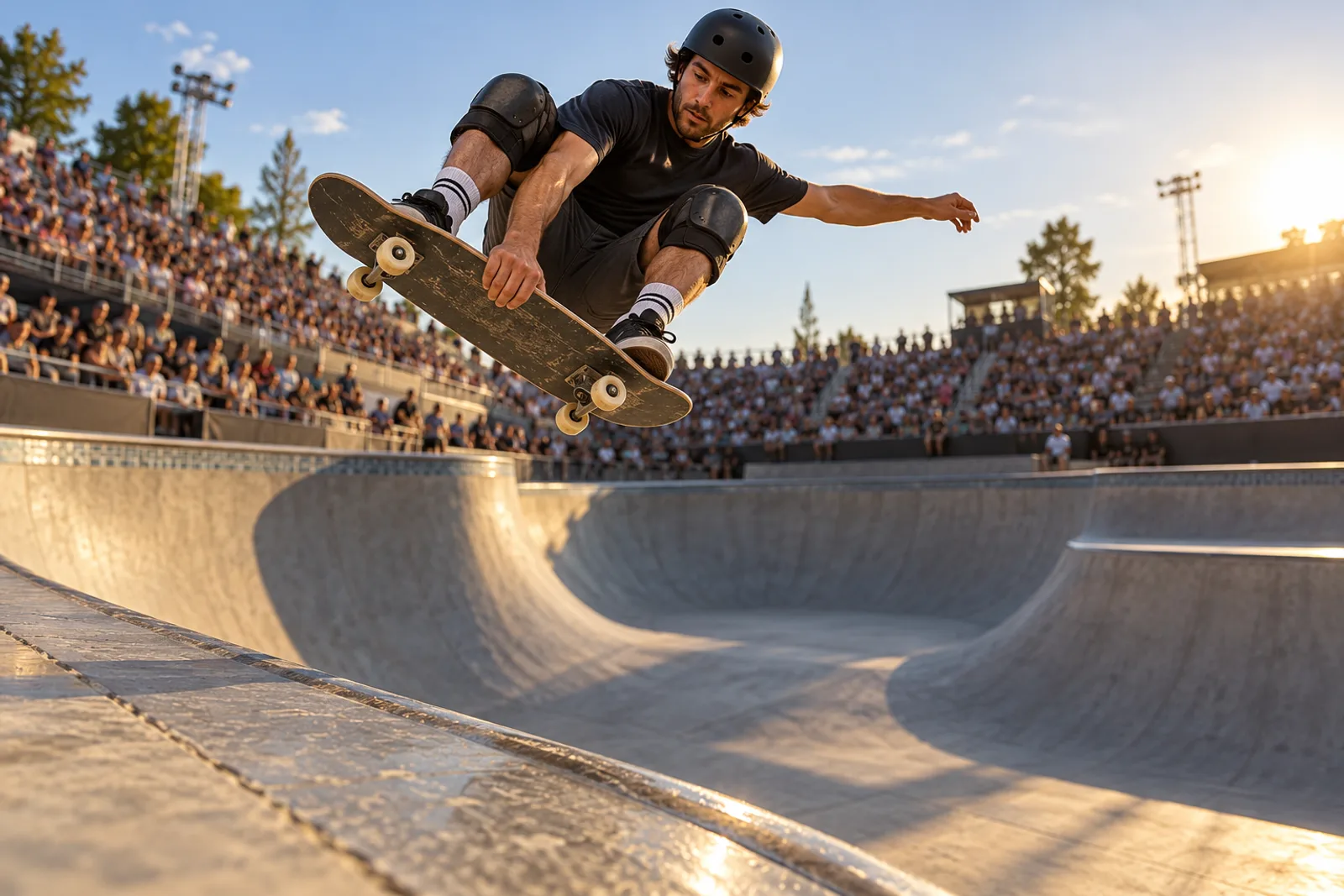
Olympic park is a continuous concrete bowl, not a public park but a designed piece, with curves, transitions, vertical walls and obstacles like spines or roll-ins. It is skated like a classic 70s-80s pool, but with the geometry tuned to allow huge aerials.
Each skater does three runs of 45 seconds and keeps the best one. There are no best tricks here; it is all flow, height and combinations.
Scoring system
The judges (five per panel, the highest and lowest scores are dropped and the three remaining are averaged) score from 0 to 100 in park, and from 0 to 10 in street (with a final total that can reach around 50 points).
There are six official criteria:
- Difficulty (technical difficulty of the trick).
- Originality / variety (not repeating the same trick all the time).
- Execution (cleanness: the landing, grinds well lined up).
- Speed (more speed, more points).
- Use of course (do you use all the obstacles or stay in one corner?).
- Flow / consistency (the line flows, without hesitation).
In practice, the judges are experienced skaters: ex-pros, Street League judges, people who know what they are looking at. But as always with subjective scoring, there is controversy: at Tokyo there was a lot of discussion about a fall by Nyjah Huston that dragged his score down further than seemed reasonable, and in Paris there were park runs that were “technically cleaner but less spectacular” and ended up lower.
Tokyo 2020: the baptism (and the American shock)
Postponed a year by the pandemic, the Tokyo Games were held in July-August 2021 at the Aomi Urban Sports Park, a temporary venue built next to Tokyo Bay and designed by CA Skateparks, the same people behind the Vans Park Series. A world-class course, in a city that has been into skateboarding since the 90s.
Men’s street, 25 July 2021
| Position | Skater | Country | Points |
|---|---|---|---|
| Gold | Yuto Horigome | Japan | 37.18 |
| Silver | Kelvin Hoefler | Brazil | 36.15 |
| Bronze | Jagger Eaton | USA | 35.35 |
That the first gold in the history of Olympic skateboarding went to Yuto Horigome, a Tokyo native and a taxi driver’s son, in his own city, was probably the perfect script. Nyjah Huston, the dominant figure on the SLS circuit for a decade, finished seventh after falling on four best tricks in a row. His face said it all: Olympic pressure was not the kind of pressure he was used to.
Women’s street, 26 July 2021
| Position | Skater | Country | Age | Points |
|---|---|---|---|---|
| Gold | Momiji Nishiya | Japan | 13 | 15.26 |
| Silver | Rayssa Leal | Brazil | 13 | 14.64 |
| Bronze | Funa Nakayama | Japan | 16 | 14.49 |
The youngest podium in recent Olympic history. Momiji Nishiya landed the last best trick to take the gold from the Brazilian Rayssa Leal, “Fadinha”, who had been a world star since she was 7 (her video doing a heelflip dressed as a fairy went viral in 2015 after a tweet from Tony Hawk). That final was when many people understood for the first time that women’s skateboarding was in another dimension.
Men’s park, 5 August 2021
| Position | Skater | Country | Points |
|---|---|---|---|
| Gold | Keegan Palmer | Australia | 95.83 |
| Silver | Pedro Barros | Brazil | 86.14 |
| Bronze | Cory Juneau | USA | 84.13 |
Keegan Palmer put down probably the most impressive run of the whole event: 540 stalefish, frontside ollie more than 4 metres above the coping, kickflip indy, alley oop. A 95.83 that made it clear that Australia leads in park. Pedro Barros, the Brazilian bowl legend, settled for silver after fighting for that title his whole career.
Women’s park, 4 August 2021
| Position | Skater | Country | Age | Points |
|---|---|---|---|---|
| Gold | Sakura Yosozumi | Japan | 19 | 60.09 |
| Silver | Kokona Hiraki | Japan | 12 | 59.04 |
| Bronze | Sky Brown | United Kingdom | 13 | 56.47 |
Yes: 19, 13 and 12 years old, an average of 14.6. Kokona Hiraki became Japan’s youngest female Olympic medallist in 85 years. Sky Brown, half Japanese and half English and raised in Miyazaki, won bronze a year after fracturing her skull in a practice fall in California. Her story went so viral that the bronze almost seemed to be for her courage rather than her skating, although the skating was also gold-level.
Paris 2024: consolidation (and Japanese confirmation)
The venue was La Concorde, in the centre of Paris next to the obelisk. Visually, one of the most powerful images skateboarding has produced in a long time: kids landing heelflips with the Eiffel Tower in the background. What was an experiment in Tokyo was already an established event in Paris, with streaming audiences higher than baseball or water polo.
Men’s street, 29 July 2024
| Position | Skater | Country |
|---|---|---|
| Gold | Yuto Horigome | Japan |
| Silver | Jagger Eaton | USA |
| Bronze | Nyjah Huston | USA |
Horigome won gold again. He did it with a nollie 270 noseslide bigspin out landed on his last attempt, when he was in fifth. It was probably the most complicated trick ever seen in an Olympic street final. Nyjah Huston made up for his seventh place in Tokyo with a fair bronze, and Jagger Eaton consolidated his Olympic career with a second medal.
Women’s street, 28 July 2024
| Position | Skater | Country | Age |
|---|---|---|---|
| Gold | Coco Yoshizawa | Japan | 14 |
| Silver | Liz Akama | Japan | 15 |
| Bronze | Rayssa Leal | Brazil | 16 |
A Japanese one-two with two teenagers unknown to the general public. Rayssa Leal added her second Olympic medal at 16, which makes her the most decorated Latin American skater in history.
Men’s park, 7 August 2024
| Position | Skater | Country |
|---|---|---|
| Gold | Keegan Palmer | Australia |
| Silver | Tom Schaar | USA |
| Bronze | Augusto Akio | Brazil |
Palmer also won gold again, confirming he is the dominant figure of modern park. Tom Schaar, who in 2012 became the first skater to land a 1080, at 12 years old, finally got his Olympic reward.
Women’s park, 6 August 2024
| Position | Skater | Country | Age | Points |
|---|---|---|---|---|
| Gold | Arisa Trew | Australia | 14 | 93.18 |
| Silver | Kokona Hiraki | Japan | 15 | 92.63 |
| Bronze | Sky Brown | United Kingdom | 16 | 92.31 |
Arisa Trew became the youngest gold medallist in Australia’s Olympic history. Trew had landed the first women’s 720 in history a year earlier, so the gold was no surprise to those following the circuit, though it was to the general public. Hiraki and Brown repeated on the podium, showing that women’s park is going through a golden moment.
The paradox of girls on the podium
If you stop to think about it, it is dizzying. In two Olympic editions, skateboarding has produced more medallists under 16 than any other sport except gymnastics. Hiraki won silver at 12. Brown, bronze at 13. Nishiya and Leal, gold and silver at 13. Trew, gold at 14.
Why does this happen? Three factors come together:
- Physique and weight. In park and street, being light helps. Less weight means more height in aerials, faster recovery after falls and fewer accumulated injuries. At 13, a 35 kg skater jumps higher than a 55 kg one at 25.
- No learned fear. Fear in skateboarding is a layer that builds up with every bad fall. At 12 that layer doesn’t exist yet. At 25 it conditions what you try in an Olympic final.
- Early high-performance programmes. Japan, Australia and Brazil have been putting 8-10 year old girls into high-performance programmes since 2017. When Tokyo and Paris arrived, they were ready.
The uncomfortable part, and the reason the conversation isn’t simple: 12-year-olds competing under worldwide Olympic pressure is something the IOC has regulated in other sports (gymnastics raised its minimum age to 16 after the systemic abuse in the USA and China). In skateboarding, for now, there is no minimum age. And many voices inside the community are asking for a review.
The big debate: does going Olympic change what skateboarding is?
This is where we stop doing chronology and get into the mud. The entry of skateboarding into the Olympics was not, and is not, a decision the community agrees on. An important part of skate culture considers going Olympic a textbook betrayal.
The arguments against
The historic independent skate media has been consistently critical. Their arguments:
- Skateboarding doesn’t need outside judges. Historically, contests were organised by skaters, judged by skaters and held in skaters’ parks. Putting an IOC panel with standardised criteria flattens what is interesting about skateboarding: the stylistic decisions, the odd bets, the person who lands an “ugly” but personal trick.
- Federations and bureaucracy. Having your access to the top level go through the Real Federación Española de Patinaje or national equivalents, instead of through proving your level by filming video parts, goes against everything skateboarding has been for 50 years.
- Uniforms and flags. Skating in a national suit, in Nike or Adidas kit assigned by a federation, is the opposite of skateboarding’s historic uniform (a T-shirt from your favourite brand, cut-off pants, whatever).
- The podium rewards the same skating. As in any judged sport, winning runs look more and more alike. The official criteria penalise the odd and reward the “clean”. The skating of Daewon Song, Mark Gonzales, Jerry Hsu or Ben Raemers would never have won an Olympic gold.
- Doping, age, medical framing. Skateboarding turned into a high-performance sport starts to have high-performance sport problems: chronic tendinitis at 16, psychological pressure, early screening, parent-managers.
The arguments in favour
But there are also solid arguments on the other side, and not only from people who have “sold out”:
- Visibility and money. The Games put skateboarding in worldwide prime time. That turns into sponsorships, grants for skaters from countries with no industry of their own, and media coverage that lets girls in the Philippines or Egypt dream of doing this.
- Dignified women’s skateboarding. Before Tokyo, women’s skateboarding lived on the periphery. Today, medallists have big contracts and film video parts with a budget. That is real.
- New skateparks. In Spain, Mexico, Argentina, Chile and Brazil, dozens of Olympic-spec skateparks have been built since 2017 thanks to institutional momentum. Even if you never use them for the Olympics, you use them to skate on a Saturday afternoon.
- Change in public perception. For decades, skateboarding in many places was hunted down as vandalism. The Olympics have led councils that used to ban skating in plazas to fund parks. It is counterintuitive, but it has happened.
- Coexistence. Nothing stops Olympic skateboarding existing alongside video-part skating, curb skating outside school and anti-establishment skating. It isn’t exclusive. Yuto Horigome films parts in Tokyo in his spare time; Rayssa Leal still skates the streets of Imperatriz.
Spain at the Olympic Games
For a country without a long-established competitive tradition, Spain has been represented in both Olympic editions, and in Paris 2024 even earned a diploma. Let’s go in order.
Tokyo 2020
- Andrea Benítez (women’s street, Madrid). 27 at the time, with SLS and X Games experience. She missed the final by a small margin.
- Julia Benedetti (women’s park, Galicia). She was 14, which made her the youngest Spanish Olympian in years. She didn’t reach the final but put down very decent runs.
- Danny León (men’s park, Madrid). 24, one of the leading figures in Spanish park skating over the last decade. He finished close to the final.
- Jaime Mateu (men’s park, Mallorca). 22, a more bowl and pool profile. Eliminated in qualifying.
Paris 2024
Spain was represented again, with the standout debut of Naia Laso:
- Naia Laso (women’s park, Bilbao). At 15, she arrived in Paris coming from national championships and a fifth place at the Rome 2023 World Championships. In the final she placed seventh with 86.28 points, competing with lower back pain after a fall in the morning round. That seventh place is the first Olympic diploma in history for Spanish skateboarding.
- Danny León returned in men’s park.
- Julia Benedetti returned in women’s park, now with more experience.
- Alain Kortabitarte debuted in men’s park.
Naia Laso is currently the great hope of Spanish skateboarding heading into LA 2028 and, if nothing gets in the way, a real podium candidate. The generation coming up behind her (Laia Sanz, Daniela Terol, Ian Ponciano) is also aiming high.
LA 2028: what is known and what is speculation
Los Angeles 2028 has confirmed:
- Disciplines: street and park, men’s and women’s. The same four events as in Tokyo and Paris.
- Venue: a sports complex at the Sepulveda Basin Recreation Area, in the San Fernando Valley. Street and park courses will be built specifically for the Olympics.
- Tentative schedule: 21 July to 6 August 2028.
- Permanent status. From LA 2028, skateboarding stops being an ‘optional’ sport and joins the permanent Olympic calendar. That means it will be in Brisbane 2032 and presumably every future edition. This matters because optional sports can be dropped (as happened with baseball between 2008 and 2020).
The vert debate
What is not confirmed for LA 2028: the vert discipline (the classic vertical ramp, 4 metres, the X Games staple). Tony Hawk, who lives 30 kilometres from the Sepulveda Basin, has been lobbying for years to have vert included at least as an exhibition. His arguments: LA is the historic cradle of vert (Del Mar, Upland, Mount Baldy), the legends are still alive, and women’s vert is in a spectacular moment with Lizzie Armanto, Arisa Trew and Sky Brown skating competition ramps.
As far as we know in May 2026, the IOC hasn’t confirmed vert. But in a host city like LA, with Hawk applying pressure, a surprise announcement can’t be ruled out.
Impact on amateur skateboarding after the Olympics
What has changed in neighbourhood skateparks since skateboarding became Olympic? Quite a bit more than it seems at first glance.
- More girls skating. The “Sky Brown / Rayssa Leal effect” is very real. In Spain, the share of girls in skate classes went from 8% in 2019 to 30-35% in 2024-2025 in several academies.
- Park construction. Dozens of councils have approved new skateparks citing the “Olympic sport”. The Parque del Olivar (Madrid), Skatepark Pajaritas (Logroño), Skatepark de Imperatriz (Brazil) and others were born in this context.
- Early high-performance programmes. There are federated programmes in Spain that recruit girls and boys of 6-8. This was unthinkable before.
- Sponsorship from childhood. Today an 11-year-old skater with a good profile can have a brand contract, which has a good side (resources, travel, training) and a very bad side (pressure, expectations, parent-managers, risk of burnout).
- A denser competition calendar. On top of SLS and the classic X Games, there are now the Olympic Qualifier Series (OQS) and a World Skate circuit with Olympic points. This mostly affects the professional circuit, not the amateur one.
For the average skater, the one who goes to the neighbourhood park on Saturday, which is the vast majority, the Olympics haven’t changed anything essential. You still skate for yourself, you still film on your phone, you still buy your deck at a local shop. The existence of a medal-winning Yuto Horigome neither takes your ollie away nor gives it to you.
Summary
Skateboarding entered the Olympic Games at Tokyo 2020 after decades of resistance, with Yuto Horigome and Momiji Nishiya as the first golds and a podium of teenagers that made history. Paris 2024 confirmed Japanese and Australian strength and established a generation of medallists aged 12-16. LA 2028 brings street and park again, with skateboarding now a permanent sport on the Olympic calendar and a debate still open about whether to add vert.
Spain has been at both editions, and in Paris 2024 earned its first Olympic diploma with Naia Laso (15 years old, seventh in women’s park). Heading into LA 2028, there is a new generation coming through.
The underlying question, whether it is good or bad for skateboarding to be Olympic, still has no unanimous answer, and probably never will. What can be said is that skateboarding has come through going Olympic better than many feared. There are still curbs, there are still video parts, and there are still locals who skate for the love of it.
If you want to know more about skate culture, take a look at the full history of skateboarding, the greatest skateboarders of all time or our article on skateboarding for girls. And if the technical terms lost you (best trick, run, kicktail, McTwist), our skateboarding dictionary has the answers.
Conversation
Your name will be public. Your email stays private. Comments are reviewed before publishing.