
Any veteran skater will tell you this sooner or later, usually sitting on a curb after a session: skateboarding isn’t just a sport, it’s a way of looking at the street. Where other people see a staircase, you see a five-set. Where other people see a broken bench, you see a whole session. That way of looking wasn’t invented in an office or patented by anyone. It was cooked slowly over seventy years, on California sidewalks, in empty pools, on wooden ramps and in the parking lots of closed shopping malls.
This is the history of skateboarding told the way we like it: with names, with dates, with the two times it nearly died and the brands and skaters who brought it back each time. Just what happened, in order, and why it matters.
The origins: California, 1948-1959
Nobody invented the skateboard. That is the first thing to understand. There is no patent, no eureka moment, no person in a lab coat. What there is: surfer kids in southern California, in the late 1940s, who one day with no waves decided to take apart some street roller skates, nail the trucks to a wooden plank and ride down the hill in front of their house.
They called it sidewalk surfing. It was done barefoot, copying the movements of surfing: feet apart, arms out, hips leading the turns. There were no tricks and no curbs to speak of. You just rode down.
The first real commercial board was launched by Roller Derby in 1959, a roller skate brand that noticed the thing was growing. It was rudimentary (plywood, steel wheels, no concave, no kicktail), but it was the first time anyone could walk into a shop, pay a few dollars and walk out with a factory-made skateboard.
The first commercial wave (1962-1965) and the crash
The 60s were the first boom. In 1962, Val-Surf opened a shop in Hollywood selling its own boards. That same year, Patterson Forbes started making industrial complete boards. In 1963 the first official contest was held, in Hermosa Beach (California), organised by Larry Stevenson, founder of Makaha and one of the most underrated figures in this whole story. A few years later Stevenson invented the kicktail, that raised tail that looks like a small detail but is what makes practically every trick possible.
In 1964 The Quarterly Skateboarder appeared, the first skateboarding magazine in the world. And in 1965 the National Championships in Anaheim were broadcast on ABC’s Wide World of Sports. Patti McGee, the first female pro, appeared in Life, on the Tonight Show and everywhere else. It looked like skateboarding had made it.
Then it collapsed just as fast.
Clay wheels were dangerous: they gripped poorly, locked up on any pebble and threw riders to the ground. Accidents multiplied, city councils banned skateboarding in many places, parents declared it dangerous and the brands that had jumped in headfirst closed one after another. By the end of 1965, skateboarding was clinically dead.
The 70s revival: urethane, Z-Boys and Dogtown
Skateboarding came back for a very specific reason: chemistry. In 1972, a surfer named Frank Nasworthy realised that the polyurethane wheels used on rink roller skates could work perfectly on a board. He founded Cadillac Wheels and put the first urethane skateboard wheels on the market.
That changed everything. Urethane grips and absorbs vibration. It lets you go fast without the board shooting out from under you at the first pebble. For the first time you could skate with both safety and real speed.
Del Mar 1975: the day skateboarding changed its DNA
The Zephyr Skateboard Team was a group of kids from Santa Monica and Venice Beach, a rough and then marginal area known as Dogtown. They surfed the ruins of the Pacific Ocean Park pier, where only locals went in because outsiders got beaten up. And they skated with the same aggression: low, fast, with hands brushing the ground, copying the style of Hawaiian surfers.
At the Bahne-Cadillac Nationals in Del Mar (1975), the whole team turned up (Tony Alva, Jay Adams, Stacy Peralta, Peggy Oki, Bob Biniak, Jim Muir) and blew away the competition, who were still skating in the upright, almost dance-like style of the 60s.
The empty pools
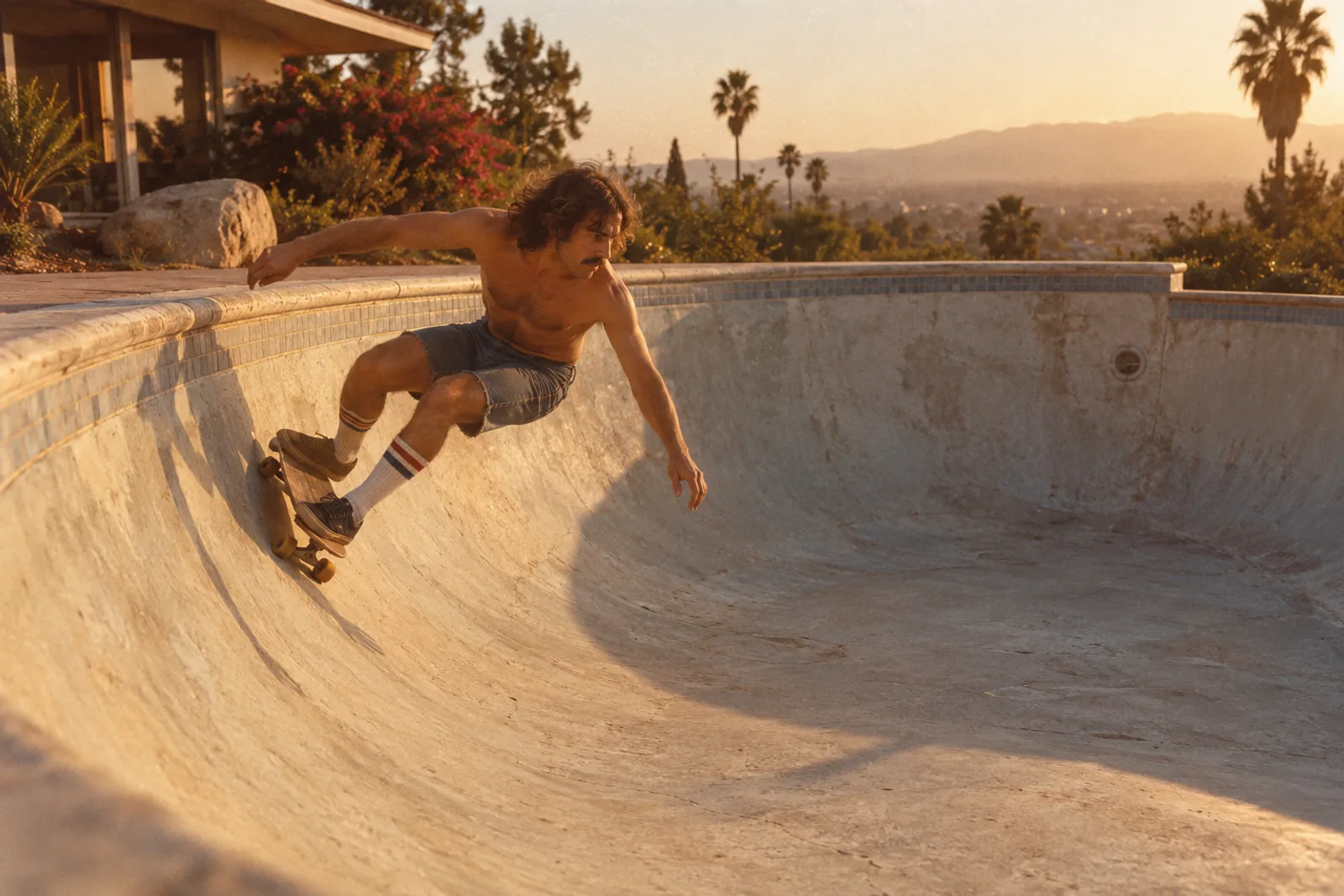
In 1976 California suffered a historic drought and city councils banned filling private pools. The result: hundreds of empty pools with perfectly curved walls, abandoned in the gardens of Beverly Hills and residential areas of Los Angeles. The Z-Boys started jumping fences, draining the few that still had water and inventing vertical skateboarding.
Tony Alva was the first to do a frontside air in a pool, in 1977. That move, the first deliberate aerial on four wheels, opened the door to everything that came after: vert, megaramp, X Games.
The ollie changes the game (1978)
In 1978, in Florida, a fifteen-year-old called Alan “Ollie” Gelfand found by accident that if he popped the tail against the wall of the bowl at the right moment, the board stayed stuck to his feet in the air without him having to grab it. It was named after his nickname: the ollie.
Over the next five years, Rodney Mullen, an obsessive Florida freestyler who later joined the Bones Brigade, worked out that the trick could be done on flat ground. From there he unlocked, one after another, the kickflip (1983), the heelflip, the 360 flip and a large part of the vocabulary of modern street skating.
The 80s: Powell-Peralta, Bones Brigade and the vert empire
The 80s are the decade when skateboarding professionalised. Brands that are still references today appeared: Powell-Peralta (founded by George Powell and Stacy Peralta in 1978), Vision, Santa Cruz, Independent Trucks. Boards got much wider, up to 10 inches, to handle ramps.
And the Bones Brigade was born, the Powell-Peralta team that defined the 80s the way the Beatles defined the 60s. The line-up is absurd: Tony Hawk, Steve Caballero, Rodney Mullen, Lance Mountain, Mike McGill, Tommy Guerrero. Stacy Peralta directed the videos (The Bones Brigade Video Show (1984), Future Primitive (1985), The Search for Animal Chin (1987)) and they were passed from hand to hand on VHS.
Thrasher Magazine was born in San Francisco in 1981. Transworld Skateboarding followed in 1983. The culture had a voice, it had photographers (Glen E. Friedman, J. Grant Brittain, Spike Jonze before he became a director) and it had a market.
Tony Hawk invented, among others, the stalefish (1989). Mike McGill came up with the McTwist (1984), an inverted 540 that raised the ceiling of vert.
The 90s: street takes over from vert
If the 80s were Powell-Peralta, the 90s were Plan B, World Industries, Girl, Chocolate, Toy Machine, Flip, Anti Hero, Foundation, Zero. Small brands, founded by skaters, selling to skaters. “Skater-owned” stopped being a label and became a mark of credibility.
Boards got slimmer: from the 10 inches of vert to a standard 7.5-8 inches. Wheels got smaller and harder (99A) to turn faster. The symmetrical double kicktail appeared, the popsicle shape that is still the standard today.
The videos that shaped a generation
- “Questionable” (Plan B, 1992): Pat Duffy, Mike Carroll, Rick Howard. If you can only watch one video from the 90s, this is the one.
- “Goldfish” (Girl, 1993).
- “Welcome to Hell” (Toy Machine, 1996), by Jamie Thomas.
- “Mouse” (Girl, 1996), directed by Spike Jonze.
- “The End” (Birdhouse, 1998).
Street also brought a new set of heroes: Mark Gonzales (the Gonz, considered by many the most influential skater ever), Eric Koston, Jamie Thomas, Andrew Reynolds, Geoff Rowley, Daewon Song, Chad Muska.
In 1995 the X Games started in Rhode Island. In 1999, Tony Hawk landed the first 900 in history at the X Games in San Francisco.
The 2000s: globalisation, video games and the first millionaire pro
In 1999 Tony Hawk’s Pro Skater 1 came out on PlayStation. The series sold tens of millions of copies and put skateboarding in the bedrooms of teenagers who had never touched a board.
The Tampa Pro became established as the “real” contest of the community, as opposed to the televised X Games. The Maloof Money Cup and later Street League Skateboarding (SLS), founded by Rob Dyrdek in 2010, made prizes of $200,000 or more per event normal.
Brands like Vans had a second youth. If you want the details, there is the full history of Vans in another article.
In 2003 Go Skateboarding Day was held for the first time (21 June).
The modern era (2010-2020): the internet, The Berrics and the return of style
The 2010s are the years of The Berrics, the website founded by Steve Berra and Eric Koston in 2007 that changed how skateboarding is consumed.
Instagram changed the rules again. Profiles appeared that generated more impact in a week than some entire careers of the 90s.
On the technical side, style came back. After a decade obsessed with “bigger, higher, more rotation”, the new generation (Tyshawn Jones, Mason Silva, Yuto Horigome, Aurelien Giraud, Leticia Bufoni, Pamela Rosa, Sky Brown) combines very hard tricks with a clean, almost classic look.
Olympic skateboarding: Tokyo 2020 and the ongoing debate
On 3 August 2016, the IOC approved the inclusion of skateboarding in the Tokyo 2020 Games. The community split in two.
The Games were finally held in 2021 because of the pandemic, in Tokyo:
- Yuto Horigome took the first gold in history in men’s street, at home.
- Momiji Nishiya, a 13-year-old from Japan, won gold in women’s street.
- Sakura Yosozumi (Japan) won women’s park and the British skater Sky Brown, also 13, took bronze.
- Keegan Palmer (Australia) won men’s park.
Paris 2024 confirmed the trend: Horigome won gold again and Arisa Trew, a 14-year-old Australian, won women’s park.
Today: community, social media and the new generation
Skateboarding in 2026 lives with an interesting contradiction: it has never been so mainstream, or so deeply local. On one side, Instagram profiles with millions of followers. On the other, a strong return to DIY culture: self-built skateparks, hyperlocal brands, night sessions of five friends in a parking lot.
If you want to go deeper, here is the ranking of the most influential skaters, and if the vocabulary gets confusing, the skateboarding dictionary has all the terms.
Timeline: the key dates
- 1948-1959: sidewalk surfing begins in California.
- 1962: Val-Surf starts selling boards. Larry Stevenson founds Makaha.
- 1963: first contest in Hermosa Beach.
- 1965: the market crashes at the end of the year.
- 1966: Vans is founded in Anaheim.
- 1972: Frank Nasworthy launches urethane wheels.
- 1975: the Z-Boys take over Del Mar.
- 1978: Alan Gelfand invents the ollie. Powell-Peralta is founded.
- 1981: Thrasher Magazine is born.
- 1983: Rodney Mullen lands the first flatground kickflip.
- 1995: the X Games begin.
- 1999: Tony Hawk lands the first 900. Tony Hawk’s Pro Skater is released.
- 2010: Street League (SLS) begins.
- 2016: the IOC approves Olympic skateboarding.
- 2021: Olympic debut in Tokyo.
- 2024: Paris confirms Japan and Australia as new powers.
A final note, from one skater to another
Seventy years after the first kid nailed four wheels to a plank in California, skateboarding is still the same thing and something completely different at once. The boards are better, the tricks would have been impossible by 70s standards, and there are Olympians and millionaires. But if you stand in front of any staircase in the world with your board in your hand, the feeling (that mix of fear, desire and “this time it’s going to work”) is the same one Tony Alva had in front of a pool in 1977.
No federation, sponsor or Olympic Committee has changed that part.
Conversation
Your name will be public. Your email stays private. Comments are reviewed before publishing.