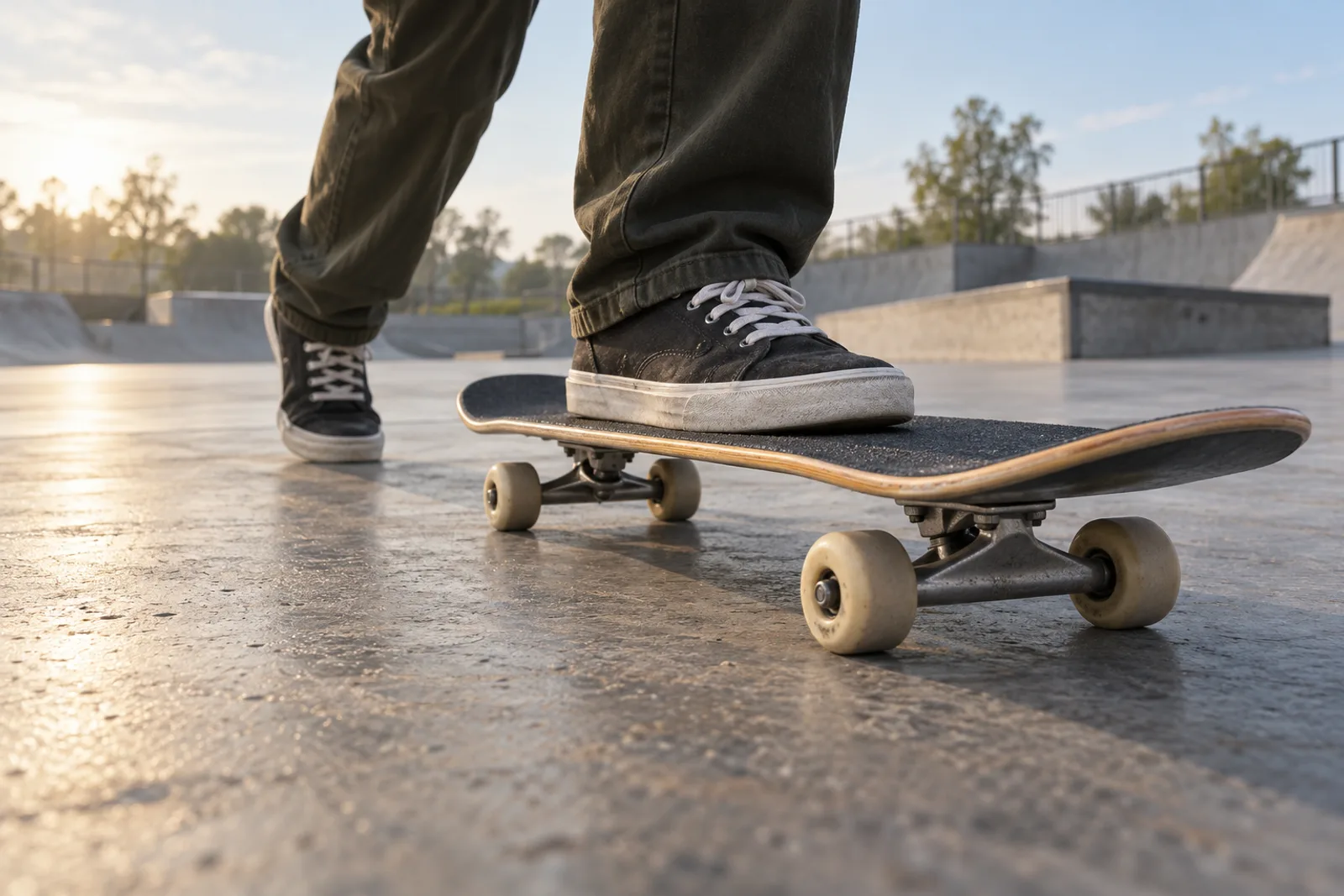
Starting skateboarding feels intimidating. It doesn’t matter if you are 8, 28 or 48: the first time you step on the board everything moves, you feel like you are about to fly off, and you wonder how anyone does this. Don’t worry, everyone starts like that. The good news is that skateboarding, like learning to ride a bike, comes down to patience and repetition: once you get the balance, you don’t forget it.
This guide is meant to help you start well from day one: with the right board, the necessary gear, the first moves in a logical order, and knowing which mistakes to avoid.
The time to start is now
Two myths get repeated a lot and are worth clearing up at the start:
-
“I’m too old to start.” False. Thousands of people skate in their 30s, 40s and 50s. Tony Hawk is still rolling at 57. Starting as an adult only means you will progress a bit more slowly (more fear, more responsibilities) and your body needs a longer warm-up.
-
“It’s very dangerous.” It is less dangerous than football, rugby or motorbikes. Serious injuries are rare if you wear a helmet and start sensibly. 90% of falls are scrapes and bruises.
How much does it cost to start? A realistic budget
To start with everything you need without buying junk, this is the reasonable range:
| Item | Serious minimum | Recommended |
|---|---|---|
| Complete skateboard | 60-80€ | 100-130€ |
| Helmet | 25-35€ | 40-60€ |
| Wrist guards | 12-20€ | 20-30€ |
| Knee + elbow pads | 20-35€ | 35-50€ |
| Skate shoes | (whatever you have) | 50-70€ |
| Initial total | 120-170€ | 245-340€ |
The realistic figure to start well without overspending: 150-200€ all included. If you want to go deeper on each component, we have a dedicated article: how much a complete skateboard costs in 2026 and another on affordable skateboard decks.
Your first skateboard: what to buy
Type of board: classic skateboard (popsicle)
To learn to skate properly (going up kerbs, doing tricks, turning well), you need a classic popsicle skateboard: the symmetrical board with a raised nose and tail that you picture when you hear the word “skateboard”.
Leave longboards, cruisers, surfskates and penny boards aside if you want to learn real skateboarding. If you are unsure about the differences between types, see types of skateboards.
Board size by foot size
| Your foot size (EU) | Recommended width |
|---|---|
| Up to 35 | 7.0” - 7.375” (mini board) |
| 35-39 | 7.5” - 7.75” |
| 40-43 | 7.875” - 8.125” |
| 44-46 | 8.25” - 8.5” |
| 47+ | 8.5” - 8.75” |
For an average adult beginner (size 41-44), a width of 8.0” - 8.25” is the safe choice. If you want to fine-tune by height, weight and style, read the complete guide to choosing a skateboard deck.
Recommended brands to start
Affordable and honest (60-90€ complete):
- Enuff Skateboards: the best value for beginners.
- Tony Hawk Signature Series: a decent entry-level range at 60-80€.
- Mini Logo: Powell’s sister brand.
Decent brands (95-130€ complete):
- Element: solid-quality completes.
- Santa Cruz: a classic that never fails.
- Powell Peralta: a living legend.
- Globe: well-built completes at a good price.
Protective gear: yes, it matters
1. Helmet (non-negotiable)
The helmet is the only thing between a knock on the head and a knock on the skull. The only really serious injuries in skateboarding are head injuries.
- Recommended brands: Triple 8, ProTec, TSG, Bullet.
- Reasonable price: 30-60€.
- Type: certified skate helmet (CE EN 1078).
2. Wrist guards (almost non-negotiable)
The instinctive way to fall is hands first. Without wrist guards, you break a wrist. With wrist guards, you scrape your palm. They cost 15-25€ and prevent 80% of wrist injuries.
3. Knee and elbow pads
For the first 1-2 months, while you learn to fall, they are very useful.
4. Shoes
You don’t need to spend 100€ from day one, but don’t skate in running shoes: the sole is soft and doesn’t grip the grip tape. Any shoe with a flat vulcanized sole works at the start (Vans, Converse, DC).
Stance: goofy or regular?
Before you step on the board, you need to know which foot goes in front:
- Regular: left foot in front, right foot behind (you push with the right).
- Goofy: right foot in front, left foot behind (you push with the left).
A trick to find your natural stance: ask someone to give you a gentle push from behind. The foot you instinctively put forward to avoid falling is your front foot on the board.
If you want to go further, read the complete goofy vs regular guide.
First steps: getting on the board and keeping your balance
Exercise 1: the board still on grass
Put the board on grass (so it won’t roll) and just step on. Feet shoulder-width apart, one over each truck.
Exercise 2: getting on and off
Learn to step on from the skater position and to step off with a gentle hop forwards. Do it 50 times.
Exercise 3: rolling very slowly
Board on a smooth surface, step on and let it roll a few metres with a slight push. Don’t push yet.
How to push: the basic technique
- Front foot pointing forward, not sideways, over the front bolts.
- Back foot comes down to the ground and pushes backwards.
- After the push, the back foot returns to the board and turns 90 degrees.
Typical mistakes:
- Pushing with the front foot (mongo push).
- Front foot sideways when pushing.
- Short, quick pushes.
How to brake: safe ways to stop
1. Foot brake
You put your back foot down and drag the sole. This is the one to master first.
2. Stepping off while rolling
At low speed, you step off with a gentle step forwards.
3. Tail scrape
You press the tail down so the wood scrapes the ground and slows you down.
4. Power slide
An advanced trick. As a beginner, ignore it.
How to turn: tilt and kickturn
1. Tilt (a gentle turn by leaning)
You put weight on your heels to turn one way or on your toes to turn the other. It is the natural, smooth turn, ideal for wide curves.
2. Kickturn (turning by pivoting on the back wheels)
You press the tail down to lift the front wheels, turn the board 30-90 degrees with your shoulders, and set it back down.
Your first trick: the ollie
The ollie is the parent of all tricks in modern skateboarding. You jump with the board stuck to your feet, without holding it with your hands.
Basic idea of the ollie:
- Back foot on the tail, front foot in the middle of the board.
- You snap the tail against the ground.
- As the board rises, you slide your front foot towards the nose.
- You land with both feet over the trucks, knees bent.
It is hard. Don’t expect to do it in 2 days. The average is 3-6 months of daily practice.
We have dedicated pages:
- How to ollie on a skateboard, step by step
- Ollie trick page with videos and variations.
Other first tricks: tic-tac, pivot, manual
Tic-tac
Moving the board forward with small alternating kickturns, without pushing with your foot.
Pivot
A 180-degree kickturn on the back wheels, usually leaning on a wall or a kerb.
Manual
Balancing on the two back wheels while you roll. Start with 1-second manuals, then 2, then 3.
Shove-it
The board spins 180 degrees under your feet without you stepping on it. Easier than the ollie.
50-50 stall on a low kerb
You bring the board up onto a low kerb (10-15 cm) with both trucks resting on top.
Where to practise as a beginner
For the first 4-6 weeks, what you need is not a skatepark. You need:
- A smooth surface: polished concrete, fine asphalt or sports court paving.
- No slope (or a minimal one).
- No traffic: empty car parks on Sundays, school playgrounds at the weekend.
- Not too many people.
The skatepark comes later. To find skateparks near you, we have a skatepark directory.
Common mistakes and how to avoid them
- Buying a toy-shop skateboard.
- Skipping the protective gear.
- Starting on a slope.
- Looking at the ground instead of ahead.
- Feet in the middle of the board.
- Stiff knees.
- Pushing with the front foot (mongo).
- Trying the ollie in the first week.
- Comparing yourself to YouTube videos.
- Quitting after the first bad fall.
How long it takes to learn the basics
With 2-3 sessions a week of 30-60 minutes:
| Skill | Average time |
|---|---|
| Getting on and off the board with confidence | 1-3 days |
| Rolling 50 metres without falling | 1-2 weeks |
| Pushing correctly | 2-4 weeks |
| Braking with the foot brake | 1-2 weeks |
| Turning with tilt and kickturn | 3-6 weeks |
| Fluid tic-tac | 1-2 months |
| 2-3 second manual | 2-4 months |
| Your first clean ollie | 3-6 months |
When to upgrade
Your first complete will last between 6 months and 2 years. Signs it is time to upgrade:
- Deck: when the tail or the nose breaks.
- Grip tape: when it wears out and stops gripping.
- Wheels: when they develop flat spots.
- Bearings: when they make noise, jam or roll less. Before replacing them, clean them.
- Trucks: when the kingpins are battered.
Conclusion: start today
Skateboarding is one of the most accessible sports there is: you don’t need a team, a federation or specific facilities. A board, a helmet, a stretch of smooth concrete and the will to try. That is all.
Buy a decent board, put on your helmet, find an empty car park and give it a go.
Conversation
Your name will be public. Your email stays private. Comments are reviewed before publishing.