
Talking about the best skate spots in the world is complicated because, depending on who you ask, you’ll get a different list every time. Some people think of an empty pool in Venice in the seventies; others think of the granite plaza at Love Park where half a dozen era-defining parts were filmed; others remember the first time they saw MACBA in a video and realised Europe had something going on too. Skating has spent fifty years using places that were almost never built for it, and that’s exactly what makes them special.
What is clear is that a handful of spots keep coming up in every conversation — the ones that gave their names to entire obstacle types (hubbas come from Hubba Hideout, if you didn’t know), the ones that invented new ways to skate (Dogtown, Mt Baldy), the ones that won legal battles to avoid demolition (Southbank in London, MACBA in Barcelona) and the ones that lost those same battles and became myth (Love Park, EMB).
This list is not definitive. If you think something’s missing, drop it in the comments and we’ll add it next time. And if you find a fact that’s wrong, same thing: we’ll check it and fix it.
How we chose the 20 spots
We looked for places that meet at least three of these four criteria:
- They appear in video parts that skaters are still watching years later.
- They have a story beyond the spot itself — local culture, battles with the city, whatever.
- They show up in similar lists from international media (it’s not just us).
- They represent a distinct type of terrain: pools, bowls, plazas, handrails, DIY under a bridge, indoor competition.
Spots that also hurt to leave out: Pulaski Park (Washington DC), Stoner Skate Plaza (Los Angeles), Channel Street (San Pedro), Bercy (Paris), the marble plazas of Tokyo or Shenzhen. If this list leaves you wanting more, we’ll do a second part at some point.
The ’70s — Origins: Dogtown, Mt Baldy and the birth of transition skating
In the mid-seventies, skateparks as we know them didn’t exist, and the word “spot” didn’t mean anything yet. But in Southern California there were two places that changed what you could do on a board: an empty swimming pool and an industrial concrete pipe. That was enough to open everything that came after.
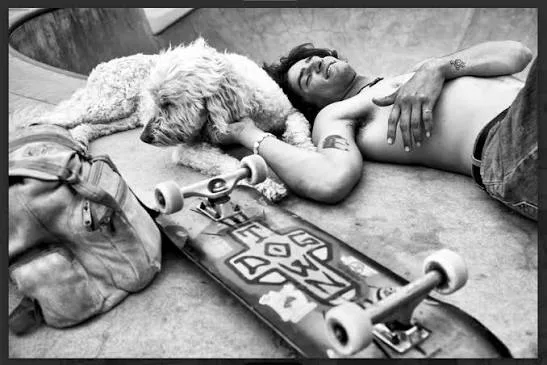
Dogtown / Venice Empty Pools
Venice / Santa Monica, Los Angeles · United States
Type Concrete pools (backyard)
Status Demolished / filled in
When the California drought of 1976–77 forced thousands of private pools on Los Angeles' West Side to be drained, the Z-Boys of the Zephyr team (Tony Alva, Jay Adams, Stacy Peralta, Shogo Kubo, Bob Biniak, Wentzle Ruml, Jim Muir, Peggy Oki) invaded them one by one with hoses and pumps to finish draining them. The most famous, the Dog Bowl, was a private kidney pool on San Vicente Boulevard above the Brentwood Country Club, drained at the request of a terminally ill teenager and named after the dogs that roamed the property. In the fall of 1977, Tony Alva threw down the first documented frontside aerial beyond the coping there — Glen E. Friedman's photograph became one of the defining images of twentieth-century skateboarding. Craig Stecyk's articles in Skateboarder Magazine (the Dogtown Articles, 1975–79) elevated the group to myth while it was still happening.
Why it matters The moment skating stopped being a sidewalk pastime and became a counterculture. The low, aggressive Pacific Ocean Park surf aesthetic applied to concrete invented the physical vocabulary of vert skating, opened the door to skater-owned brands (Alva Skates, Powell-Peralta), and established the DIY ethic that Burnside and FDR would later carry forward.
Mt Baldy Pipeline (Baldy Pipe)
San Bernardino County, California · United States
Type Drainage pipe / cylindrical concrete
Status Still standing (restricted access)
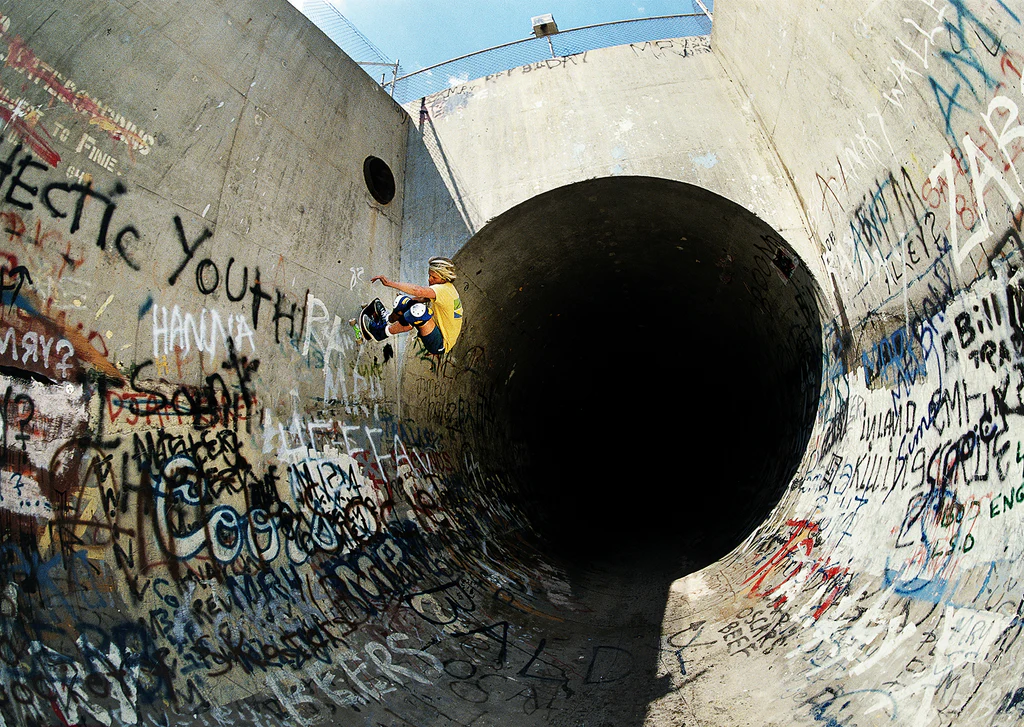
A full-diameter drainage pipe in the San Antonio Dam system, on the lower slopes of Mt San Antonio (Mt Baldy). The diameter is wide enough to ride past vertical — dropping in and coming out with the board inverted at the upper edge. Discovered as a spot in December 1975 by Jim Higham, a scout for Skateboarder Magazine, who returned with Gary Kocot, Dale Schull, and Waldo Autry. Photographer James O'Mahoney captured Waldo Autry in a frontside drop-in inside the pipe — the first documented photo of a skater going past vertical, reproduced in more than 50 books and magazines according to O'Mahoney himself. Dale Schull attempted a full loop in the same session and made it to roughly ten o'clock before falling. The April 1977 issue of Skateboarder published Mike Weed's photo of him 'curve conforming' at Baldy. Then came the Z-Boys (Alva, Adams, Peralta), and later entire generations: Salba, Tony Hawk, Andrew Reynolds, Greyson Fletcher.
Why it matters The first spot that photographically proved a skater could go past 90 degrees. Before Baldy no one had visual evidence; after it, that reality became the DNA of the entire vert discipline. It also established the idea that you could skate borrowed industrial infrastructure rather than dedicated skateparks — the direct ancestor of empty-pool culture, ditches, and all modern DIY.
What connects Dogtown and Mt Baldy isn’t so much what they were as what they represented. Skaters stopped waiting for someone to build them a place to skate and started using what was already there: pools emptied by drought, county drainage pipes. That idea of taking a space that wasn’t yours and turning it into something new is the one that, fifteen years later, would lead to Burnside.
1989–1996 — The Bay Area as the laboratory of modern street skating
If the seventies were the era of transition, the nineties were the era of the street. And the street, for a few years that have never come back, was concentrated in five corners of San Francisco. Embarcadero / EMB and Hubba Hideout were practically next to each other. Pier 7 was three blocks north. Wallenberg 4 and, further down in San Diego, Carlsbad Gap closed the circuit connecting SoCal with NorCal.
Embarcadero Plaza ('EMB')
San Francisco, California · United States
Type Street plaza (brick)
Status Architecturally eradicated
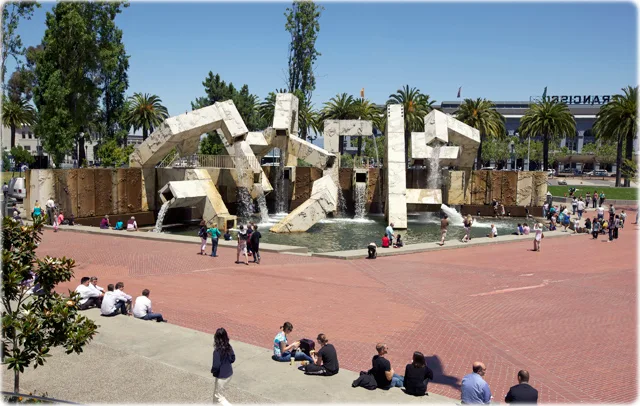
A brick plaza at the foot of Market Street on the Embarcadero, originally designed by Lawrence Halprin and M. Paul Friedberg in the early 1970s as part of the waterfront regeneration. Its skateable elements — low brick ledges at varying heights, stairs, a semicircular transition known as 'The Wave,' the famous 'gonz gap' / 'big seven' / 'big four' — made it the laboratory where modern street skating was literally invented, between 1989 and 1993. Mike Carroll's part in Plan B's Questionable (1992) — backside lipslides and switch-stance on ledges, almost all filmed at EMB — is the most imitated piece of technical street skating from the entire decade. Henry Sanchez's part in Blind's Tim and Henry's Pack of Lies (1992) introduced flip-outs and flip-ins on ledges at a level the rest of the world had never seen. James Kelch served as the unofficial mayor of the spot. FTC documented the era with Penal Code 100A (1996), featuring more than 50 skaters. The city installed skate stoppers in 1995 and effectively shut it down in 1996. Massive renovations between 1998 and 2001 eliminated nearly everything. In April 2025, the SF Board of Supervisors approved a $40 million plan that will erase what remains, including the Vaillancourt Fountain.
Why it matters EMB is to street skating what the Dog Bowl was to vert: the single location most responsible for defining the modern grammar of the discipline. Nearly every standard technical trick between 1992 and 1998 was invented or popularized there. It launched the careers of Mike Carroll, Rick Howard, Eric Koston, Keith Hufnagel, Karl Watson, and Henry Sanchez. Activision modeled the 'Streets' level in Tony Hawk's Pro Skater (1999) on EMB. Its eradication in 1996 marked the symbolic end of the 'one plaza, one scene' era.
Hubba Hideout
San Francisco, California · United States
Type Ledge with gap to flat (origin of the term 'hubba')
Status Demolished January 2011
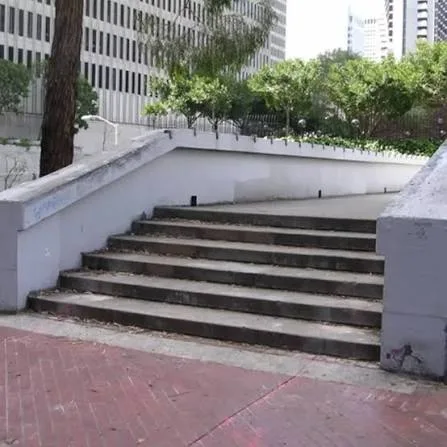
Two sets of six stairs flanked by tall angled concrete ledges running at the same pitch, tucked in a hidden corner next to Justin Herman Plaza (beside the Embarcadero). That geometry — ledge parallel to the staircase with a gap to flat — is what skate vocabulary now calls a 'hubba,' and the name comes from here. The term itself came from Bay Area street slang for crack cocaine ('hubbas'); the spot's hidden corner drew users looking for cover, and skaters absorbed the word into their own lexicon. First documented trick: Wade Speyer crooked grind, around 1989. The December 1992 Thrasher cover with Mike Carroll in a crooked grind gave the spot global exposure. Carl Shipman (frontside bluntslide, Thrasher January 1994), Fred Gall (switch 5-0, Thrasher February 1995), and Eric Koston (backside nosebluntslide, Transworld cover 1998) kept pushing the technical ceiling. Skate-stoppers were installed in the late '90s; in March 2007 the landing brick was removed and covered with sand; full demolition on January 22, 2011.
Why it matters Foundational: it renamed an entire architectural element in skating, codified a generation of ledge tricks, and stands alongside Love Park (Philadelphia) and Brooklyn Banks as one of the three or four most important spots in street skating history. No other object in skate architecture has so completely named itself. SLS built a faithful replica in 2022 ('SLS Resurrection: Hubba Hideout').
Pier 7
San Francisco, California · United States
Type Waterfront plaza (granite + bay blocks)
Status Active (reclaimed by the community in 2021)
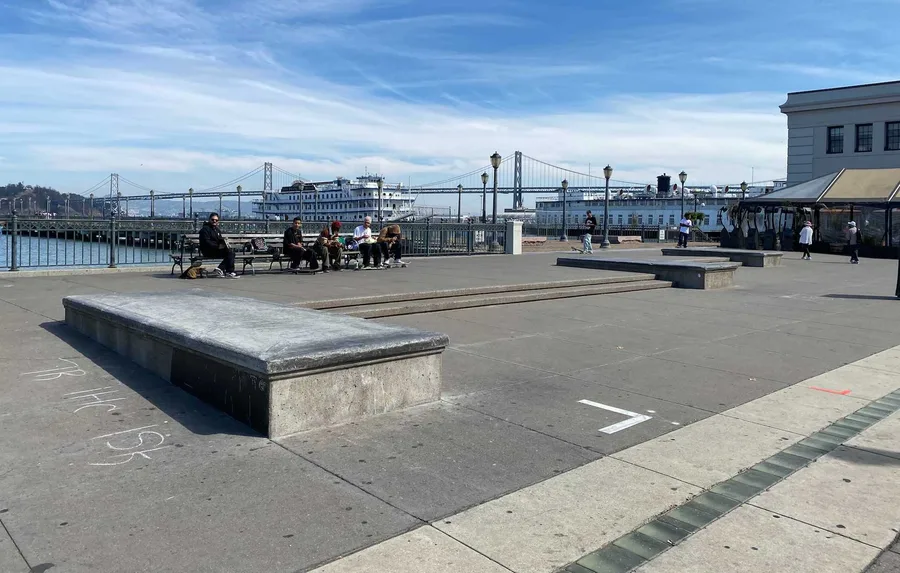
A pedestrian pier built in the late '80s as part of the Embarcadero's post-Loma Prieta earthquake redevelopment. The skate-relevant section is the entry plaza: a two-step drop, smooth granite and concrete flooring, parallel rows of Bay Blocks (low benches capped with granite), and ledges flanking shallow stairs. The ground is legendary in skating for being abnormally smooth and fast — granite over immaculate flatground, the ideal manual-pad-and-ledge plaza. It rose to global prominence at the exact moment the city was shutting down EMB in the mid-'90s. It appeared in 'Mouse' (Girl/Chocolate, 1996), 'Welcome to Hell' (Toy Machine), 'Super Champion Funzone' (Fourstar), 'Penal Code 100A' (FTC), and dozens of 411VM spot checks. Henry Sanchez is widely credited as one of the first to flip out of ledge tricks here. Mike Carroll's footage was later compiled by Thrasher as 'Classics: Mike Carroll at Pier 7.' The SF Port Authority and contractors repeatedly capped the granite ledges with metal and wood between 2000 and 2020. In 2021 an anonymous local crew quietly removed the skate-stoppers, leveled the cracks, and re-cemented the surface — the moment documented by Jenkem as 'The Resurrection of Pier 7.'
Why it matters Pier 7 is to technical ledge street skating what Burnside is to DIY transition: the canonical reference point. It is one of the very few major plazas from the '90s still standing, and the only granite plaza of its era to have been actively rescued by the community. Its ground and the Bay Blocks have been replicated in skateparks worldwide as the reference for perfect flatground.
Wallenberg 4 (Raoul Wallenberg HS)
San Francisco, California · United States
Type 4-stair handrail-less (big ollie gap)
Status Active, with modified run-up
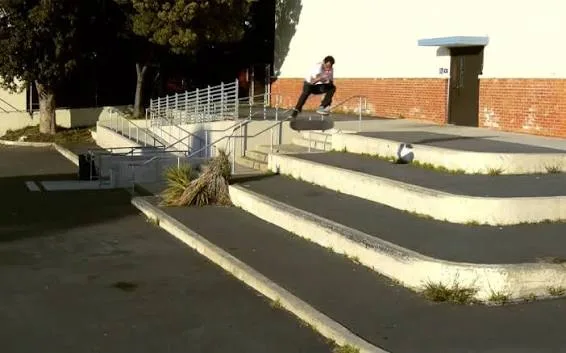
A four-stair concrete set adjacent to a planter at the side entrance of Raoul Wallenberg Traditional High School (40 Vega Street, 94118). Verified dimensions: 4.4 ft high and 16.5 ft long. Its defining characteristic is the length — abnormally large for a 4-stair, it demands a level of pop and float that a normal four doesn't require. Mark Gonzales was the first to ollie it with a frontside 180 to flat in Blind's 'Video Days' (1991), and from that moment Wallenberg became the benchmark for the next generation. Andrew Reynolds made the spot a personal battleground: frontside flip at the Thrasher-organized 'High Noon at the Big Four' jam in 2004 (alongside Darrell Stanton switch back 180 and Lindsey Robertson heelflip) and the definitive backside flip on the 2007 Thrasher cover. Chris Cole raised the technical ceiling in 2009 with a back 360 and a switch frontside flip. Forrest Edwards locked down a switch kickflip in 2013. Miles Silvas landed a switch back heelflip in 2019 after four years of attempts — the current benchmark for the state of the art.
Why it matters It's the universal handicap: when a skater does X down Wallenberg, the entire industry understands that's the maximum-difficulty version of that trick on a 4-stair. It functions as a standardized exam for big flip tricks. Jenkem personified it in 'Interview with Wallenberg' as a character in skating's collective memory.
Carlsbad Gap
Carlsbad, California · United States
Type 11-stair gap with uphill landing
Status Demolished February 23, 2012
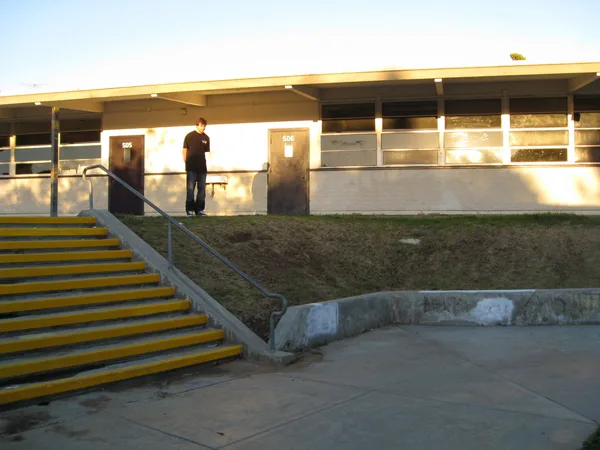
An eleven-stair gap on the south side of the former Carlsbad High School (built in 1957). It crossed a grass embankment, and its most celebrated — and brutal — feature was the uphill landing: the landing ramp rose against the rider, killing speed and throwing weight forward. As Jeremy Wray explained: 'at any other gap you'd roll away, but the Carlsbad and its uphill landing threw your weight out from under you and slammed you down.' Matt Hensley lived within skating distance and was among the first to ollie it in the late '80s. The late-'80s/early-'90s arms race between Kris Markovich (first kickflip, Transworld cover) and Rob Dyrdek (first switch ollie) put it on the map. But the Plan B skater truly synonymous with Carlsbad was Jeremy Wray, whose part in 'Second Hand Smoke' (1994) — frontside halfcab, frontside 360, frontside flip, switch backside 180, backside 180 heelflip — opened the door to technical tricks there. Then came Andrew Reynolds, Chris Cole (switch frontside heelflip, backside 360 kickflip that snapped his board), Josh Kasper (360 flip, heelflip front-grab, impossible, pop-shove tailgrab). Demolished on February 23, 2012 as part of the campus's $86 million renovation. Markovich was invited to land one last ollie minutes before the excavators arrived — a poetic full circle, given that he had thrown down the first kickflip there.
Why it matters It defined an entire genre of trick — gap skating — and was the benchmark gap of '90s SoCal. Its appearances in Tony Hawk's Pro Skater and dozens of seminal video parts made it the gap even non-skaters recognized. Its demolition was covered as a cultural loss well beyond California. NOTE: contrary to popular legend, Pat Duffy's iconic trick in 'Questionable' (Plan B, 1992) was not at Carlsbad — it was a 50-50 on a double-kink handrail in SF.
Almost everything we take for granted in technical street skating today — switch heelflip, nollie flip out, backside noseblunt slide, switch crooked grind, frontside flip down big stairs — was done for the first time or popularised at these five corners. When the City of San Francisco cracked down and forced EMB to close in 1996, the skaters who lived there (Carroll, Howard, Koston, Hufnagel) scattered to other cities and took with them the way of skating they had learned. The physical spot, the original plaza, no longer exists.
The legendary handrails: the most physical side of street skating
While the East Coast and San Francisco were specialising in technical tricks on ledges, another part of street skating was heading in the opposite direction: going down bigger and bigger stairsets. First with ollies. Then with flip tricks. And finally, with grinds and slides on handrails that make your head spin. The two most famous handrails in the world are in California, an hour and a half apart.
Hollywood High 16
Los Angeles, California · United States
Type 16-stair handrail
Status Active (with school security)
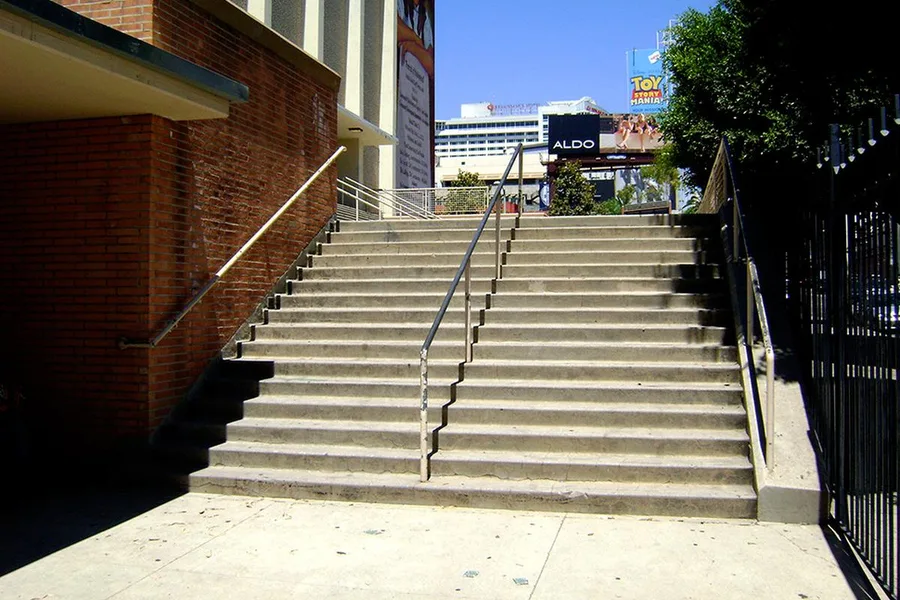
A 16-stair set with handrail on the Hollywood High School campus (1521 N Highland Ave). The facade also features an adjacent 12-stair with its own handrail (Hollywood High 12). Long, straight, metal rail with grind marks accumulated over decades. Considered one of the most difficult handrails in world street skating. Andrew Reynolds has three documented cover tricks on the 16 over the span of a decade: Kickflip (Transworld Oct 2000 / Baker2G), Frontside 180 Kickflip (The Skateboard Mag Sept 2005 / Baker 3), and Varial Heelflip (The Skateboard Mag Nov 2010 / Emerica 'Stay Gold') — cited as one of the spot's greatest technical achievements. Other documented enders: Dallas Rockvam fakie back tailslide (Powell 'Fun!' 2007), Lizard King frontside noseslide (Deathwish Video 2010), Dashawn Jordan frontside 270 to back lipslide (Berrics 'RADAR' 2017). Leticia Bufoni filmed her frontside feeble on the adjacent 12 in 2016 — a key moment in the visibility of women's skateboarding.
Why it matters It is to handrails what MACBA is to ledges: an unavoidable final exam. What makes it decisive is not the height — there are bigger 18- and 20-stair rails out there — but its geographic symbolism: it sits literally meters from the Walk of Fame, in the global media capital. Reynolds' Varial Heelflip in 'Stay Gold' (2010) symbolically closes the handrail era of the 2000s.
El Toro 20
Lake Forest, California (Orange County) · United States
Type 20-stair (handrail + gap)
Status Active (school property)
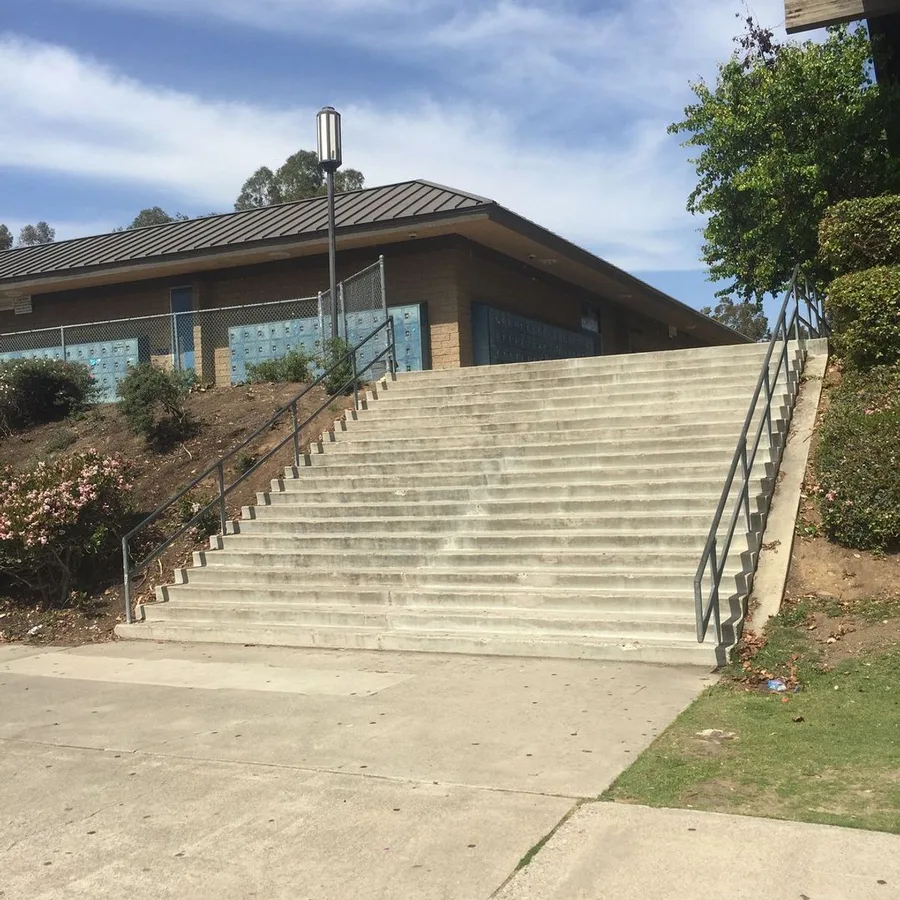
A 20-stair set with a parallel metal handrail and a lateral gap, on the El Toro High School campus (Ridge Route Drive). Considered the tallest set skated with technical tricks on a recurring basis in skateboarding history. Heath Kirchart was the first skater to land a trick on it — a frontside lipslide on the rail, in 1998. Don 'Nuge' Nguyen landed the first clean ollie in March 2001, a feat that opened the door for the modern generation. Aaron 'Jaws' Homoki is the undisputed king of the spot: he has documented an ollie, kickflip, kickflip melon grab, melon, stalefish, tuck-knee, and a heelflip that Rolling Stone covered as the highest in history. Chris Joslin landed a 360 flip — one of the most technically impressive tricks ever performed at the spot. Clive Dixon did a nollie noseblunt slide after first landing the regular noseblunt. Each generation renegotiates the limit — and every slam feeds a YouTube crash catalog as legendary as the makes.
Why it matters If Hollywood High 16 is the cathedral of technical handrails, El Toro 20 is the cathedral of pure fear. For years it was considered literally humanly impossible to skate, until Kirchart proved otherwise in 1998. Its importance lies in the physical threshold it represents: every clean trick rewrites what the human body can absorb on impact.
These two spots are essentially the body vs gravity. Hollywood High 16 measures how far you can push technically on a handrail. El Toro 20 measures how far you can go before you break something.
Philadelphia — The city where skateboarding became political
Few cities have a relationship with skateboarding as complicated, as well-documented and as culturally important as Philadelphia. Two spots tell the whole story: Love Park is what happened when the city decided skating didn’t fit its image, and FDR is what happened when skaters decided they would build their own spot.
Love Park (JFK Plaza)
Philadelphia, Pennsylvania · United States
Type Public plaza (granite)
Status Demolished (granite purchased by Malmö 2024)
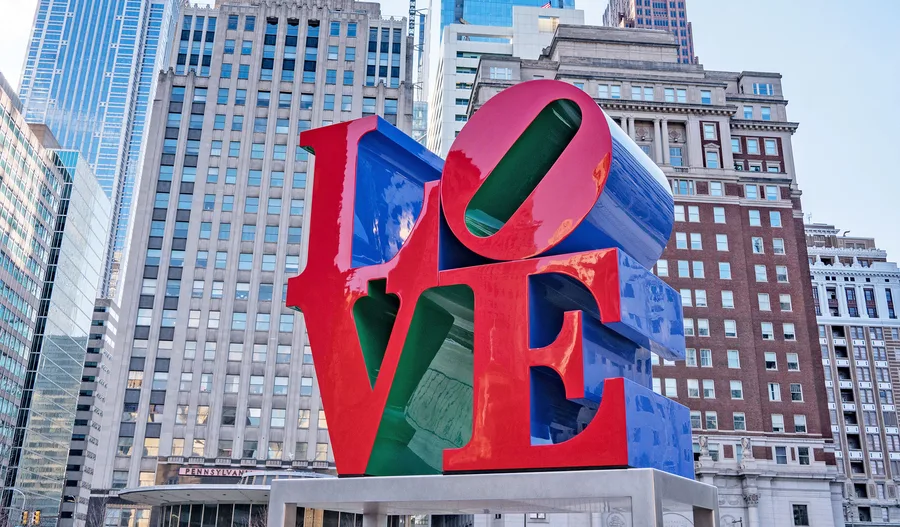
Public plaza designed by urban planner Edmund Bacon and architect Vincent G. Kling, built in 1965 (officially dedicated in 1967). Polished granite across the ground, ledges, steps, and edges at multiple levels, a central fountain, and the iconic LOVE sculpture by Robert Indiana (permanent since 1978). The granite had a unique density and slide quality. 1984: first skateboarding ban. The '90s: Ricky Oyola and the Sub Zero crew define East Coast aesthetics. Late '90s–2004: the golden era with Josh Kalis (DC Shoes) and Stevie Williams (DGK). In 1999 Kalis filmed the 360 flip over a trash can for 'Photosynthesis' (photo by Mike Blabac) — an iconic poster for an entire generation, recreated by Kalis twenty years later in 2019. 2000: Love Park appears as a playable level in Tony Hawk's Pro Skater 2. 2001–02: Mayor John Street, having hosted two X-Games events and generated 80 million dollars in revenue, raises fines to $300, deploys 24-hour security, and announces a renovation explicitly designed to kill the skateability. 2002: DC Shoes offers to pay the mayor $1 million a year to keep Love open to skating — rejected. October 28, 2002: Edmund Bacon, aged 92, rides a skateboard in protest: 'I am deliberately skating in my beloved Love Park.' February 2016: Mayor Jim Kenney lifts the ban temporarily for five days before demolition — a brutal farewell with people burning wood in oil drums and others prying up granite slabs as keepsakes. 2024: the city of Malmö, Sweden, announces it has purchased the original granite to reconstruct a skateable version in Europe.
Why it matters The most mythological spot in Northern Hemisphere street skating. Its importance is not the geometry — it is the historical and political context: the only spot where the skate-vs-city battle reached the level of a constitutional argument. It is the documentary proof that skateboarding is not merely a sport but a form of reclaiming public space — and that municipal power can destroy that reclamation. DGK (Dirty Ghetto Kids) carries the Love Park lineage in its DNA.
FDR Skatepark
Philadelphia, Pennsylvania · United States
Type DIY concrete (under I-95 overpass)
Status Active, community-managed
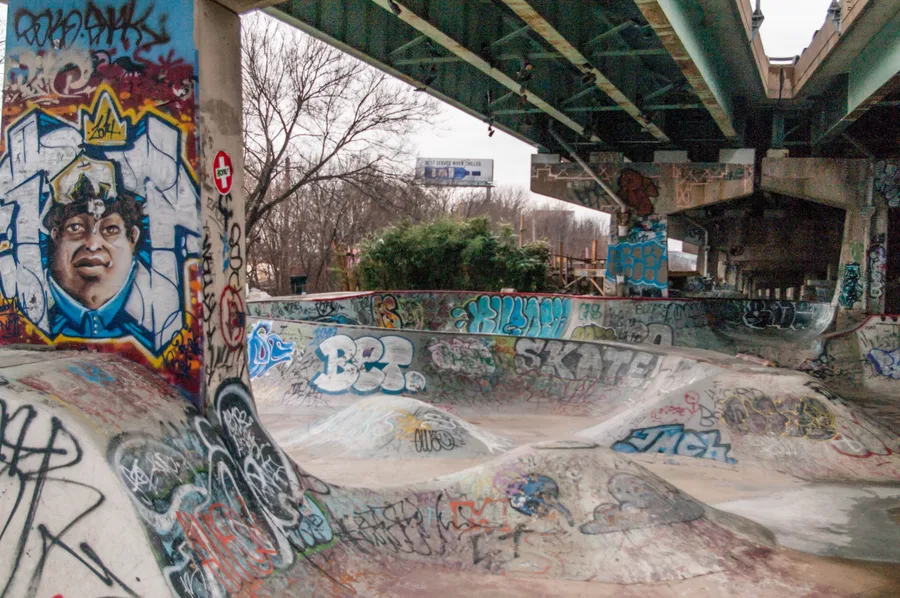
Concrete skatepark under the Interstate 95 viaduct inside Franklin Delano Roosevelt Park. It started as roughly 1,500 m² of flat asphalt with a couple of pyramids and a grind box built by the city in 1994 — a concession-bait to pull skaters away from Love Park. The city's offer was minimal; in 1996, inspired by Burnside, the locals (John Meat, Carlos Baiza, Jim Young, Tim Guza, Gabe Strain, George Draguns) began illegal DIY construction: transitions, corners, bowls. They pooled their own money to buy cement. Chuck Treece — Philly skate legend and bassist of McRad — established the cultural bridge between skate and punk. The ethos crystallizes in a line from John Meat: 'the place is 100% punk in DIY attitude.' The culture is deliberately hostile to posturing. Bam Margera visited during his pre-Jackass era and, according to Meat, 'threw a tantrum and chucked his helmet — I wasn't impressed.' In 2019 the city announced a $200 million plan to renovate FDR Park, raising concerns about the skatepark's future; Friends of FDR Park and the broader community have fought for its preservation.
Why it matters The absolute counter-model to Love Park. If Love is the tragedy of skaters losing the city, FDR is the victory of skaters building their own city underneath a highway. Born as an illegitimate child of repression, the community transformed it into something the city never planned. Alongside Burnside and Bowl du Prado, it defines the global canon of the DIY concrete park — a model any European city (Madrid, Barcelona, Bilbao) should study if it wants authentic skate culture.
Love and FDR are two sides of the same coin. Love is what the city chose to destroy. FDR is what skaters built under a highway when they were told to leave Love. Any European city that takes skateboarding seriously as urban culture should look closely at how each case was handled.
New York and Venice — Both coasts and their landmark skateparks
The East Coast and West Coast have operated for decades as two separate scenes with very different aesthetics. If Philadelphia was the soul of the East Coast, New York was the muscle. And if Dogtown was where it all started on the West Coast, Venice Beach is its modern version: a municipal park by the ocean, yes, full of tourists, but one that still works as a genuine local scene.
Brooklyn Banks (Gotham Park)
New York · United States
Type Brick banks under a bridge
Status Reopened June 5, 2025 as 'Gotham Park'
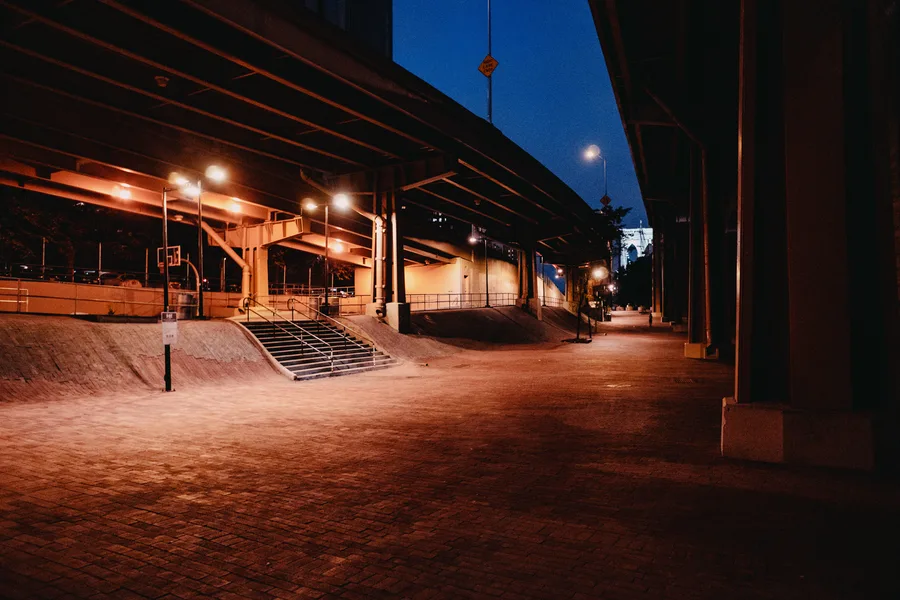
Wave-shaped red brick banks of varying incline, designed by landscape architect M. Paul Friedberg in 1972 as part of the Lower Manhattan renewal, beneath the Manhattan side of the Brooklyn Bridge (Tribeca / Civic Center). Two zones: the 'little banks' (technical, planters, ledges) and the 'big banks' (steeper transitions, aerials, wallrides, transfers). The brick surface — not concrete — gave them a unique texture, sound, and difficulty. Adopted by skaters from the late '70s when NYC had no skateparks; peak years 1985–2004. Harold Hunter (Zoo York, KIDS, RIP 2006) made them his living room. Keith Hufnagel (Real, founder of HUF, RIP 2020), Justin Pierce (Zoo York, KIDS, RIP 2000), and Ricky Oyola filmed the foundational East Coast pieces there: Zoo York 'Mixtape' (1997, dir. R.B. Umali) and Dan Wolfe's 'Eastern Exposure 3: Underachievers' (1996). The New York Times called them 'the mecca of New York skateboarding.' Steve Rodriguez (5Boro) led the lobby in 2004–05 to save the big banks when post-9/11 renovations destroyed the little banks. In 2010 NYC closed the site and used it as a construction staging area for bridge rehabilitation for ~15 years. It partially reopened on May 24, 2023, and fully on June 5, 2025 as 'Gotham Park.' Mayor Eric Adams allocated 50 million dollars for a full reconstruction beginning in fiscal year 2028.
Why it matters The East Coast counter-myth to California pool dominance: proof that street skating could emerge from the accidents of civic architecture rather than purpose-built terrain. Zoo York was founded in 1993 explicitly around the Banks scene. The 2025 reopening is bittersweet — the raw original spot has become a curated public park.
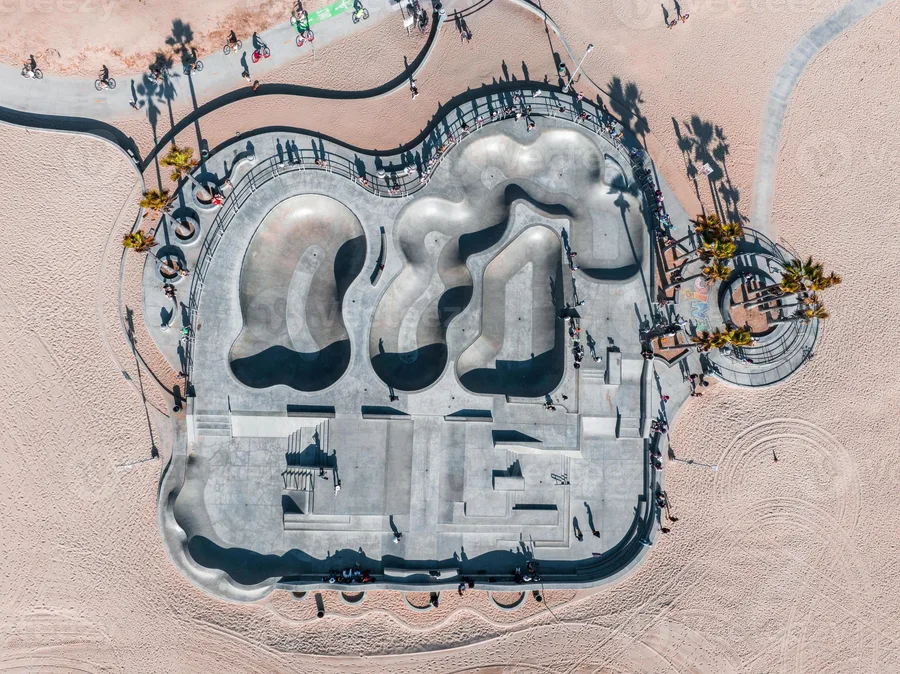
Venice Beach Skatepark
Venice, Los Angeles · United States
Type Oceanfront concrete park (pool + bowl + snake run + street)
Status Active, free, managed by LA Recreation
Roughly 1,500 m² of oceanfront concrete, officially the Dennis 'Polar Bear' Agnew Memorial Skatepark, at Windward Ave / Ocean Front Walk. Four sections: a kidney pool inspired by backyard pools, a mini bowl, a snake run, and a street plaza. Opened October 3, 2009. A $3.4 million construction funded by the sale of surplus municipal land in Venice. It did not replace the Z-Boys pools — those were illegal backyards; it replaced the Venice Pavilion ('the Pit') from 1975, demolished in 2000 due to liability concerns. For 20 years, Jesse Martinez and Ger-I Lewis founded the Venice Surf and Skateboard Association (VSA) to lobby the City of Los Angeles for a replacement. The campaign is documented in 'Made in Venice' (Jonathan Penson, 2016). Designed by Zach Wormhoudt (RRM Design Group) with Christian Hosoi, Pat Ngoho, and Jesse Martinez as skater consultants — the initial sketches were revised at their request for a softer hip. Martinez still cleans the graffiti at 4 a.m. every day to keep the park photogenic.
Why it matters A paradox: a tax-funded municipal installation that feels like an organic extension of forty years of street culture. The credit for that paradox belongs overwhelmingly to Jesse Martinez. Simultaneously the most tourist-heavy skatepark in the world and a local scene that keeps functioning — locals take over the bowl at certain hours, pros rotate through, kids take photos. Its visual identity (concrete + Pacific + sunset + palm trees + graffiti) has made it the most reproduced skatepark image on social media of the past decade.
Europe — The spots that put the continent on the map
Through the seventies and eighties, European skateboarding was little more than an echo of the American scene. That changed in the nineties thanks to three or four spots that suddenly started showing up in international magazines and videos: a plaza that appeared almost by accident in Barcelona (MACBA), a bowl in Marseille designed by an architecture student obsessed with physics (Bowl du Prado), the concrete undercroft beneath London’s Queen Elizabeth Hall (Southbank Undercroft), and — after the fall of communism — the plaza where the world’s largest Stalin statue once stood, in Prague.
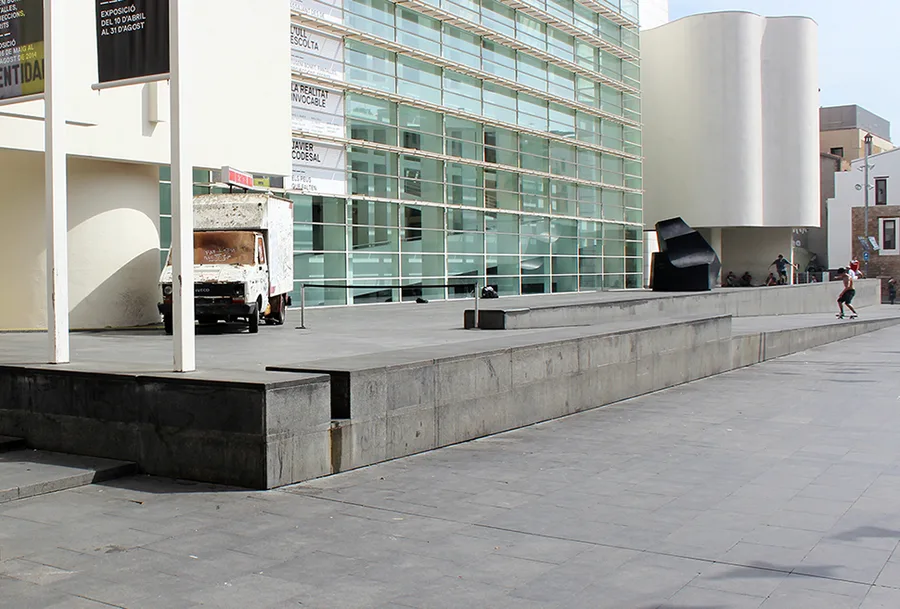
MACBA / Plaça dels Àngels
Barcelona, Catalonia · Spain
Type Street plaza (marble/granite)
Status Active, under threat (museum expansion 2024)
The plaza in front of the Museu d'Art Contemporani de Barcelona, designed by architect Richard Meier (same as the Getty Center in Los Angeles) and opened in 1995 in the Raval neighborhood. Surface close to perfectly smooth and flat, low ledges along the museum facade, the famous 'four-block' and 'three-block' (granite/concrete blocks of different heights), gaps between sets, the iconic five-stair at the far end, a long curved ledge. Four open sides allowing approach from any angle. Catalan and Basque locals (Enrique Lorenzo, Daniel Lebrón, later Javier Mendizabal) colonized it in the late '90s — Mendizabal arrived in 1999 when there were around 10 skaters and skated there daily for 3 years. The international breakthrough came with Eric Koston's part in 'Menikmati' (éS, 2000): overnight, every American and European pro routed trips through Barcelona and rented flats in Raval and Poble Sec. Mike Carroll, Rick Howard, Lucas Puig (who became a Barcelona fixture), Pontus Alv, the entire Cliché team, Stevie Williams, Bastien Salabanzi, and Danny Way all passed through — his back 360 over the four-block is plaza folklore. In 2015 the museum itself acknowledged the skate heritage with an institutional exhibition. 2019: first nighttime ban (10 p.m.–7 a.m.). 2020: weekend ban added (largely ignored). 2024–25: ongoing museum expansion has already demolished the small five-stair.
Why it matters The most influential street skating spot of the past two decades globally. Nearly every purpose-built skate plaza since 2005 (Stoner Skate Plaza in LA, European municipal parks) explicitly copies MACBA's geometry. The architectural irony — Meier's immaculate facade reduced to the backdrop of an unofficial skatepark — is the defining joke of MACBA's identity. The 'Keep MACBA Skating' campaign (Free Skate Mag, 2019) and the @macbalife platform (Alex Braza, ~2016) are the active layers of its ongoing story.
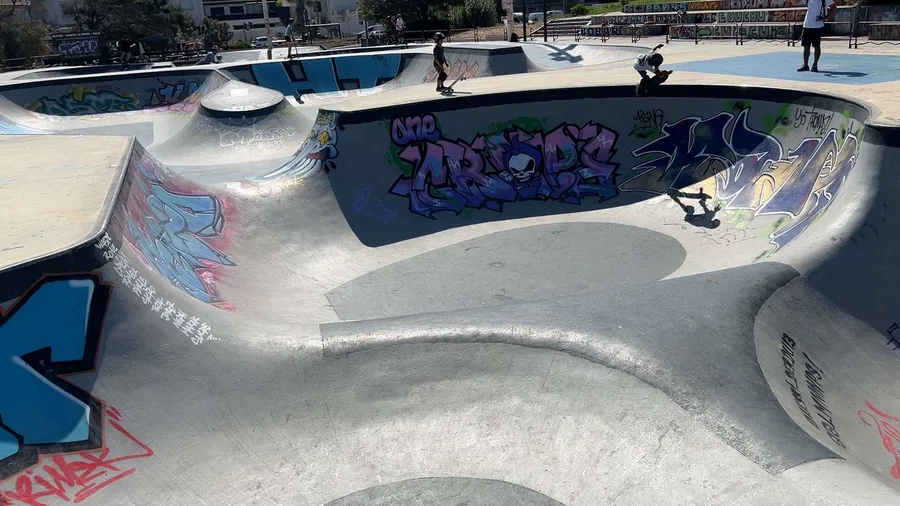
Bowl du Prado
Marseille · France
Type Trifoil bowl (concrete)
Status Active, restored in 2017
Opened July 13, 1991 in the Parc Balnéaire du Prado, alongside the Mediterranean at the Escale Borély. Designed by Jean-Pierre Collinet, then an architecture student, who applied principles of geometry and physics (he cited Newton's pendulum as inspiration: the bowl as a machine for converting potential energy into kinetic and back). Three modules in a clover arrangement: a 1.70 m spine, depths ranging from 1.80 m to 2.70 m (the deepest pocket nicknamed 'la mega'). Built by a landscaping company in 1991 because no skatepark builder in France could handle the project; cost roughly 150,000 euros at the time. Five bowls total plus a street section added later. In 1999 the Quiksilver Bowlriders contest brought Tony Hawk, Rune Glifberg, John Cardiel, Tony Alva, Steve Alba, Omar Hassan, Tony Trujillo, and Wade Speyer — since then it has been a fixed stop on the worldwide bowl pro circuit. Its inclusion in Tony Hawk's Pro Skater 2 (2000) gave it a parallel cultural life. Le Monde has called it 'without doubt the most famous skatepark on the continent.' A 590,000-euro renovation in 2017 (funded by the City of Marseille) preserved the original shape and resurfaced the concrete. Today it annually hosts the Red Bull Bowl Rippers and the Quiksilver Bowlrider.
Why it matters The European answer to the great American bowls. Its design — created by a student informed by physics rather than skater intuition — produced a bowl with lines that lose notably little energy; pros describe it as 'fast' and 'rewarding.' The Huntington Beach skatepark in California is widely reported to be a direct copy of the Prado — a rare case of European export to America. One important footnote: the viral article from April 2023 claiming the bowl was to be demolished for a Primark was a French April Fools' Day joke.
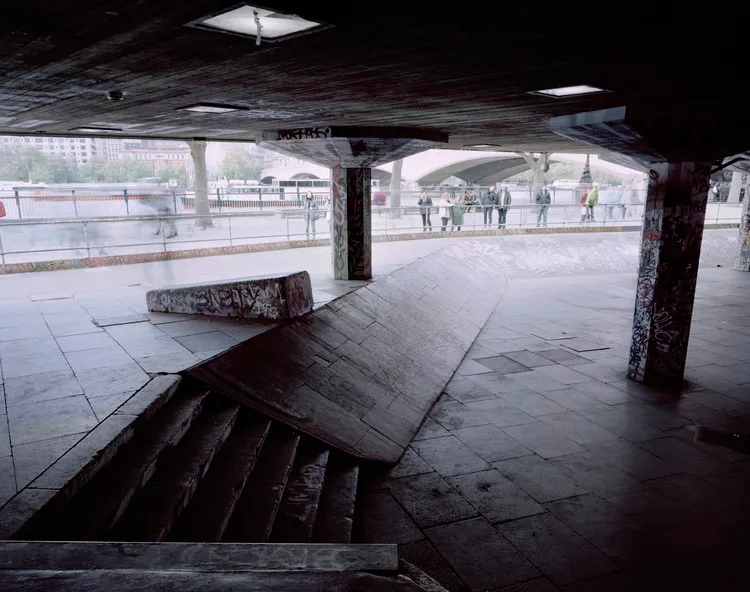
Southbank Undercroft
London · United Kingdom
Type Brutalist undercroft (concrete)
Status Active, legally protected since 2014
A concrete undercroft beneath the Queen Elizabeth Hall, inside the brutalist complex of the Southbank Centre. Square concrete pillars, low banks, low ledges, a small set of stairs, polished concrete floor. Adopted by skaters around 1973 — arguably the oldest continuously skated street spot on the planet, predating any purpose-built skatepark in the United Kingdom. In 2004–05 filmmaker Winstan Whitter premiered 'Rollin' Through The Decades', a retrospective documentary featuring 100+ skaters, photographers and filmmakers. In April 2013 the Southbank Centre announced the 'Festival Wing' plan to convert the Undercroft into shops and restaurants. Skaters and allies launched the Long Live Southbank (LLSB) campaign, gathering ~150,000 signatures and 27,000 letters of objection. On 18 September 2014, LLSB signed a legally binding Section 106 agreement with the Southbank Centre guaranteeing the long-term future of the space. Between 2017 and 2019, LLSB raised funds to restore and reopen the section that had been boarded up in the '90s, with new lighting and concrete repairs. That section reopened in 2019. The spot was the cradle of Palace Skateboards, founded by Lev Tanju from a Southbank crew known as the 'Palace Wayward Boys Choir' (Lucien Clarke, Blondey McCoy).
Why it matters The symbolic heart of British skateboarding and the most significant skate preservation victory in Europe. Its cultural weight accumulates in three layers: longevity (52+ continuous years), political victory (the Section 106 agreement is now a legal precedent cited by similar movements — Love Park, MACBA, Bercy) and cultural incubator (Palace, the most influential UK brand of the 2010s, was born there).
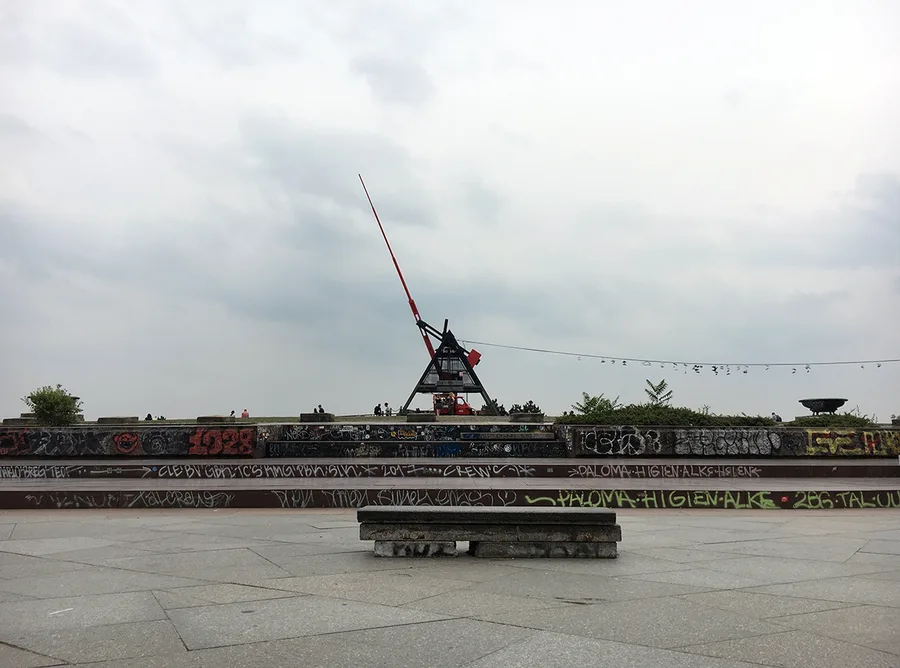
Stalin Plaza / Letná
Prague · Czech Republic
Type Marble plaza + stairs + hubbas
Status Active (with occasional closures)
A large terraced plaza of marble and granite on the Letná hill, overlooking the Vltava and the center of Prague. Originally the base of the largest Stalin statue in the world: 15.5 m tall, ~17,000 tonnes of granite, sculpted by Otakar Svec, inaugurated in 1955 and demolished in 1962 using ~800 kg of explosives. The sculptor took his own life days before the inauguration. After 1989 (the Velvet Revolution), the empty platform went through a stint as a pirate radio station, Prague's first rock club, and — informally — a skate spot, once skaters discovered the loose marble slabs and began repositioning them to build their own ledges. In 1991 the giant metronome (Stroj casu, 75 m) was installed on the vacant pedestal. From the 2000s onward it became a fixture in international skate media — Europe's answer to MACBA. Thrasher's 'Plazacation: Stalin Square' (2020) featuring Marek Zaprazny cemented it in the American skate consciousness. Kingpin Magazine included it in its '25 Most Iconic Skate Plazas of All Time'. In September 2019 structural issues forced a temporary closure of the upper platform; locals organized the 'Save Stalin Plaza' petition.
Why it matters The most politically loaded skate spot on the planet — a marble monument to totalitarian personality cult, reclaimed by post-communist youth as a free-use zone. Skaters completed an organic recoding of the space: a monument designed to impose ideological reverence became a site of play, expression and competition. For skaters from Central and Eastern Europe, Stalin functions the way MACBA does for Catalans — undeniable home spot and international meeting point.
What’s interesting is that none of the four was built for skating, and yet all four ended up defining what it means to skate in Europe. MACBA shows that the right geometry is enough to turn a spot into a global myth. Marseille shows that a well-built bowl gets copied all the way to California (the Huntington Beach park is based on the Prado, according to multiple sources). Southbank shows that when a community organises itself it can win legal battles against property developers. And Stalin Plaza shows that a monument built to impose fear can end up being the freest public space in the city.
2000–2010 — Skateboarding as industry and as media
The last two spots on the list represent skateboarding’s most recent major shift: the moment it became a professional contest industry and something consumed as a daily online feed. Tampa Skatepark and The Berrics are almost opposites. One is an indoor competition venue that skaters have been running for over 30 years. The other was a website that rewrote how skate videos were watched on the internet. But neither can be separated from the skating of the last two decades.
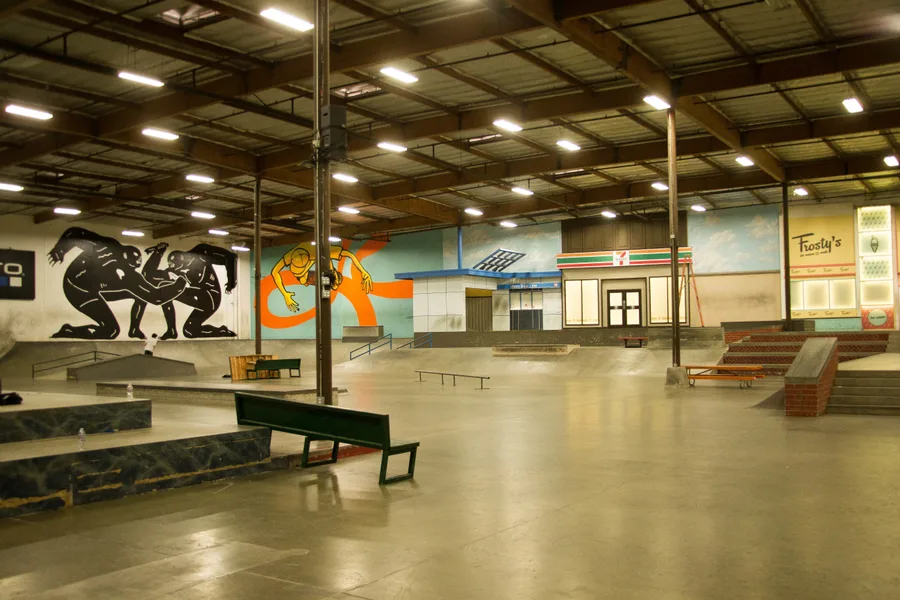
The Berrics
Los Angeles, California · United States
Type Private indoor skatepark (warehouse)
Status Closed 2024, 'Berrics 2.0' relaunched July 2024
A private indoor skatepark built inside a warehouse at 2535 East 12th Street, near downtown Los Angeles. Layout centered on flatground: smooth polished floor, ledges, manual pads, small stair sets, hubbas, banks. Designed as much for filming as for skating — multi-camera setup, controlled lighting, no street friction. The name is a portmanteau of 'Berra' (Steve Berra) and 'Eric' (Eric Koston). In 2007 Berra and Koston opened the original warehouse and launched theberrics.com. In 2008 the first Battle at the Berrics (BATB) was held — a 1v1 Game of SKATE tournament won by Chris Cole. BATB became the most-watched recurring skateboarding format on YouTube throughout the 2010s, with rounds drawing millions of views. Yuto Horigome and Luan Oliveira both used it as a launching pad. In 2019 they launched Women's Battle at the Berrics (WBATB) featuring Lizzie Armanto, Mariah Duran, Pamela Rosa and Lacey Baker. In 2024 Berra publicly revealed that monthly rent had escalated from ~$8,000 (at the original, smaller location) to ~$105,000 — the company ran out of runway. In February 2024 theberrics.com went dark and production halted. In May, Berra and Koston held a public garage sale of 'Canteen' merchandise to cover debts. On 3 July 2024 Berra announced the 'Berrics 2.0' relaunch in a reduced form, searching for a new location.
Why it matters It rewrote the distribution model of professional skateboarding. Before 2007 skate media was anchored to monthly magazines and annual parts on VHS/DVD; The Berrics introduced near-daily online video — high production value, intimate access, competition — and trained an entire generation to consume skateboarding as a streaming feed. Its 2024 collapse crystallized a broader crisis: free-to-watch platforms struggling to sustain the production costs that built them.
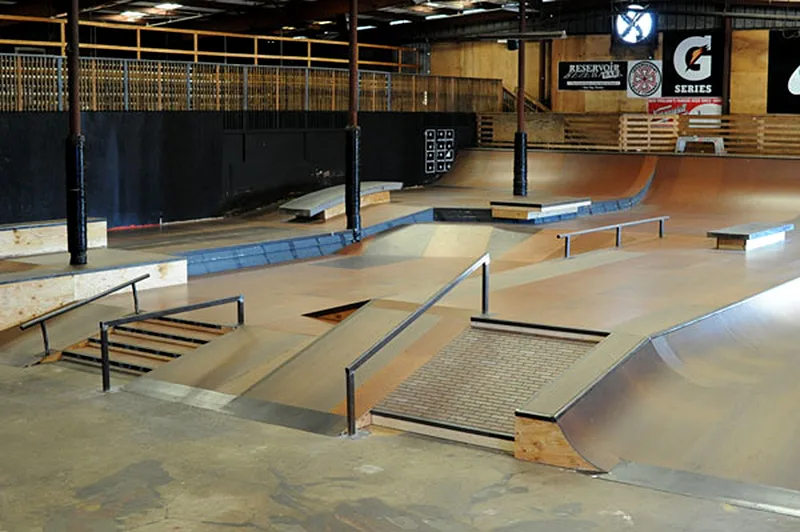
Skatepark of Tampa (SPoT)
Tampa, Florida (Ybor City) · United States
Type Indoor street + bowl, home of Tampa Am/Pro
Status Active, 30+ years in operation
An indoor (and partially outdoor) skatepark housed in a warehouse in the Ybor City district of Tampa. The course is periodically rebuilt for the Tampa Am and Tampa Pro contests: stair sets, hubbas, rails, banks, manual pads, competition-level street course and a bowl/transition area. Its layout has set the benchmark for modern indoor contest street design for three decades. It also houses a skate shop, offices and a small museum. In 1991, local skater Paul Zitzer's vert ramp was dismantled. In 1993, Brian Schaefer opened Skatepark of Tampa in a warehouse to restore a place to skate. In 1994 the first Tampa Am was held; in early 1995, the first Tampa Pro (inaugural winner: Mike Vallely); the first standalone Tampa Am was also won by Josh Stewart. Through the late '90s and 2000s, winning Tampa Am established itself as the credential for turning pro. In 2005, a 10-year-old Nyjah Huston won Tampa Am, marking his arrival. In 2023–24 Yuto Horigome won Tampa Pro back-to-back, bridging core credibility with post-Olympic visibility. In 2025, Sora Shirai won the 31st Tampa Pro.
Why it matters SPoT occupies a unique position in skateboarding: the longest-running and most respected skater-owned contest institution in the world. Where Street League (from 2010) commercialized the format and the X Games televised it as spectacle, SPoT maintained a distinct line — core alternative, skater-run, where the course, the judging and the atmosphere prioritize authenticity over broadcast optimization. The fact that year after year for 30+ years the industry physically convenes in a Florida warehouse twice a year on terms set by skaters — not broadcasters — is its defining cultural contribution.
What these 20 spots teach us
Look at all 20 together and three things come up again and again.
The first is that the best spots were almost never designed for skating. M. Paul Friedberg wasn’t thinking about Brooklyn Banks as a skatepark when he drew it in 1972. Richard Meier didn’t build MACBA so people could do kickflips in front of the museum. Lawrence Halprin didn’t picture backside lipslides when he designed EMB. The best skateable architecture almost always shows up by accident, in plazas built for something else entirely.
The second is that the difference between a spot that survives and one that doesn’t usually has less to do with how good the spot is than with how organised the community behind it is. Southbank survived because its skaters mounted a serious legal campaign that ended with a Section 106 agreement signed in 2014. Love Park didn’t survive. Neither did EMB. MACBA is right now in the middle of that same fight (a nighttime ban since 2019, museum expansion since 2024). The spots that last aren’t always the most spectacular ones; they’re the ones with people behind them willing to move.
The third is that when a spot gets destroyed, it doesn’t entirely disappear. The original granite from Love Park was bought by the city of Malmö in 2024 to reconstruct a skateable version in Sweden. The layout of Bowl du Prado was copied in Huntington Beach. The geometry of Hubba Hideout appears replicated in skateparks from Stockholm to Sydney. And what was learned at EMB was exported around the world through the skaters who lived there. Spots as physical objects can be torn down; what happened in them tends to reappear somewhere else.
Quick reference: where the 20 spots are
| Region | Spots |
|---|---|
| California (SF Bay Area) | EMB, Hubba Hideout, Pier 7, Wallenberg 4 |
| California (LA / SoCal) | Dogtown pools, Mt Baldy, Carlsbad Gap, Hollywood High 16, El Toro 20, Venice Beach, The Berrics |
| Pacific Northwest (USA) | Burnside (Portland) |
| East Coast (USA) | Love Park, FDR (Philadelphia), Brooklyn Banks (NYC), Tampa Skatepark (Florida) |
| Europe | MACBA (Barcelona), Bowl du Prado (Marseille), Southbank (London), Stalin Plaza (Prague) |
There’s an obvious American bias: 16 of the 20 are in the United States, and the four European spots are places that appeared almost by accident — plazas or undercrofts that were never made for skating. That’s not editorial prejudice; it’s what happens when the discipline is born in California and takes a couple of decades to travel. Next time we’ll try to do a second part covering spots from Latin America, Japan, Brazil and China, which is where the new stuff is happening.
Spots that nearly made the list
To keep the selection tight we left out around ten candidates that also deserved a place:
- Pulaski Park (Washington DC) — Pepe Martínez’s brutalist plaza
- Stoner Skate Plaza (Los Angeles) — first public plaza explicitly built “MACBA-style”
- Channel Street (San Pedro, CA) — DIY under a highway, demolished in 2014 and reopened in 2024
- Bercy (Paris) — the French marble plaza of the nineties
- MACBA big 5-stair (Barcelona) — shows up in many videos as its own separate spot
- Hyde Park (Sydney) — something like the Australian MACBA
- Yoyogi Park (Tokyo) — foundational for Japanese skateboarding
- Praça Roosevelt (São Paulo) — Brazilian reference point post-2010
- El Muelle de Bilbao (Bilbao, Spain) — one of the few Spanish spots with any profile outside Barcelona
- Le Dôme / Quai Branly (Paris) — the spot under the arches
If you think there’s something essential missing, say so in the comments and we’ll add it.
Comments
What spot do you think should be on this list and isn't? Any facts to correct? Say it here. Your comment goes live instantly.
Conversation
Your name will be public. Your email stays private. Comments are reviewed before publishing.