
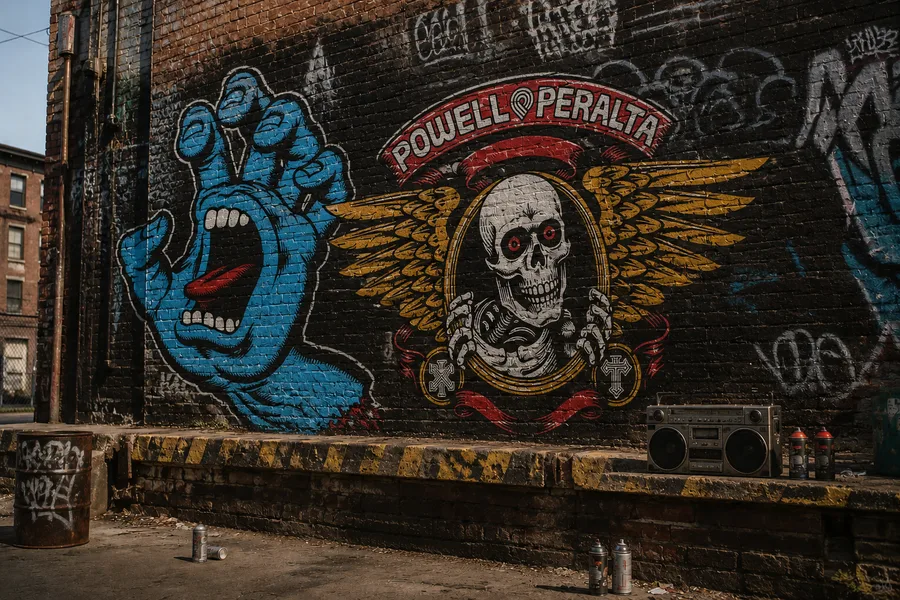
Picking the greatest skate graphics of all time is an impossible mission.
Not because there aren’t enough candidates. Because there are too many.
Every generation has its favourites. Some people remember the first time they spotted a Screaming Hand sticker on a lamp post. Others grew up dreaming of a Powell-Peralta Skull and Sword hanging on their bedroom wall. And some still feel something particular whenever they come across a Gonzales, Templeton or Natas Kaupas deck.
So let’s be clear from the start.
This is not a definitive ranking, and it makes no claim to be an objective list.
It’s our selection of some of the most important, influential, iconic or simply memorable graphics in skateboarding history.
We’ve gone through books, interviews, historical catalogues, magazines like Thrasher, Juice and Jenkem, and dozens of specialist sources to build a timeline that explains how a simple wooden board ended up becoming one of the most recognisable artistic canvases in popular culture. Because skate did something very few sports have managed. It created its own visual language.
While other sports built their identity around teams, stadiums and kit, skating turned the underside of a deck into a canvas. A space where art, music, urban culture, humour, provocation, politics and personality all shared the same surface.
Many of the images here are recognisable even to people who have never done an ollie. That says a lot about their impact.
How this list works
Each graphic includes a vote button so you can tell us which ones deserve to rank higher. Results update in real time and feed into our overall ranking.
If you also want to test your own skating biases, try our bracket: a head-to-head elimination where you pit historic designs against each other until you pick your personal champion.
One thing is certain. There is no right answer.
Is the Screaming Hand better than the Ripper?
Does the Dogtown Cross carry more historical weight than the Skull and Sword?
Can a logo like Girl compete with a Jim Phillips illustrated masterpiece?
We have our opinion, and you definitely have yours. That’s exactly why this article exists.
Before we start…
One thing worth keeping in mind: not all graphics matter for the same reasons. Some revolutionised design. Others sold millions of decks. Some defined a generation. Others helped build a brand. And a few managed to escape skating altogether and become cultural icons recognised worldwide.
Comparing them directly isn’t always fair, but that’s part of what makes it interesting.
If you think a graphic is missing that deserves a spot here, leave it in the comments. We’re sure there are gaps, and we’ll probably never stop adding new candidates. Because the history of art in skateboarding is still being written every day.
Which is the best skate graphic ever? You decide
Full bracket with every article graphic: a short qualifier + clean 64 to the final. Pick a winner each match until your champion.
Start the bracket →1976–1977 — when decks started telling stories
Today it’s nearly impossible to picture a skateboard deck without a striking graphic.
But for much of the 1960s and into the early ’70s, decks were little more than pieces of sporting equipment. A simple logo. A sticker. Some basic silkscreen. Nothing more. The idea that a deck could become a graphic artwork simply didn’t exist.
That started to change in Southern California. And, like so many skating revolutions, it began in Dogtown.
Between Venice and Santa Monica, a generation of skaters was emerging unlike any before it. They skated empty pools, listened to different music and had an attitude far closer to underground surf and punk than to mainstream sport. They needed their own identity. And that identity eventually showed up on wood.
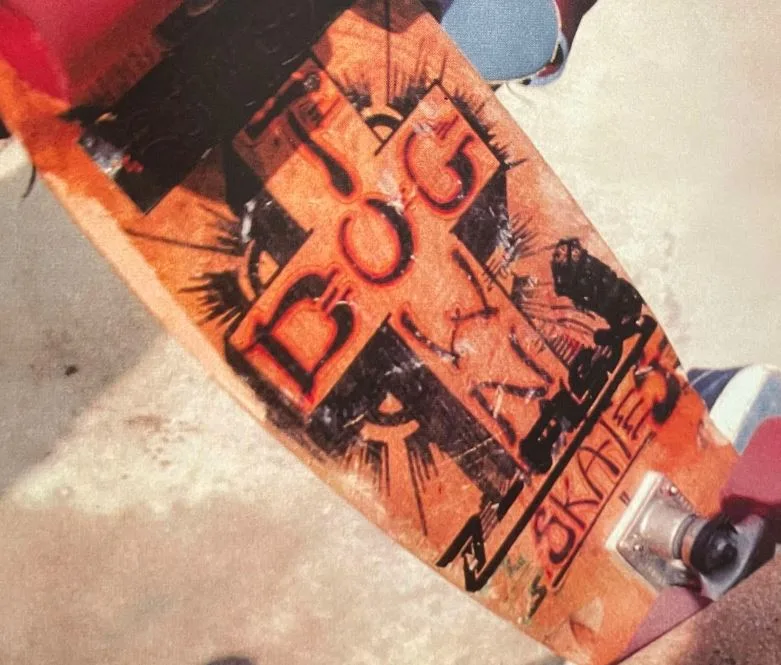
Dogtown Cross
Brand Dogtown Skates
Pro model Team (Tony Alva, Jay Adams, Jim Muir)
Designer Craig Stecyk III (símbolo) + Wes Humpston (deck)
If there is a starting point for the history of graphic art in skateboarding, it is probably the Dogtown Cross. The curious thing is that it wasn't even born as a skate graphic. Craig Stecyk III, photographer, writer, and one of the most important intellectual figures of the Zephyr movement, had spent years painting that cross on the walls of Santa Monica as a territorial mark. It was a neighborhood symbol. A signature. A message for those who belonged to the Dogtown scene. When Wes Humpston asked permission to use it on Dogtown Skates boards (around 1976), Stecyk gave it to him. But the real revolution was Humpston: he started drawing by hand directly on the boards, something that seems normal today but in 1976 was unheard of. Without Humpston it's hard to imagine the later work of Jim Phillips, VCJ, or any other great skate artist.
Why it matters Not because it was the prettiest graphic or the best-selling one, but because it was the first to prove that a board could convey culture, attitude, and belonging. Skateboarding had stopped selling only performance. It had started selling identity. The most important formal innovation in the visual history of skateboarding.
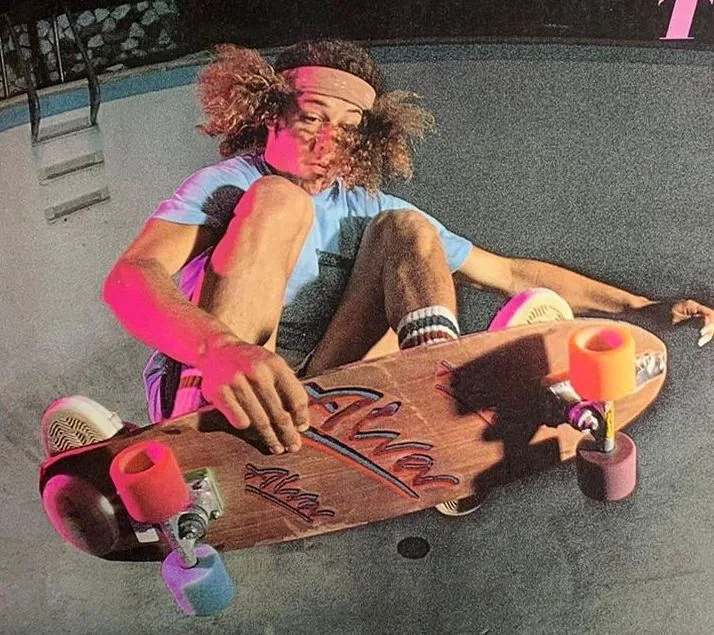
Alva (logo + fades)
Brand Alva Skates
Pro model Tony Alva
Designer Tony Alva / equipo Alva
If Dogtown helped create skateboarding's visual identity, Tony Alva helped change its business model. A Dogtown Z-Boy, he founded Alva Skates in 1977 and became the first major professional to start his own brand rather than ride for a company run by engineers. Today that sounds unremarkable, but at the time it was a declaration of independence. Alva's angular "A" and the color-fade stained decks quickly became a recognizable image within the scene. No monsters. No complex illustrations. No narratives. Just attitude. And it worked. The brand communicated exactly Tony Alva's personality: aggressive, defiant, and completely removed from the traditional sporting image.
Why it matters Set the precedent for the skater-run brand. That model — the rider as owner — is the one Powell, World Industries, Plan B, Birdhouse, Girl, Baker, and virtually every skater-owned brand would replicate afterward. The idea that a skater could control his own image started here.
Vans — Off The Wall
Brand Vans
Pro model (footwear brand)
Designer Familia Van Doren
Technically not a board graphic, but it's impossible to tell the visual history of skateboarding without pausing on Vans. The Van Doren Rubber Company opened in Anaheim in 1966 making custom rubber-soled shoes. By the mid-seventies, California skaters had adopted the Era and the Authentic for a very simple reason: they worked better than almost anything else available at the time, largely because of the sticky waffle sole. What came next was unexpected: the waffle sole, the checkerboard, the Off The Wall slogan, the Sk8-Hi, the Half Cab. All of those elements ended up forming one of the most recognizable visual systems in all of skate culture. Today you can find a Vans t-shirt in any city on the planet, but its DNA is still connected to those first California skateparks.
Why it matters Helped prove that skate aesthetics could transcend skating itself. An idea that would explode decades later with Supreme, Thrasher, and much of modern streetwear. The checkerboard and Off The Wall are among the most recognizable emblems in skate culture, both inside and far outside the board.
By the late 1970s it was clear something important was happening. The deck was ceasing to be simply a tool for skating. It was becoming a medium for expression.
Nobody imagined what was about to come next. Because in 1978 a small brand called Powell-Peralta brought on an illustrator named Vernon Courtlandt Johnson. And from that point on, nothing would ever be the same.
1978–1989 — Powell-Peralta and the golden age of the skate graphic
If there’s one brand that permanently changed the aesthetic of skateboarding, it’s probably Powell-Peralta.
During the 1980s, Powell didn’t just assemble some of the most important skaters in history under the Bones Brigade banner. It also helped transform the deck into something beyond a sporting product. For the first time, graphics were starting to matter as much as the rider.
Much of that transformation ran through Vernon Courtlandt Johnson, better known as VCJ. His work defined a large part of classic skateboarding’s visual vocabulary: skulls, dragons, fantastical creatures, medieval symbols and compositions that still show up today on reissues, collections and the walls of thousands of skaters.
What’s interesting is that many of these designs didn’t just work as spectacular illustrations. They also helped build each rider’s identity. The deck was beginning to become an extension of the personality of the person skating it.
Skull and Sword
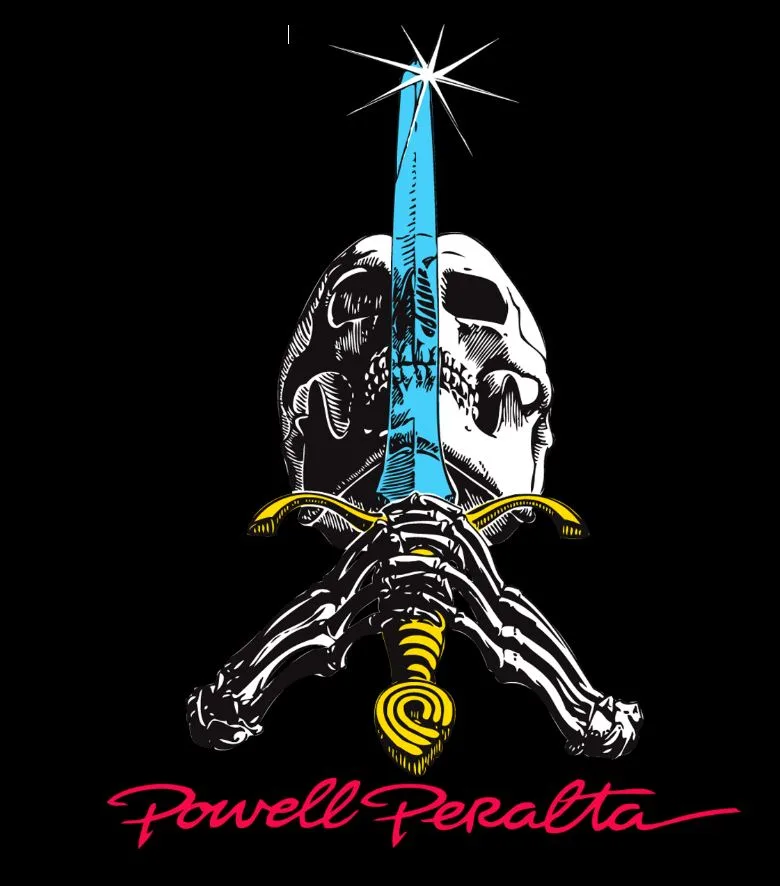
Skull and Sword
Brand Powell-Peralta
Pro model Ray 'Bones' Rodriguez
Designer Vernon Courtlandt Johnson (VCJ)
Powell-Peralta's first pro signature and one of the first great skulls on an industrially produced skate deck. Released in Brite-Lite Dayglo colors. Rodriguez's nickname 'Bones' came from the graphic itself, and the name Bones Brigade (1979) became permanently fixed following the model's commercial success.
Why it matters Established Powell-Peralta's visual DNA for the following decade.
Chinese Dragon
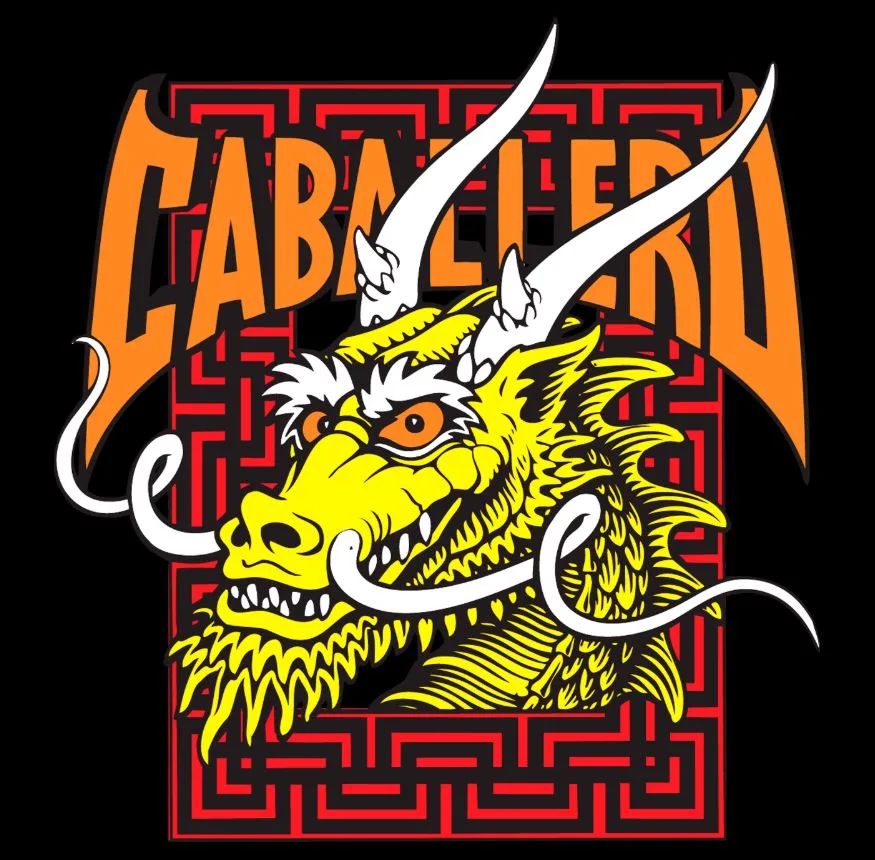
Chinese Dragon
Brand Powell-Peralta
Pro model Steve Caballero
Designer VCJ, sobre boceto de Steve Caballero
Cab was Rookie of the Year 1980 and turned down Powell's proposed design (skull + propeller), presenting his own drawing instead: a crouching dragon. VCJ finished it. The graphic ran for 6 years with minimal changes — a record.
Why it matters The first time a rider co-signed his own graphic at Powell. Established the idea that a deck should reflect the skater's personality.
Iron Cross / Screaming Chicken Skull
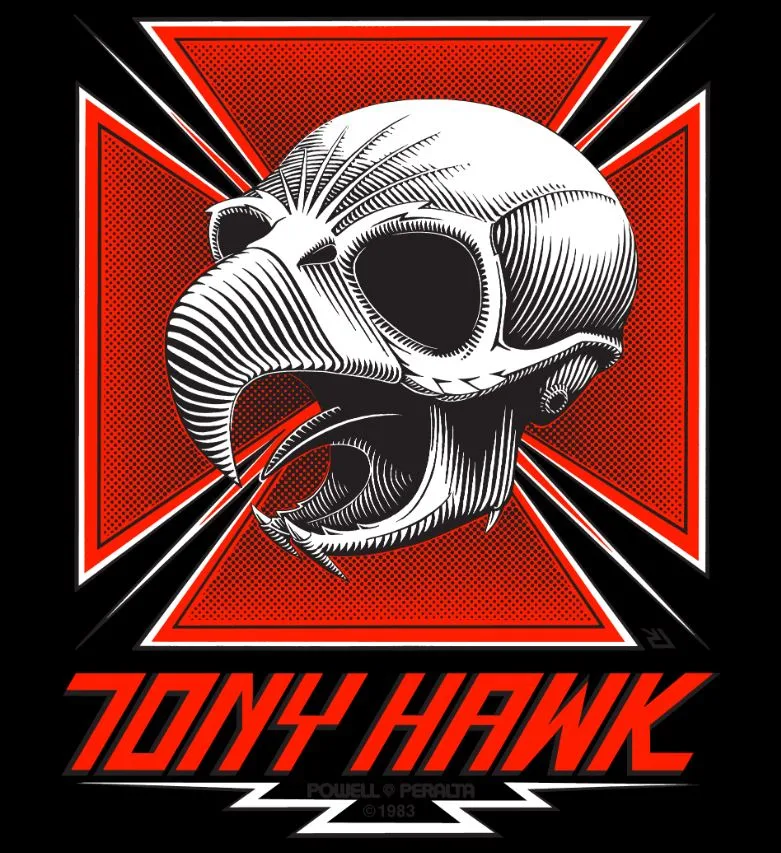
Iron Cross / Screaming Chicken Skull
Brand Powell-Peralta
Pro model Tony Hawk
Designer VCJ
Hawk had suffered a commercial failure with his 'Soaring Hawk' (1982). VCJ redesigned it: a hybrid human/hawk skull over a biker-style iron cross. When skateboarding rebounded in 1984, this graphic took off alongside Hawk's career.
Why it matters One of the most reproduced graphics in history. The visual foundation of Hawk's personal brand for 40 years.
The Ripper
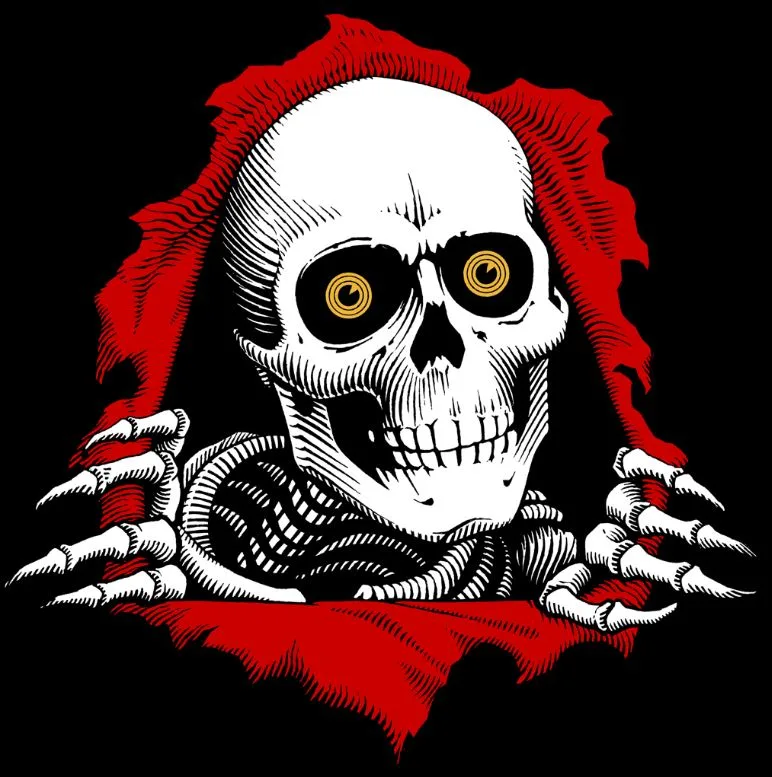
The Ripper
Brand Powell-Peralta
Pro model (brand logo)
Designer VCJ
Originally drawn as a 'Bones Sold Here' sticker for shops. It proved so successful that it migrated to T-shirts, stickers, and its own deck. A skull tearing through paper with its claw.
Why it matters Alongside the Screaming Hand, one of the most reproduced and recognized graphics in skate history. It proved that a brand image could outsell any specific pro model. Still in production more than forty years after its original release.
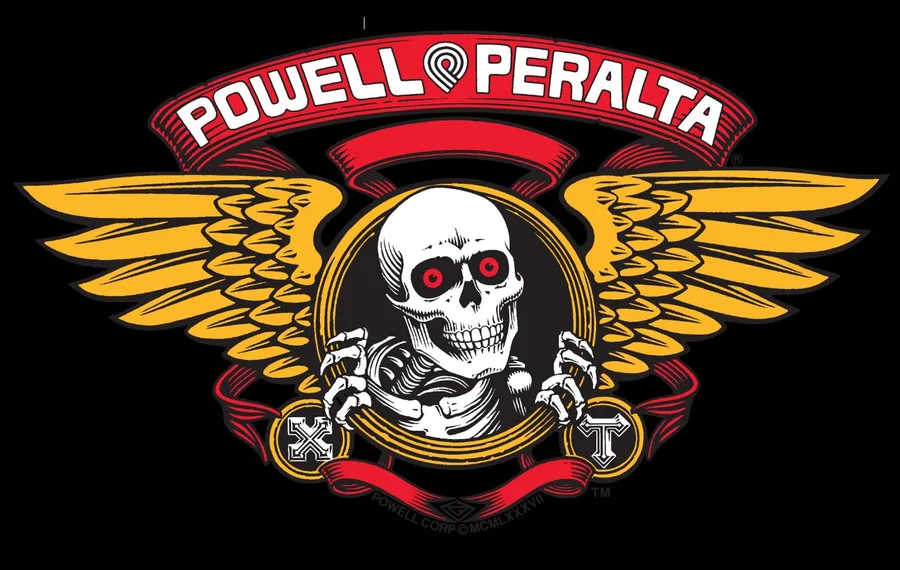
Winged Ripper
Brand Powell-Peralta
Pro model (team / promotional)
Designer Vernon Courtlandt Johnson (VCJ)
Variation of the Ripper (1983) with wings extended on either side of the skull. It appears in the Powell-Peralta catalog from the mid to late '80s as a team and promotional graphic, and has been part of the brand's recurring reissues, including modern Bones Brigade series.
Why it matters One of the most reproduced variants of the original Ripper. Expands VCJ's heraldic language toward larger-scale compositions.
Between 1983 and the late ’80s, Powell went through a creative period that’s hard to match. Each season brought new graphics that expanded the brand’s visual universe and proved that VCJ could adapt to very different personalities without losing aesthetic coherence.
Within that catalogue, one piece deserves a separate mention: the Mutt / Chess Piece by Rodney Mullen. It isn’t the most spectacular graphic the brand produced, but it’s the pro model of arguably the most influential skater in history, and it deliberately breaks with Powell’s dominant aesthetic. That choice to stand apart, within a brand with such an established visual language, says a lot about how much creative latitude existed at that time.
Nordic Skull
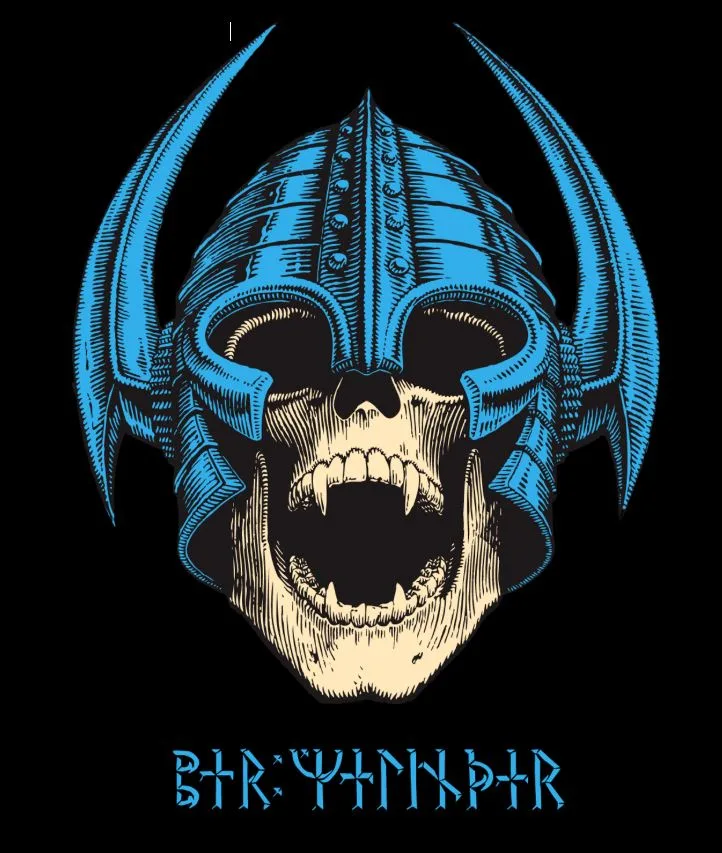
Nordic Skull
Brand Powell-Peralta
Pro model Per Welinder
Designer VCJ
A fantasy skull surrounded by Viking runes spelling out Welinder's name plus the message: 'Search and strive, push beyond with strength, yours not theirs, that is the key.' It reflected his Swedish heritage.
Why it matters The first Powell graphic with integrated cultural/ethnic identity. VCJ channeling his study of medieval manuscripts.
Skull and Snake
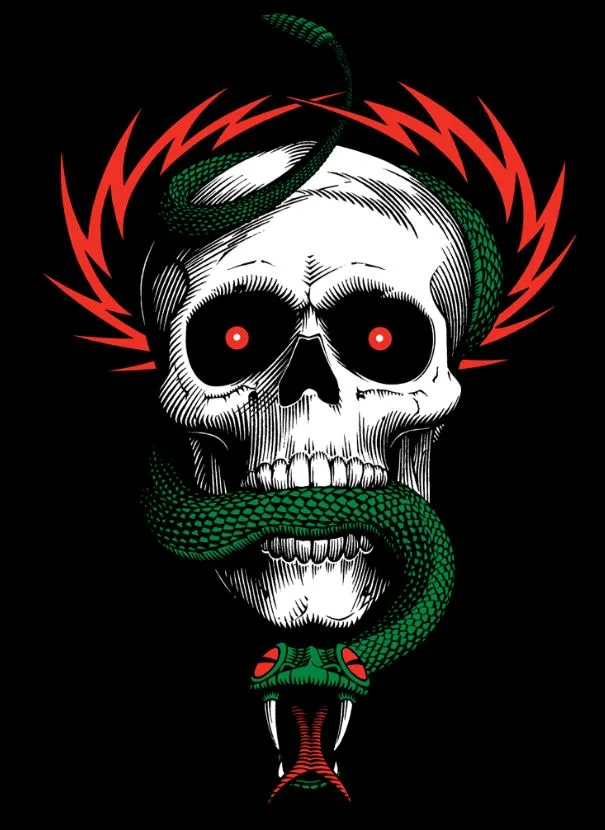
Skull and Snake
Brand Powell-Peralta
Pro model Mike McGill
Designer VCJ + Mike McGill
Designed while McGill was perfecting the McTwist at the Swedish camp in 1984. He added the snake and the lightning bolts citing Florida, his home state. One of Powell's all-time best-selling decks.
Why it matters The peak of VCJ's skull-and-creature formula. Inspiration for an entire generation of skate artists.
Future Primitive
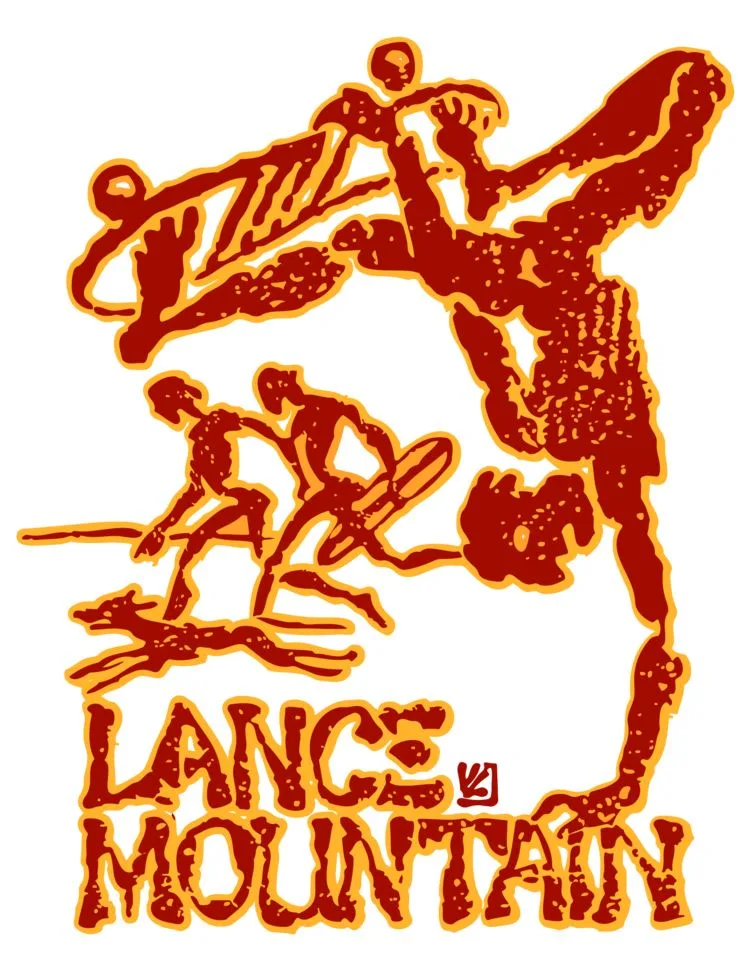
Future Primitive
Brand Powell-Peralta
Pro model Lance Mountain
Designer VCJ
Mountain rejected an initial skull-and-knee-bone concept because he wanted to break the mold. What came out was an illustrative composition with tribal/primitive references. The original run had a hidden dog phallus detail that was quickly pulled — those copies with the detail are hyper-collectible. The graphic gave its name to the Powell video in 1985.
Why it matters Broke the skull mold. Demonstrated the broader illustrative range of VCJ.
Flaming Dagger
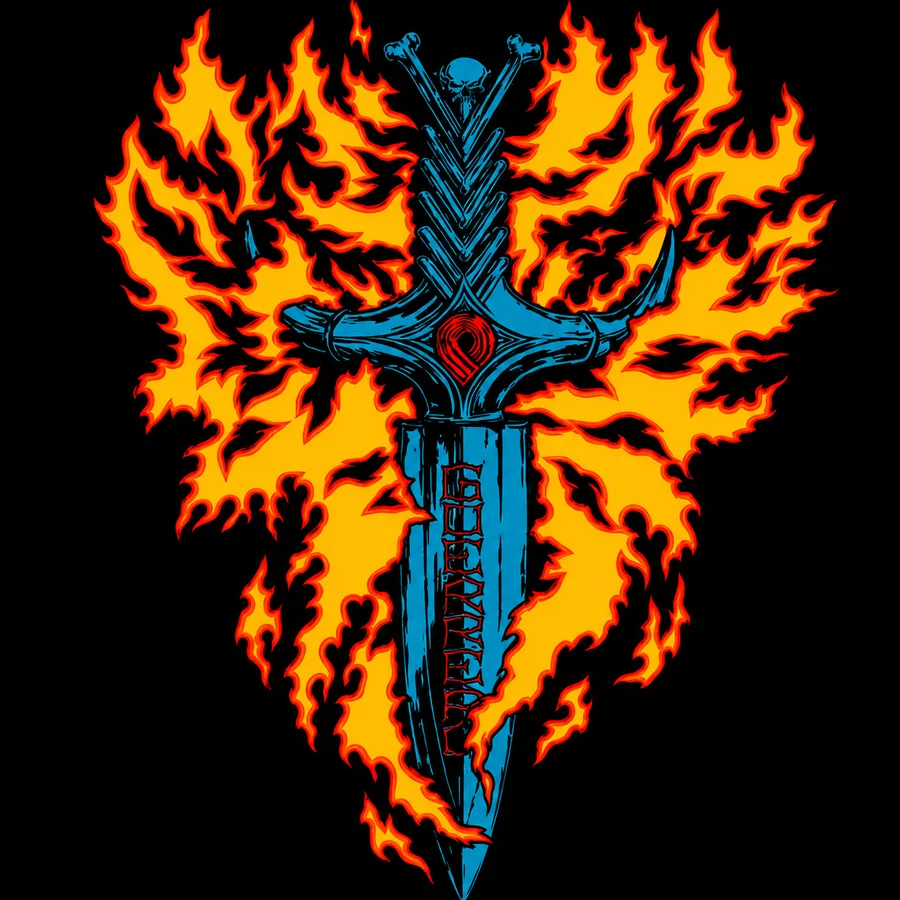
Flaming Dagger
Brand Powell-Peralta
Pro model Tommy Guerrero
Designer Kevin Ancell (NO VCJ)
Inspired by American hot rod hood art from the 1960s–70s. The first Powell pro graphic not drawn by VCJ. It marked a clear differentiation: Guerrero as a street/urban skater set apart from the rest of the vert-oriented Brigade.
Why it matters The first crack in VCJ's total dominance. A preview of the visual diversification that would come in the 90s.
Elephant
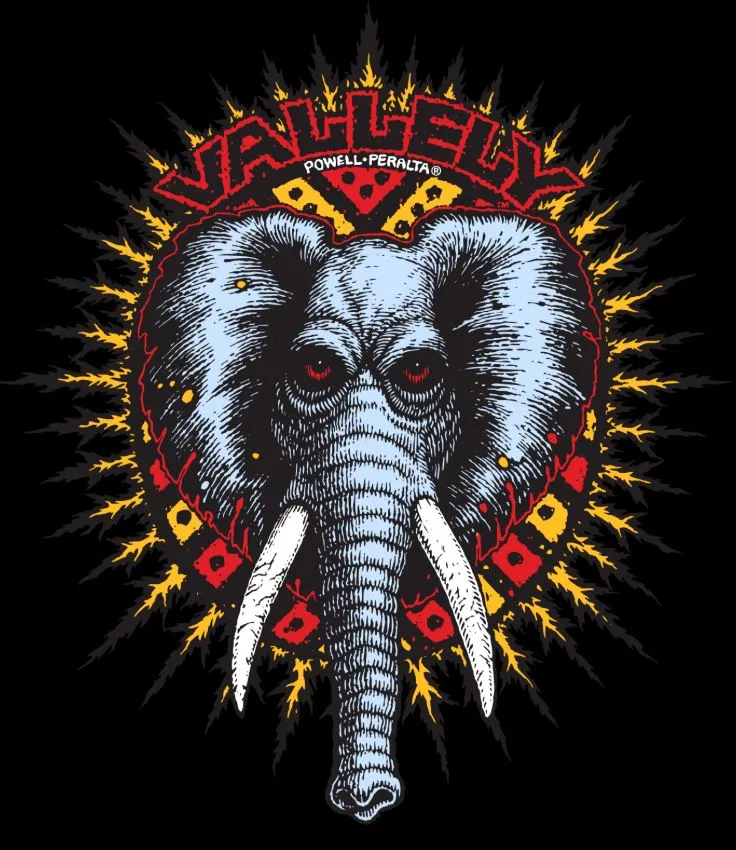
Elephant
Brand Powell-Peralta
Pro model Mike Vallely
Designer VCJ + Mike Vallely
Vallely's first pro model. He rejected an earlier 'Roach' concept. The elephant came out of his collaboration with VCJ and followed Vallely throughout his entire career (his brand is called Elephant Skateboards today).
Why it matters Last major VCJ before the mass talent exodus from Powell in 1991.
A complete universe
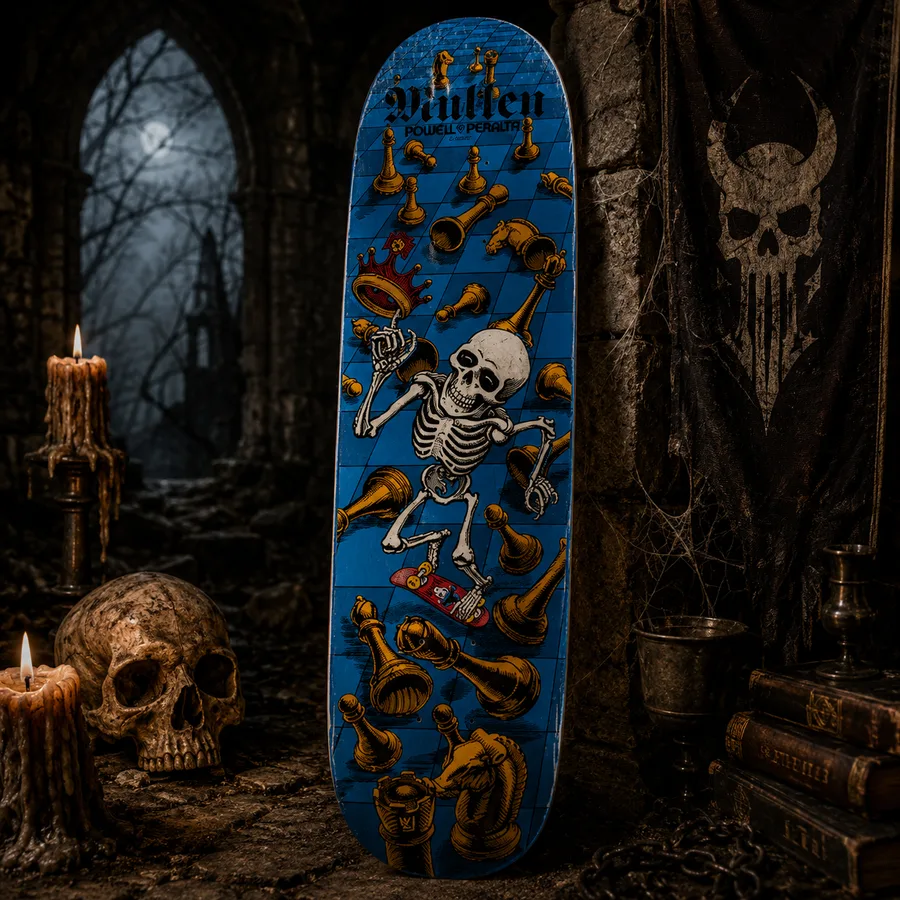
Mutt / Chess Piece
Brand Powell-Peralta
Pro model Rodney Mullen
Designer VCJ
Powell's first freestyle pro model. The chess motif (circa 1983 version) represented Mullen's analytical mind — chess as a metaphor for flatground. One piece is in the Smithsonian collection.
Why it matters Symbol of the 'thinking skater.' Mullen is the technical father of modern street skating.
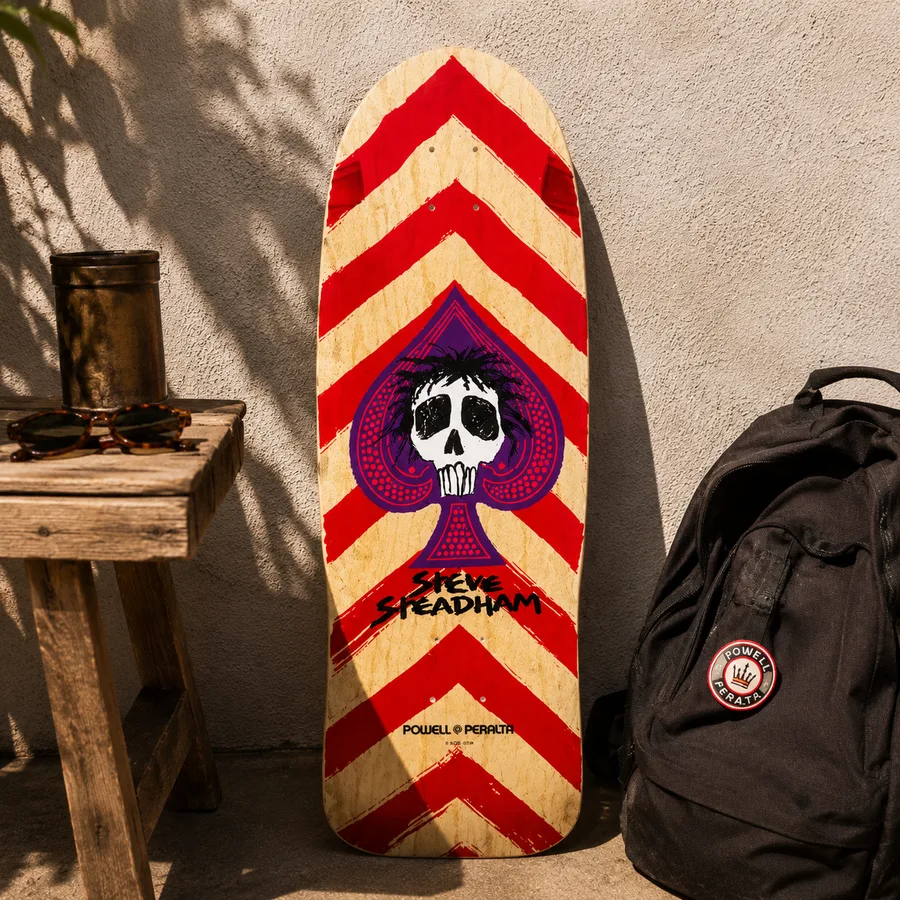
Skull and Spade
Brand Powell-Peralta
Pro model Steve Steadham
Designer Craig Stecyk III (NO Phillips)
Rasta skull + sidecut shape + squared tail for pool coping. Steadham was the first prominent Black pro rider on Powell.
Why it matters A landmark of representation in an almost entirely white industry.
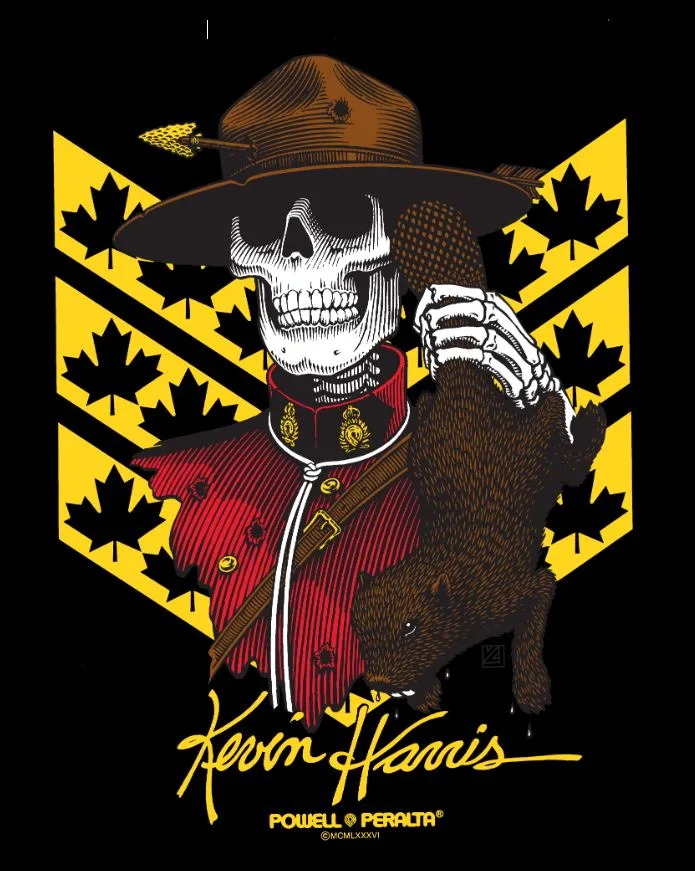
Kevin Harris (Mountie and Beaver)
Brand Powell-Peralta
Pro model Kevin Harris
Designer Vernon Courtlandt Johnson (VCJ)
Pro model for Canadian freestyler Kevin Harris on Powell-Peralta, designed by VCJ. The graphic — a Royal Canadian Mounted Police officer alongside a beaver — combined the two Canadian national icons as a nod to the rider's origins. Harris was one of the defining figures of '80s freestyle alongside Rodney Mullen, with a style oriented toward comedy and spectacle.
Why it matters One of the few freestyle pieces in the Powell-Peralta catalog alongside the Mullen Chess, and one of VCJ's pro models with the most explicit cultural identity.
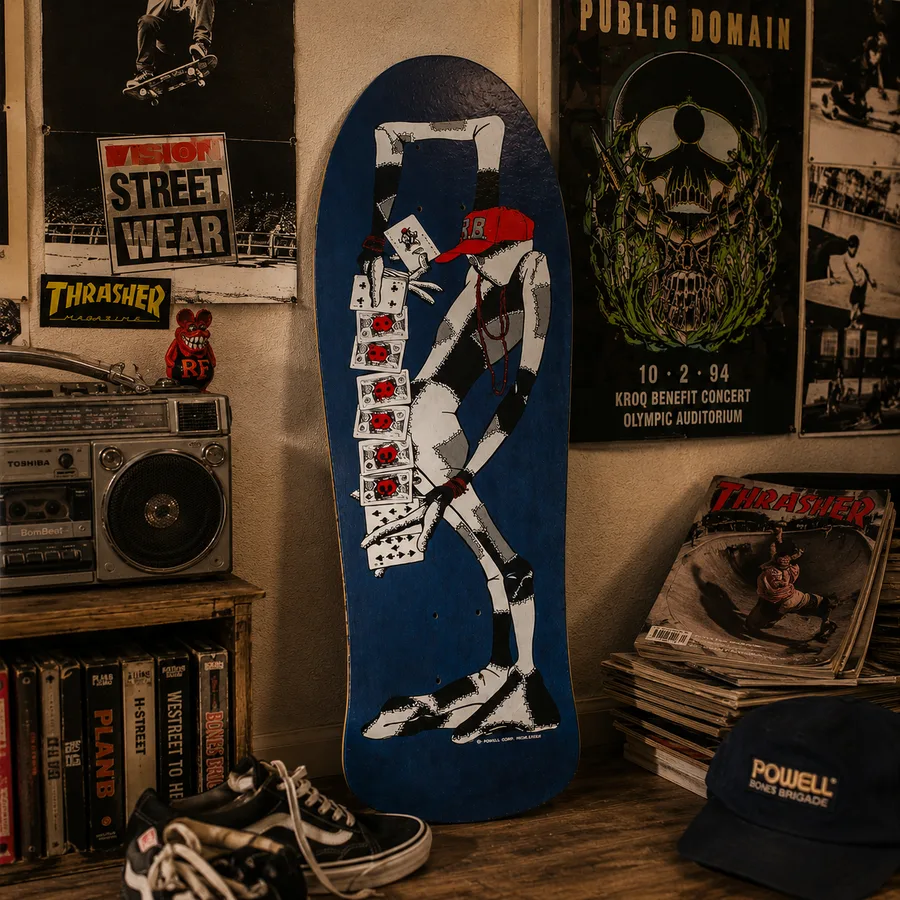
Ray Barbee Ragdoll
Brand Powell-Peralta
Pro model Ray Barbee
Designer Vernon Courtlandt Johnson (VCJ)
Ray Barbee's pro model, Bones Brigade member, designed by VCJ. The motif — a ragdoll on a warm background — moves away from Powell-Peralta's usual gothic repertoire and reflects a register closer to Barbee's own style, known for his fluid skating and his parallel career as a musician.
Why it matters One of the few Bones Brigade pro models that breaks from VCJ's characteristic heraldic code of skulls and dragons.
Vato Rats / Rat Bones
Brand Powell-Peralta
Pro model (brand logo)
Designer Craig Stecyk III
Stecyk reactivated his 1970s Dogtown iconography (Latino gangs of Santa Monica/Venice) and Stacy Peralta brought it to Powell as a brand graphic in 1983. An aesthetic line running counter to VCJ: rawer, more street-level, Latino-influenced.
Why it matters A direct line of continuity between the Dogtown underground of the 70s and the commercial Powell of the 80s. Same neighborhood, same artist, different market.
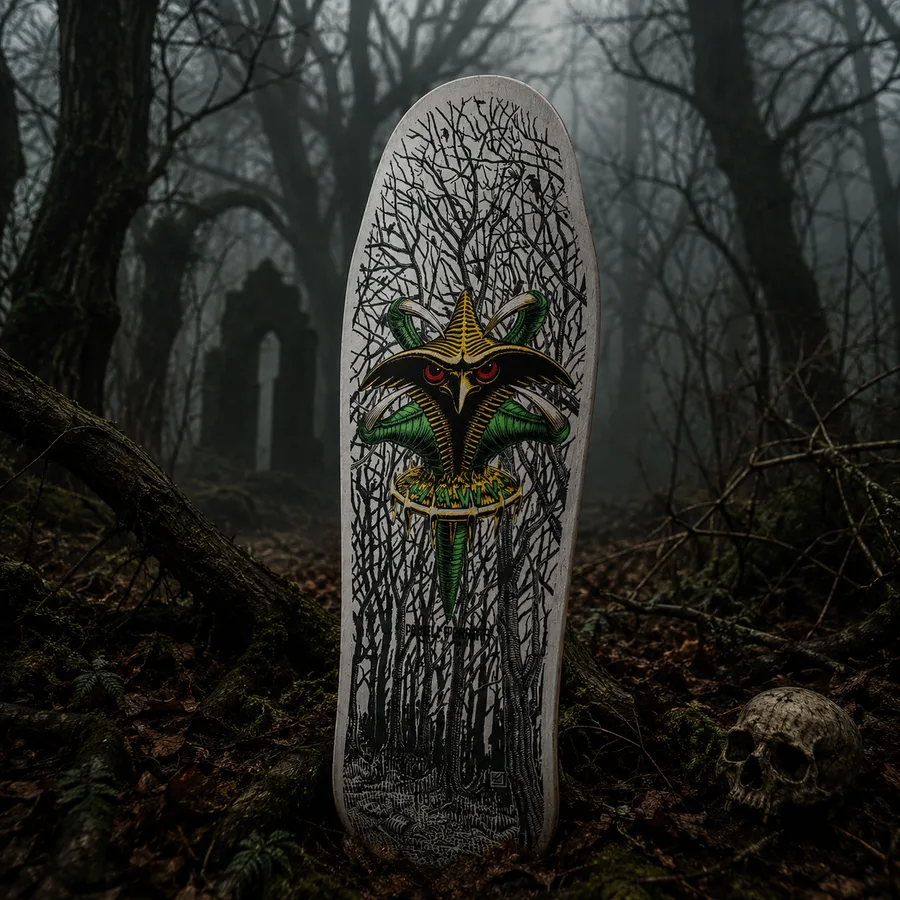
Tony Hawk Claw (Powell-Peralta)
Brand Powell-Peralta
Pro model Tony Hawk
Designer Vernon Courtlandt Johnson (VCJ)
Tony Hawk's pro model for Powell-Peralta featuring a bird claw motif. It belongs to the last generation of Hawk designs for the brand before his departure in 1992 to co-found Birdhouse with Per Welinder.
Why it matters Closes out Hawk's Powell era within the VCJ visual language. Direct precursor to the avian imagery Hawk would later bring to Birdhouse.
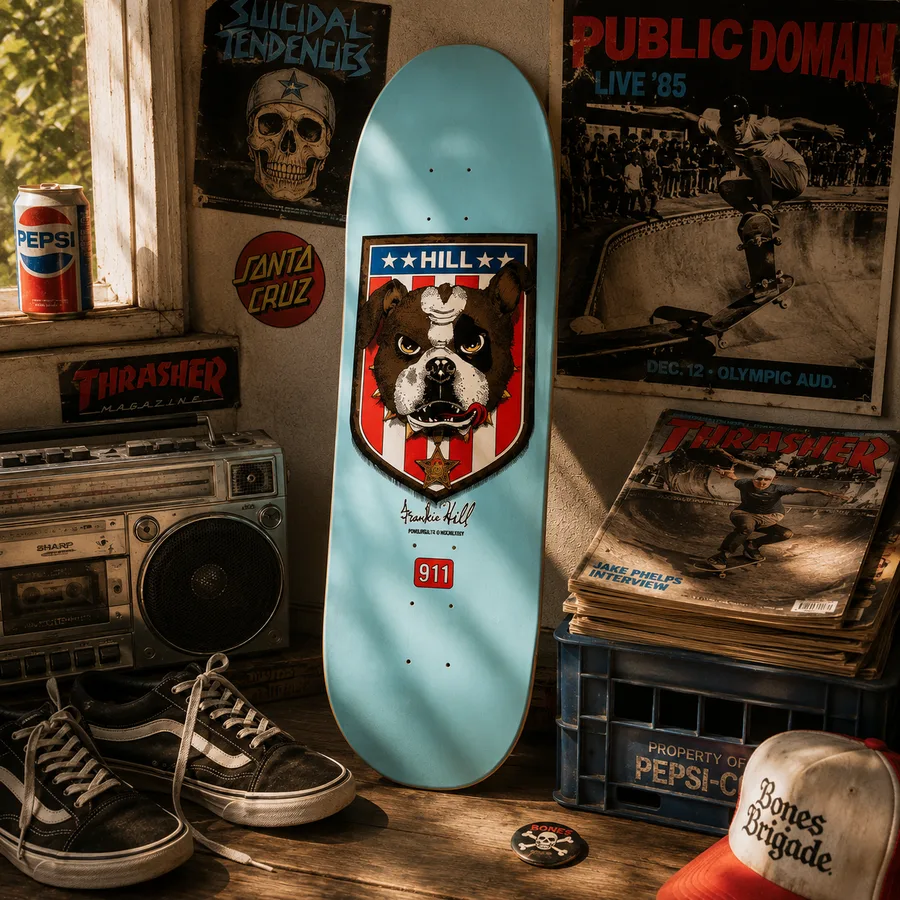
Frankie Hill Bull Dog
Brand Powell-Peralta
Pro model Frankie Hill
Designer Vernon Courtlandt Johnson (VCJ)
Frankie Hill's pro model, drawn by VCJ. Bulldog head with bandana on a yellow background. Hill was one of Powell-Peralta's street pros in the late '80s, known for his bowl-to-banks skating and powerful build. The model is considered one of VCJ's last significant designs before the industry crash of 1991.
Why it matters Closes out the final generation of VCJ '80s pro models before the dissolution of the classic Bones Brigade.
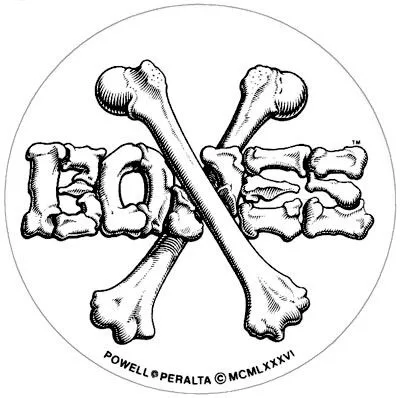
BONES (wordmark with crossed bones)
Brand Powell-Peralta · Bones
Pro model (brand logo)
Designer Powell-Peralta / Bones
Wordmark for Powell-Peralta's Bones line (Bones Wheels, Bones Bearings, Bones Brigade): the word BONES in heavy type with two crossed bones forming an X behind the letters. Heavily stamped on tees, stickers, and merch from the early '80s, it achieved massive penetration in California youth culture of the era. A significant portion of those wearing the logo didn't skate — they wore it for its association with the skate world.
Why it matters One of the skate-world wordmarks with the greatest presence outside the sport itself as a street garment during the '80s and '90s.
1980–1989 — Santa Cruz and Jim Phillips: the other great skate universe
While Powell-Peralta was building its visual world around medieval skulls, dragons and heroic fantasy, on the other side of California a completely different vision of what a skateboard deck could be was taking shape.
If VCJ represented precision, symbolism and the influence of classical illustration, Jim Phillips went all-in on excess, colour and visual energy. And it worked.
Santa Cruz had existed since the early ’70s under the NHS umbrella, but it was Phillips’s arrival as art director that ultimately defined the brand’s visual personality. His background designing concert posters and psychedelic art was a perfect fit for where skating was heading. The result was a collection of impossible creatures, deformed monsters, self-propelled hands, oversized skulls and characters that looked like they’d escaped from an underground comic cover.
Unlike Powell, where many graphics conveyed an epic or almost mythological feeling, Santa Cruz went for something more visceral. Their illustrations were fun, aggressive, exaggerated and, above all, unforgettable.
What’s interesting is that, while Powell and Santa Cruz have often been presented as polar opposites, the reality is that both brands helped build the golden age of art in skateboarding. One contributed elegance and symbolism; the other, personality and a unique ability to create visual icons that still hold up forty years later.
Few eras have concentrated so much creativity into such a short window of time. And few have produced so many graphics that are still being reissued over and over again.
The proof starts with a blue hand that went on to become one of the most recognisable symbols in all of skate culture.
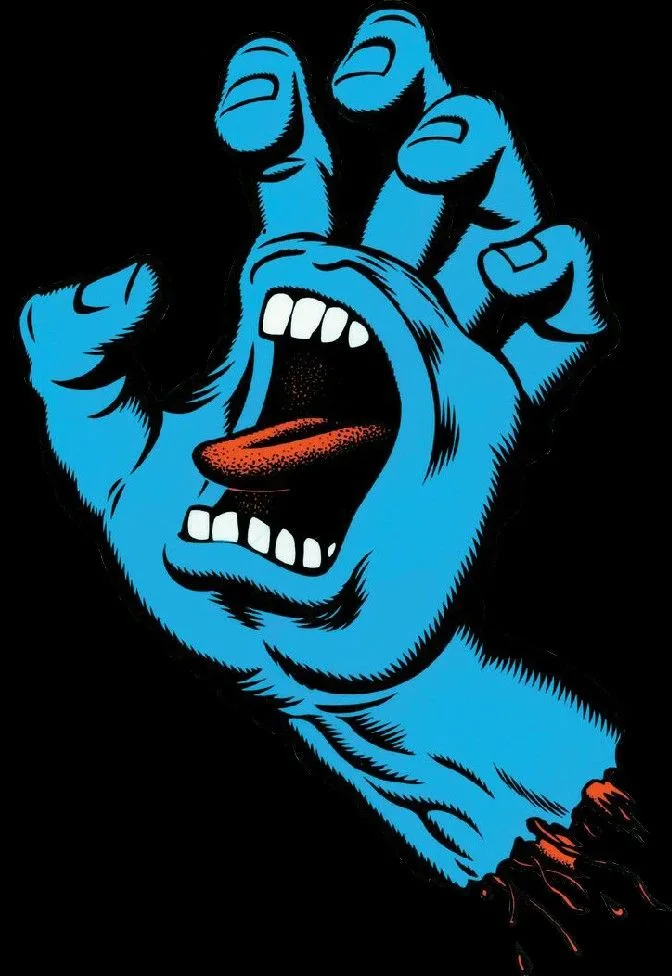
Screaming Hand
Brand Santa Cruz / Speed Wheels
Pro model (brand logo)
Designer Jim Phillips
Phillips had spent years drawing variations on the theme (a shipwreck survivor screaming with his hand above water). In 1985 he reformulated it: a blue screaming hand with its own mouth between the fingers. It was designed for the Speed Wheels line but ended up consuming the entire brand. Its 30th anniversary was celebrated with a traveling exhibition across 25+ countries.
Why it matters Frequently cited — alongside the Ripper — as one of the most reproduced graphics in skate history. It appears tattooed on thousands of skaters worldwide and functions as Santa Cruz's de facto second emblem alongside the brand's wordmark.
Even before the Screaming Hand had conquered half the planet, though, Santa Cruz already had another visual emblem that would survive entire generations of skaters.
Santa Cruz Dot Logo
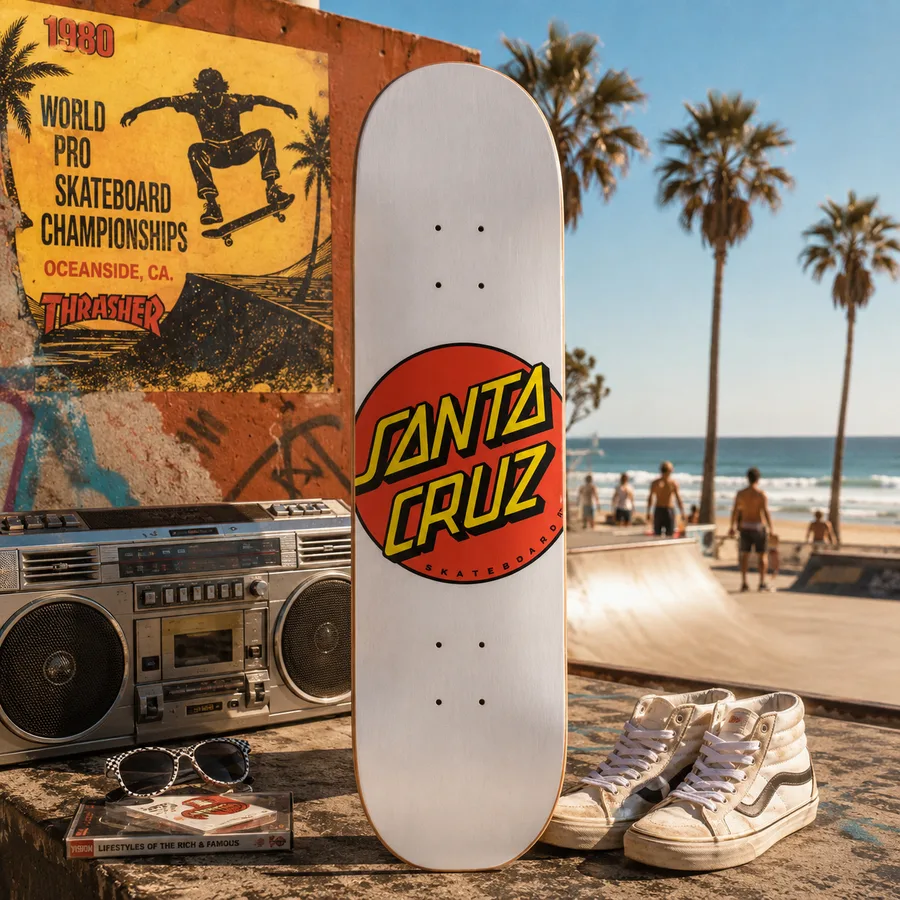
Santa Cruz Dot Logo
Brand Santa Cruz Skateboards
Pro model (brand logo)
Designer Jim Phillips
The iconic red circle with the Santa Cruz wordmark appeared in the late seventies and quickly became one of the most powerful identifiers in the entire industry. Unlike other logos that changed constantly with the trends, the Dot has barely needed updating across more than four decades. It can be found on boards, wheels, clothing, stickers, and virtually any product associated with the brand.
Why it matters Together with the Screaming Hand it forms the core of Santa Cruz's visual identity and is one of the most recognizable logos in the entire history of skateboarding.
If the Screaming Hand ended up representing an entire brand, Rob Roskopp was the subject of one of the most interesting narrative experiments in skate history. Rather than sticking to a single illustration, Jim Phillips developed a series of graphics that evolved from deck to deck — something very unusual for the time.
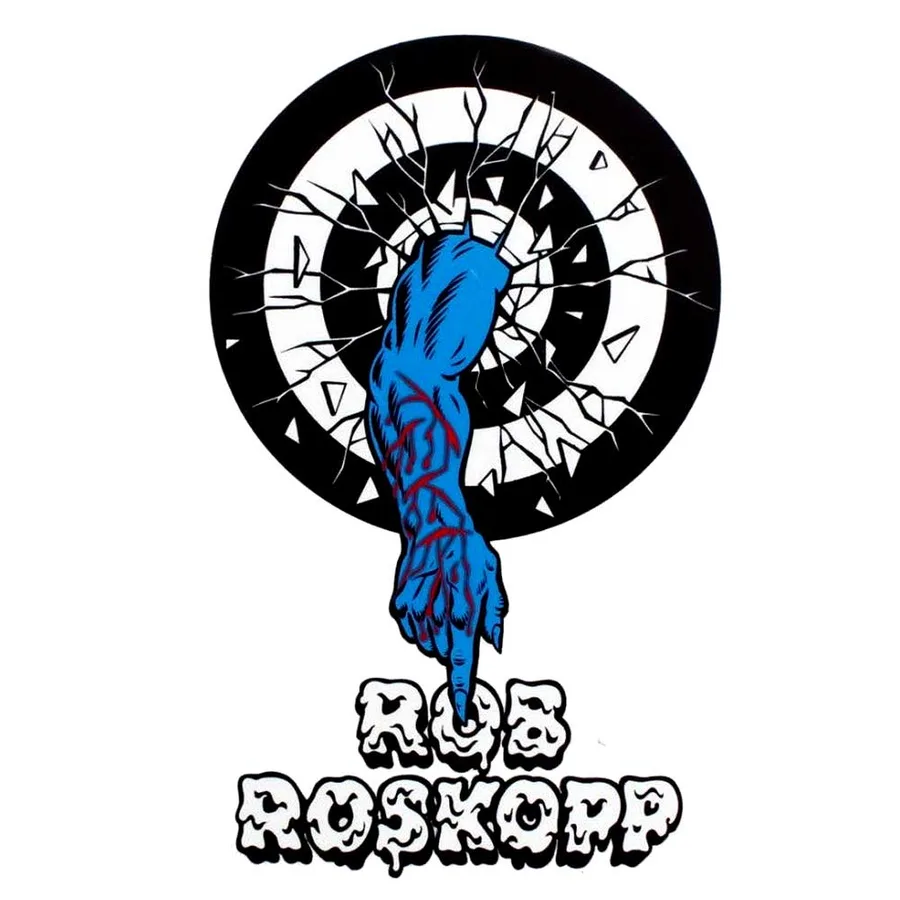
Roskopp Target
Brand Santa Cruz
Pro model Rob Roskopp
Designer Jim Phillips + Rob Roskopp
Roskopp's first pro model. The original concept ('an arm breaking through a target') was his; Phillips brought it to life. It evolved across 7-8 decks over the decade: arm, head, torso, full monster destroying the target.
Why it matters The first evolutionary series in skate. It invented the multi-board narrative mechanic.
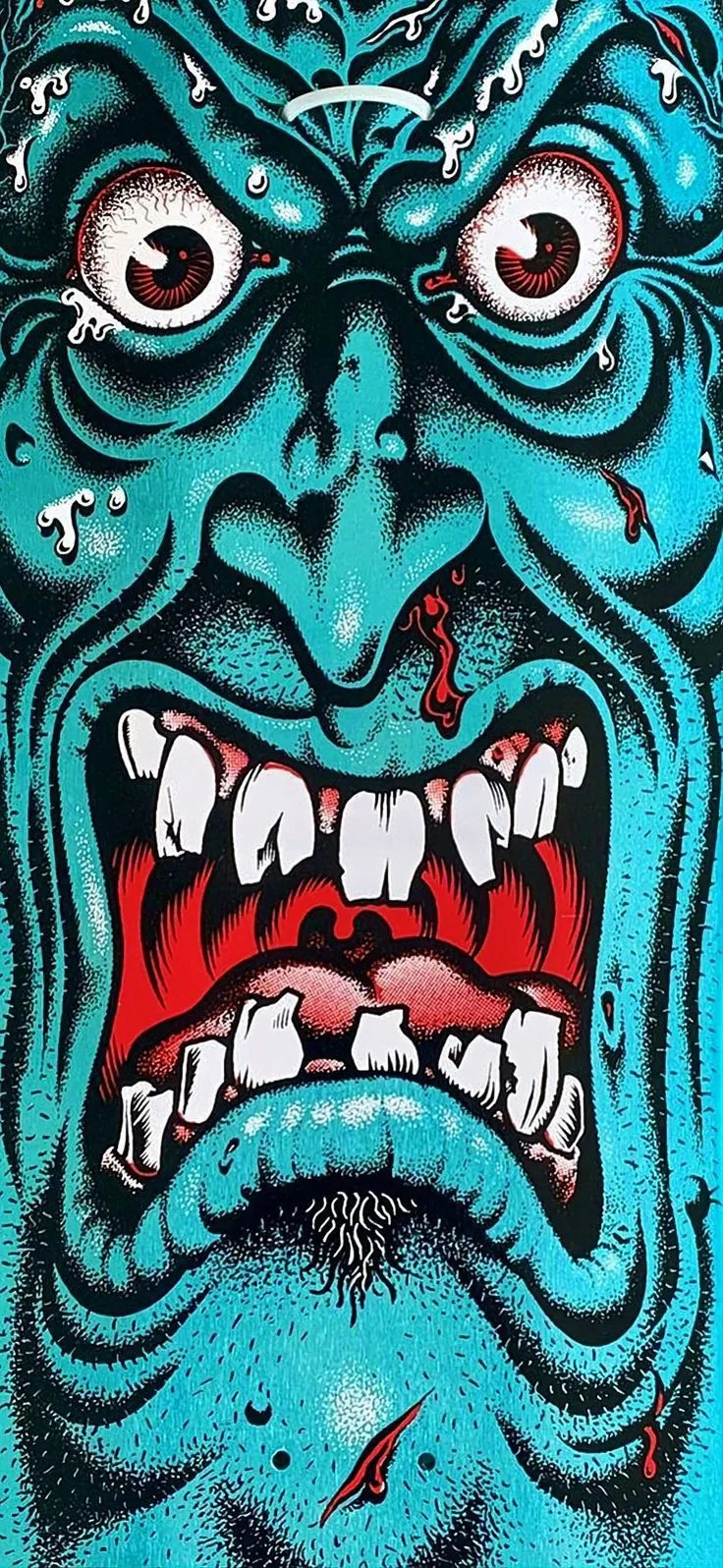
Roskopp Face
Brand Santa Cruz
Pro model Rob Roskopp
Designer Jim Phillips
Originally the 'Street model.' A ghostly, stretched face that has universally stuck as 'the Roskopp Face.' The first Santa Cruz street model to outsell many vert boards.
Why it matters Proved that street could move as much product as vert — foreshadowing the 1990 transition.
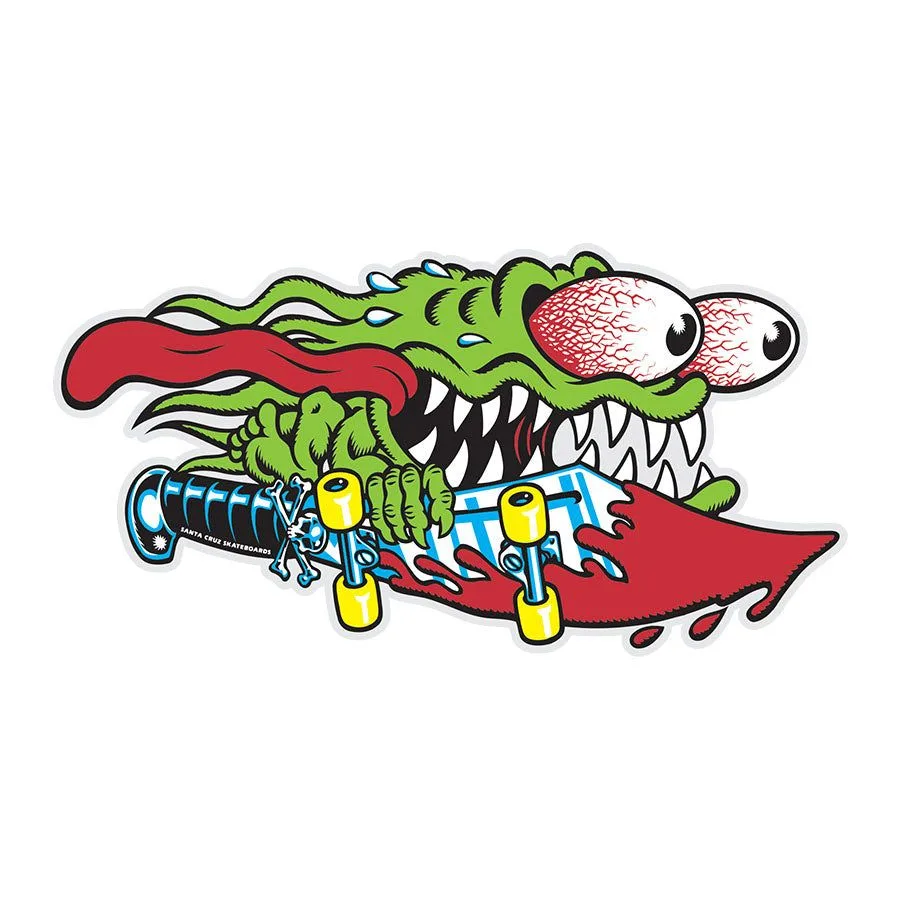
Slasher
Brand Santa Cruz
Pro model Keith 'Slasher' Meek
Designer Jim Phillips
Keith Meek's pro model for Santa Cruz, illustrated by Jim Phillips in 1986. A green clawed monster in a dynamic, near-wave composition, designed to reflect the rider's alias. NOS (new old stock) is extremely rare according to Meek himself, which has driven its value in the collector market.
Why it matters 80s punk rock pool-skating aesthetic in creature form.
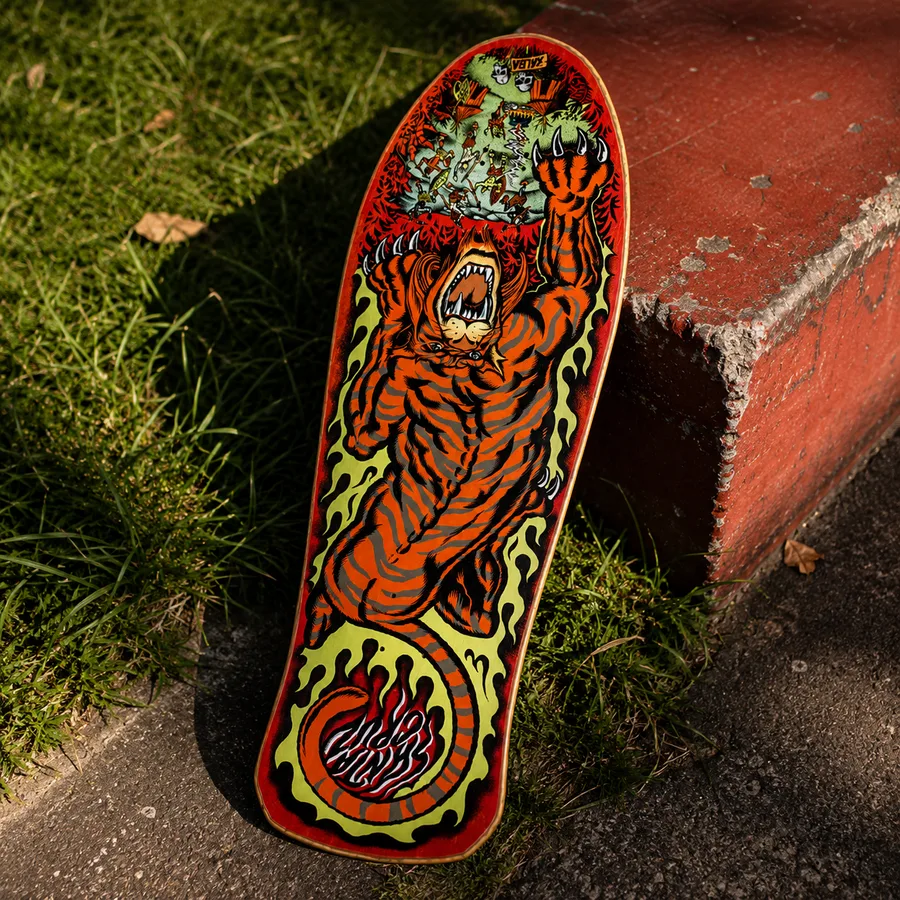
Salba — Tiger
Brand Santa Cruz
Pro model Steve Alba (Salba)
Designer Jim Phillips
Steve Alba's pro model — Salba, a legend of pool and vert — for Santa Cruz, featuring a tiger by Jim Phillips. An aggressive, feline image that matched Alba's brutal bowl style.
Why it matters Another icon from the Phillips–Santa Cruz pairing of the '80s, associated with one of pool skating's greatest names. Reissued and highly sought after by collectors.
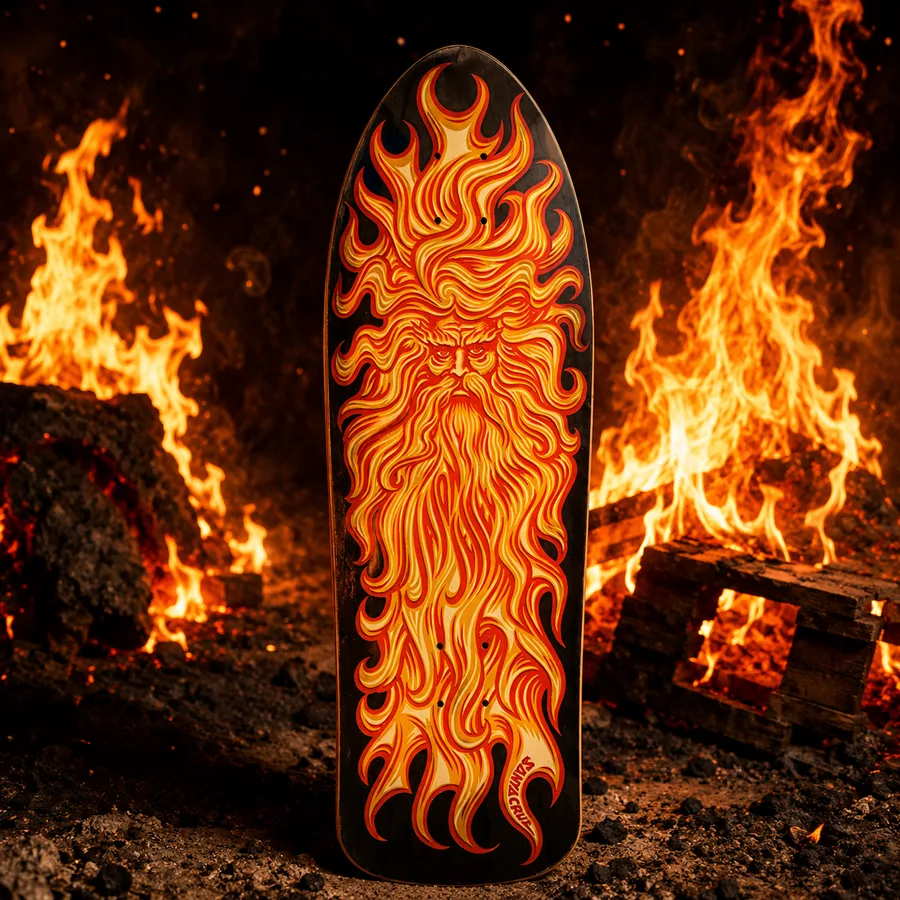
Jason Jessee — Sun God
Brand Santa Cruz
Pro model Jason Jessee
Designer Jim Phillips
Jason Jessee's pro model for Santa Cruz, drawn by Jim Phillips in the late '80s: a sun with a face, in a psychedelic, radiant style — the opposite of the brand's green-monster bestiary. One of the most recognizable graphics in the Phillips catalog.
Why it matters Proved that the Santa Cruz visual language wasn't only comic horror: there was room for the psychedelic and the luminous. A classic collector's piece from the Phillips golden era.
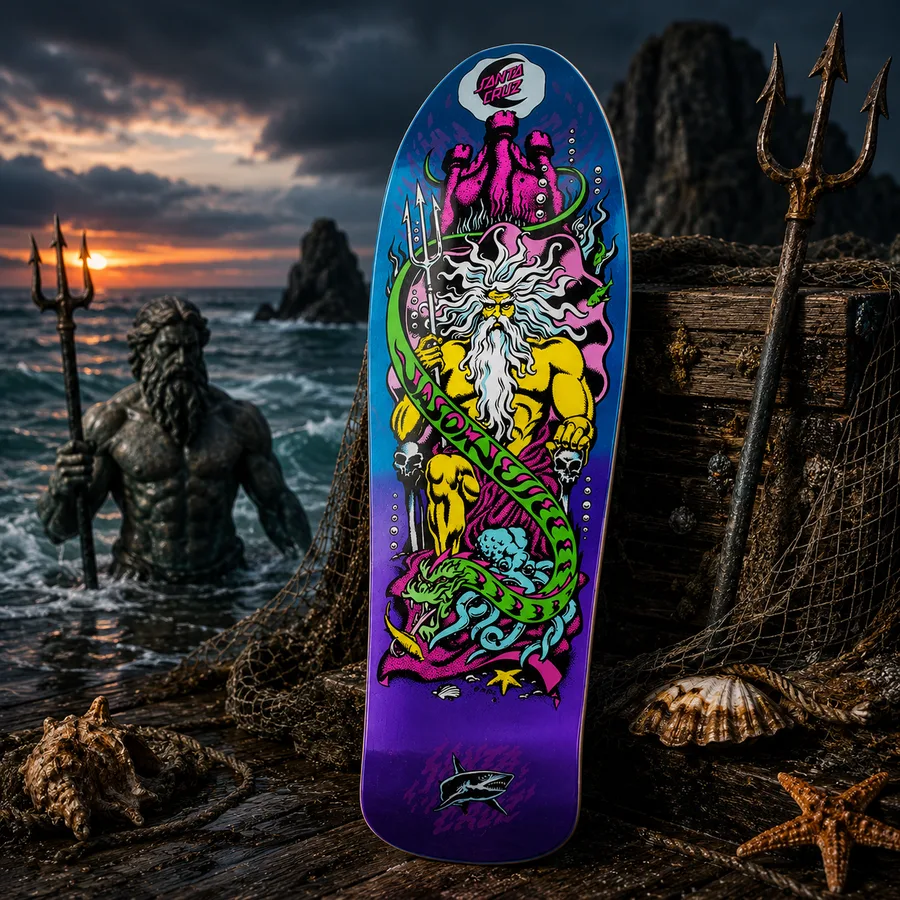
Jason Jessee Neptune
Brand Santa Cruz
Pro model Jason Jessee
Designer Jim Phillips
Jason Jessee's pro model for Santa Cruz, released in 1988, illustrated by Jim Phillips. The composition depicts the god Neptune with trident over a stormy sea and sea serpents, in a palette of golds, ochres, reds, and blues that moves away from the brand's typical saturated tones into territory closer to psychedelic poster art. The level of detail is among the densest in the Santa Cruz catalog that decade, aligned with the mystical imagery Jessee cultivated on and off the board.
Why it matters One of the most cited omissions on any international list of historic skate graphics: many collectors rank it above even Jessee's own Sun God. It marks the moment Santa Cruz blended comic horror with mystical symbolism — driven in large part by the rider's personality — and opened up a distinct register within the Phillips visual language.
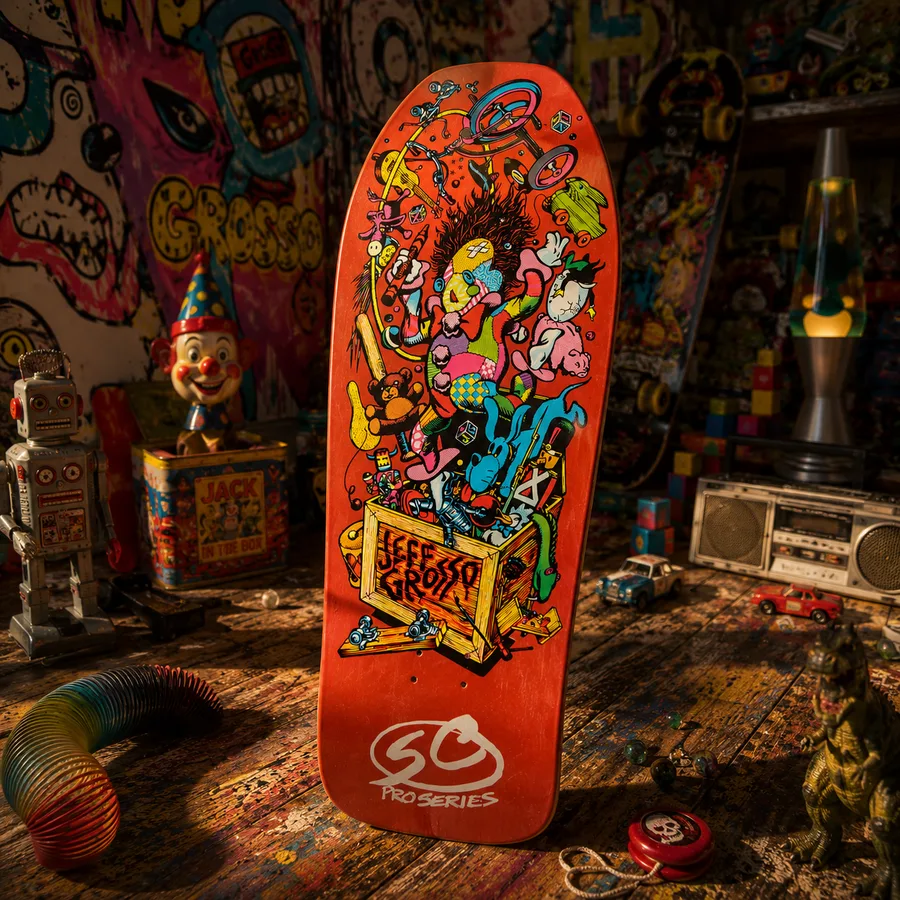
Jeff Grosso Toy Box
Brand Santa Cruz
Pro model Jeff Grosso
Designer Jim Phillips
Jeff Grosso's pro model for Santa Cruz, illustrated by Jim Phillips in the late '80s. The board shows a toy box overflowing with classic Phillips creatures — bulging eyes, teeth, hands, saturated palettes — in a horror-comedy composition. Grosso, a key figure in '80s vert and a critical voice in skating for decades, rode the board in some of the most remembered footage of the period.
Why it matters Culturally very significant, especially for those who lived through the vert era. Jeff Grosso was also one of skating's great oral chroniclers until his death in 2020 (the Love Letters to Skateboarding video series for Vans), which makes his pro models essential pieces for understanding the sport's oral memory.
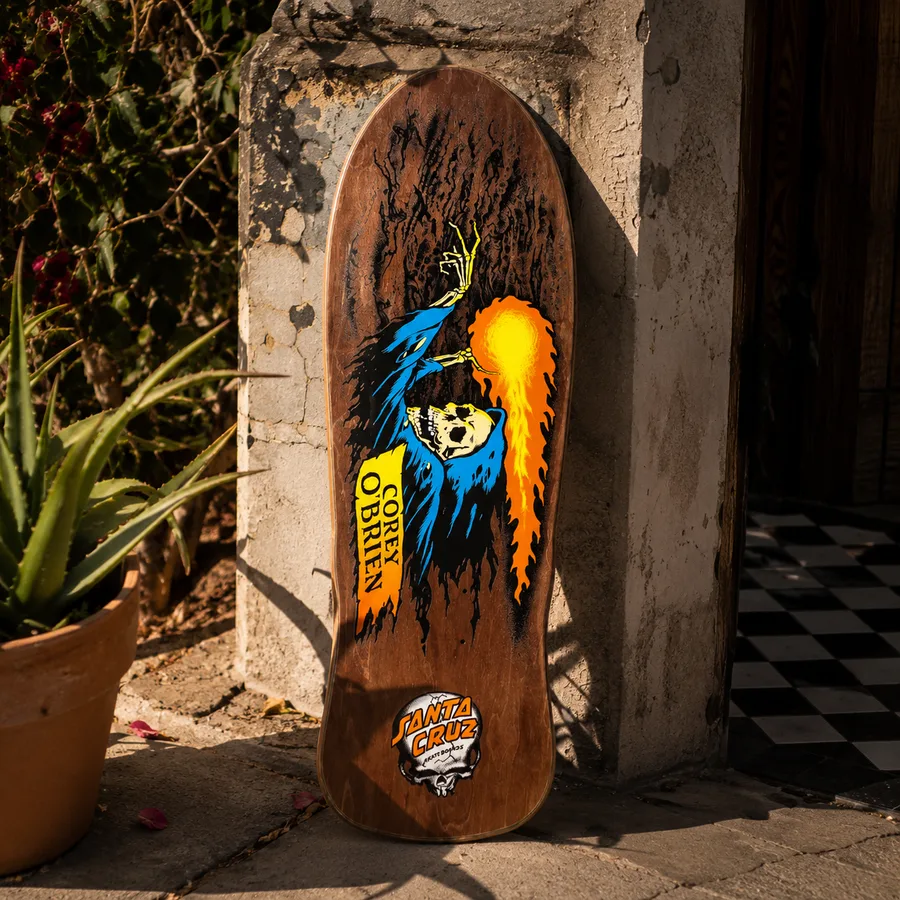
Reaper
Brand Santa Cruz
Pro model Corey O'Brien
Designer Jim Phillips
A grim reaper throwing flames. One of the most imitated Santa Cruz graphics ever. O'Brien today owns a rock club in San José.
Why it matters Gothic-skate iconography codified in a single image.
1981–1990 — Pushead, Hosoi, Sims and other voices
Although Powell-Peralta and Santa Cruz dominated much of the visual landscape in the 1980s, the decade was far richer and more diverse than we sometimes remember.
While VCJ drew dragons and Jim Phillips filled decks with impossible monsters, other brands began developing their own visual languages that connected with different cultural scenes. Punk, hardcore, heavy metal and underground culture started leaving an increasingly visible mark on skating.
It was an era when graphics stopped looking like simple illustrations and became statements of identity.
Some brands wanted to look wild.
Others wanted to look dangerous.
And some just wanted to be different.
Few people better embody that spirit than Brian Schroeder, better known as Pushead.
Artist, musician, illustrator and cult figure within the American hardcore scene, Pushead brought to skating an aesthetic drawn from record covers, photocopied fanzines and horror movies. His work for Zorlac opened up a completely different direction to what Powell or Santa Cruz were exploring.
If those brands were building recognisable visual universes, Pushead seemed interested in creating nightmares.
And that was precisely what made his graphics so special.
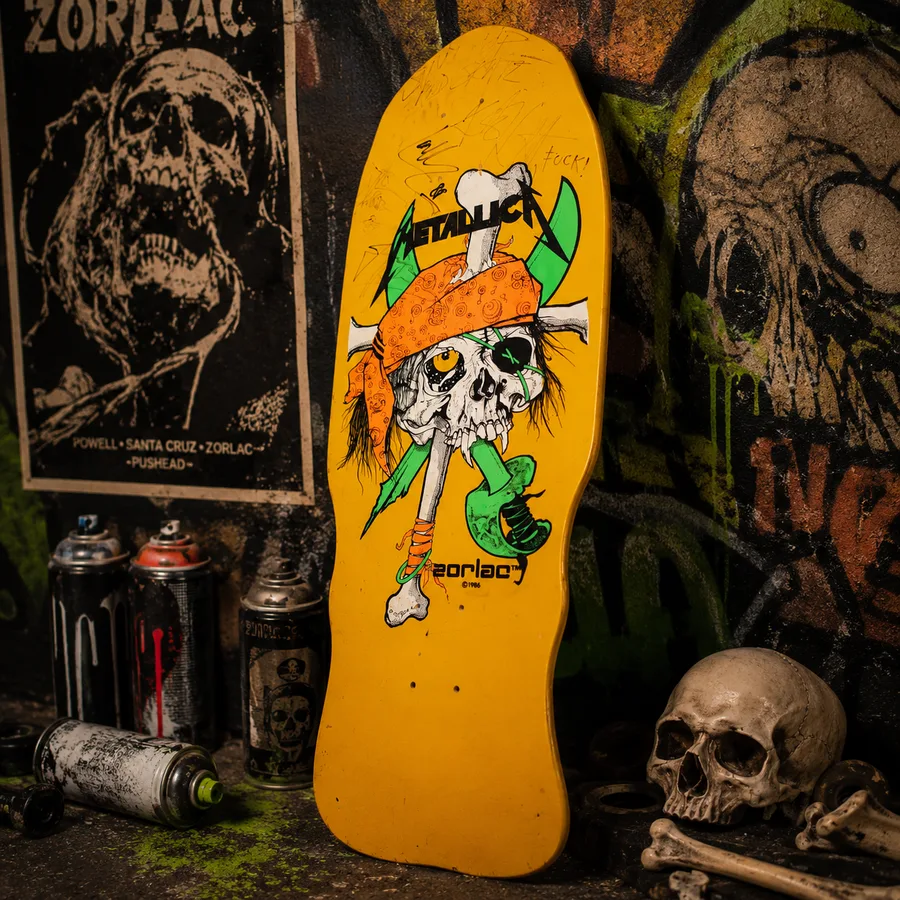
Damaged Pirate / Skull Pirate
Brand Zorlac
Pro model Team / Jeff Phillips
Designer Pushead (Brian Schroeder)
A rotting pirate skull in a hat. Pushead worked with Zorlac for nearly a decade (1981–1990). He simultaneously produced artwork for Metallica (the 'Damage Inc.' shirt, the St. Anger cover in 2003).
Why it matters The metal/horror wing of 80s skate. A body horror aesthetic that outlasted the Satanic Panic.
If Pushead represented the darker side of ’80s skating, Christian Hosoi symbolised the exact opposite. Charismatic, flamboyant and completely unpredictable, he was one of the riders who best understood that a deck could also be an extension of the skater’s own personality.
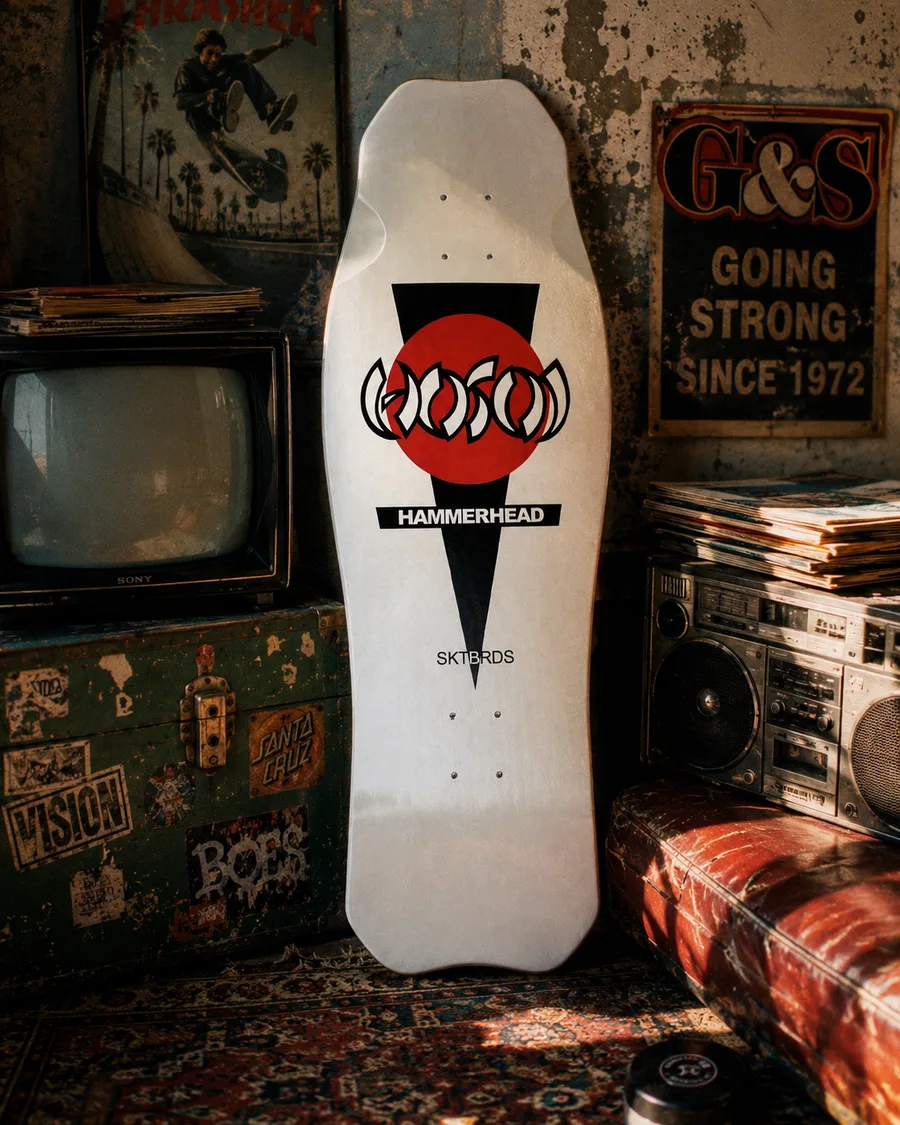
Hammerhead
Brand Hosoi Skates
Pro model Christian Hosoi
Designer Christian Hosoi (shape + gráfico)
This isn't just a graphic — it's a shape invented FOR a graphic. An elongated hammerhead-shark nose, unique profile, no concave. Designed around the Christ Airs and Rocket Airs Hosoi was inventing. In 2016 it entered the Smithsonian.
Why it matters When the shape of the board followed the art and not the other way around. Defined the shape-driven disruption of the 80s era.
The most curious thing about the Hammerhead is that it isn’t remembered solely for its graphic. It’s remembered for its shape. At a time when most decks followed relatively similar patterns, Hosoi designed a silhouette that looked like it had arrived from another planet. The result was one of the most recognisable shapes in skate history.
While Hosoi was revolutionising design from the rider’s perspective, Sims still represented an older generation. The company founded by Tom Sims was one of the great pioneers of modern skateboarding and helped bridge the 1970s with the creative explosion of the ’80s. Of all the graphics from that era, few have aged as well as the Kevin Staab Pirate.
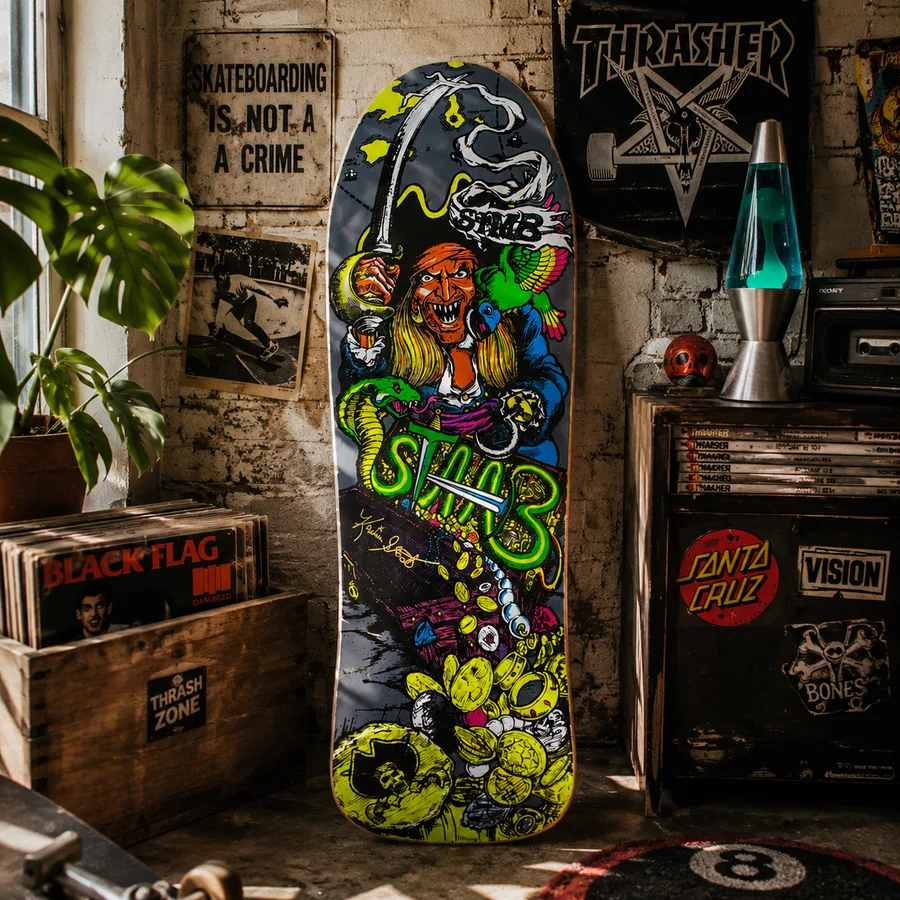
Kevin Staab Pirate
Brand Sims
Pro model Kevin Staab
Designer Equipo de arte de Sims
Sims, Tom Sims's brand (also a snowboard pioneer), was one of the major players of the '70s and '80s. Kevin Staab's Pirate — a vert pirate skull — stands as one of the brand's most recognizable graphics from the late '80s.
Why it matters Sims is one of skateboarding's foundational brands; the Pirate is a collector's piece from the '80s vert era and a reminder of a time when the major brands were not yet skater-owned.
By the late 1980s, art in skateboarding no longer answered to a single formula.
There was room for Powell’s heraldic compositions, Santa Cruz’s fluorescent monsters, Pushead’s horror-punk, Hosoi’s experiments or the proposals of legacy brands like Sims.
The deck had definitively become an artistic medium.
And the most interesting stuff was still to come.
Because while vert was dominating magazine covers and major competitions, a new generation of skaters was beginning to rewrite the rules from streets, kerbs and handrails.
They would bring new brands, new artists and a completely different way of thinking about deck design.
The 1990s were about to begin.
1985–1991 — Vision, Gonzales, Lucero and the birth of the rider-artist
Towards the end of the 1980s, a change began that went far beyond tricks or competitions.
Until then, most graphics emerged from a collaboration between a brand and a hired artist. The rider might contribute ideas, suggest concepts or have some input, but the final result usually remained in the hands of professional illustrators.
That started to change when a new generation of skaters decided to intervene directly in the creative process.
And nobody better symbolises that shift than Mark Gonzales.
Gonzales’s influence on skating is usually measured in tricks, videos or street spots, but his visual impact is just as significant. He was one of the first professionals to understand the deck as a space for personal artistic expression, and he helped open the door for dozens of riders who came after.
What seems normal today — a skater drawing, painting or designing their own graphics — was quite unusual at the time.
From this point on, the history of art in skating stops being dominated exclusively by major illustrators and starts mixing with the ideas, obsessions and drawings of the riders themselves. The shift into the ’90s was already underway.
Vision Skateboards was one of the dominant brands in late-’80s American street skating. Its Psycho Stick (team model) and the spin-off brand Vision Street Wear helped carry the skate language out of the sporting world and into urban fashion.
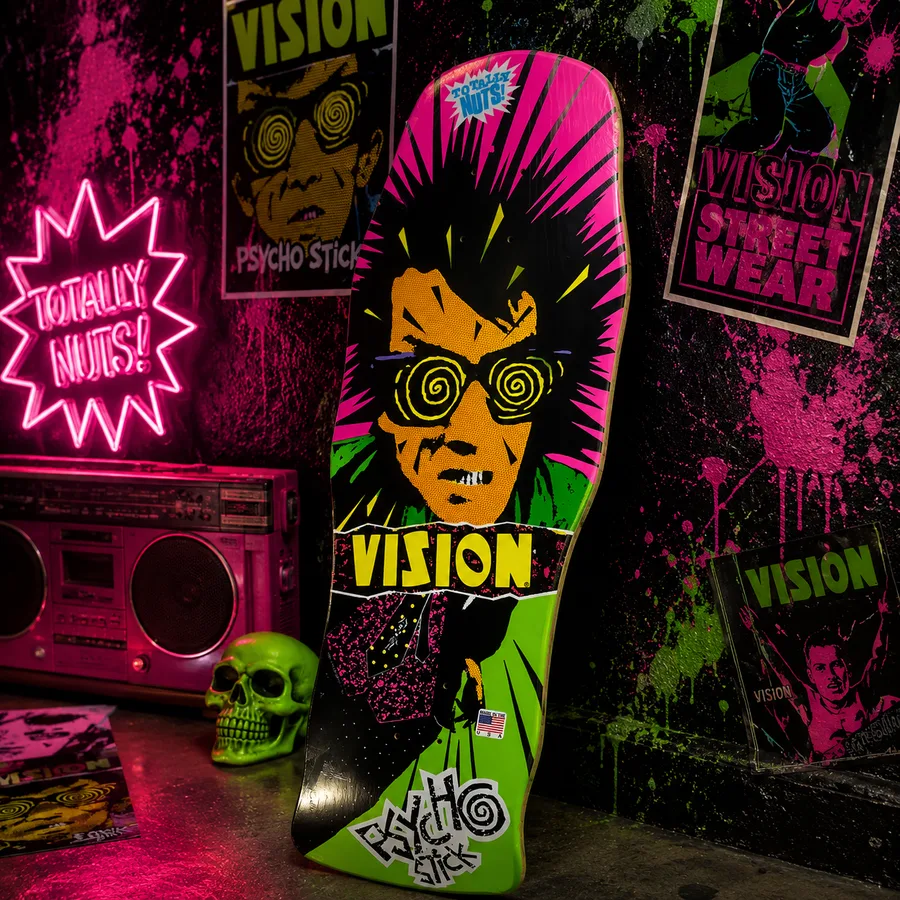
Psycho Stick (Vision, team)
Brand Vision
Pro model (team graphic)
Designer Equipo de arte de Vision
The Psycho Stick was Vision's team graphic: a punk-cartoon figure that became one of the best-selling boards of the '80s. It wasn't a pro model — it was THE Vision board that everyone had.
Why it matters An early case of a brand graphic outrunning any pro model: the board that defines an entire company and sells in massive numbers, before World Industries industrialized that idea.
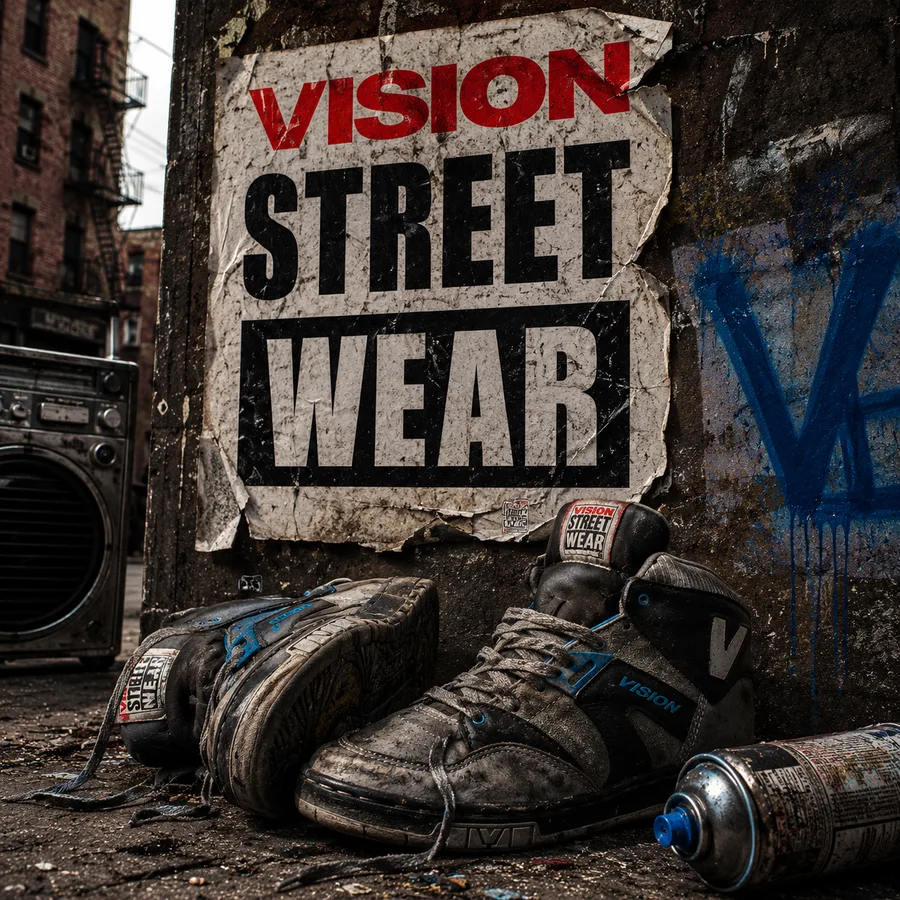
Vision Street Wear
Brand Vision Street Wear
Pro model (clothing and footwear brand)
Designer Vision (Brad Dorfman)
Around 1986 Vision launched Vision Street Wear, its apparel and footwear line. The block wordmark crossed over from skateparks into '80s street fashion and showed up on people who had never set foot on a board.
Why it matters One of the first cases of a skate brand becoming a fashion phenomenon. It anticipated the skate-as-lifestyle industry that Supreme and company would explode decades later.
Gonz / Profile (1985)
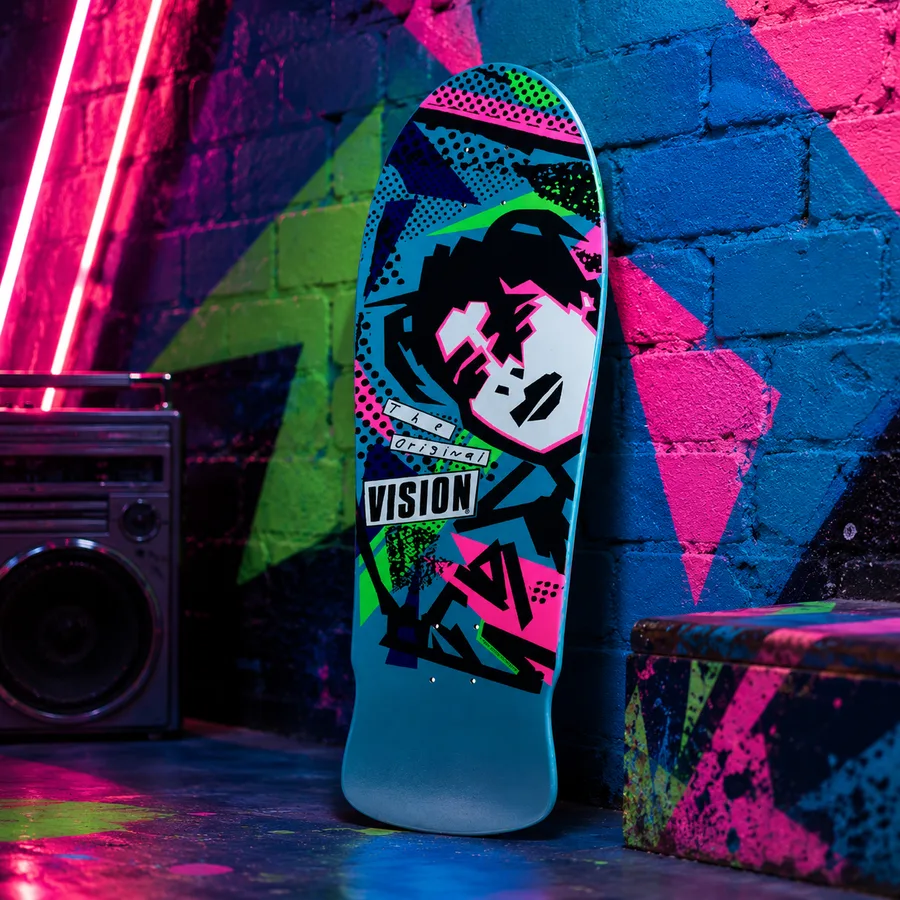
Gonz / Profile (first street pro model)
Brand Vision
Pro model Mark Gonzales
Designer Mark Gonzales
In the mid-80s Mark Gonzales dropped his pro model on Vision. It is frequently cited as the first street pro model in history: the acknowledgment that the street skater — not just the vert skater — could have his own board with his name on it.
Why it matters Marks the moment the industry accepted street as a discipline with its own stars. Gonz would also open the door to the deck drawn by the skater himself.
Behind Bars (1986)
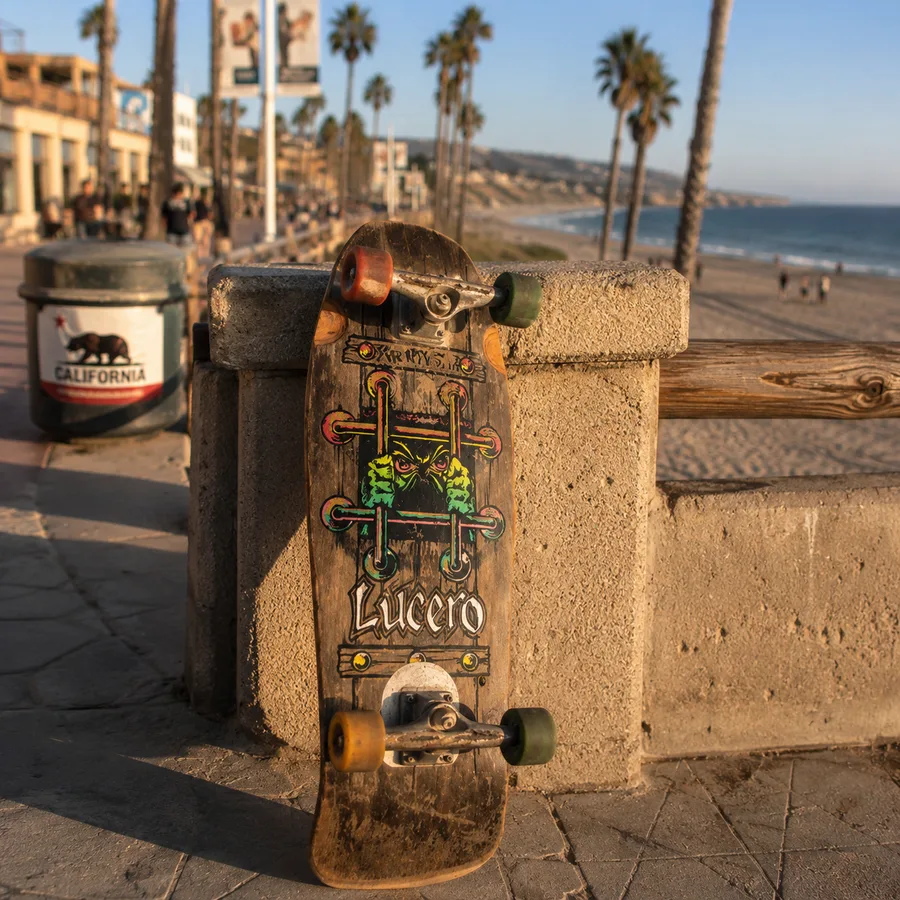
Behind Bars
Brand Schmitt Stix
Pro model John Lucero
Designer John Lucero
Lucero's first graphic for Schmitt Stix after leaving Madrid. 'It sold more in its first month than Schmitt Stix did in its entire first year.' The iconic Jester series would follow.
Why it matters Lucero codified the rider-as-artist style that Mark Gonzales was developing in parallel. He would later found Black Label.
Coffee Break (1987)
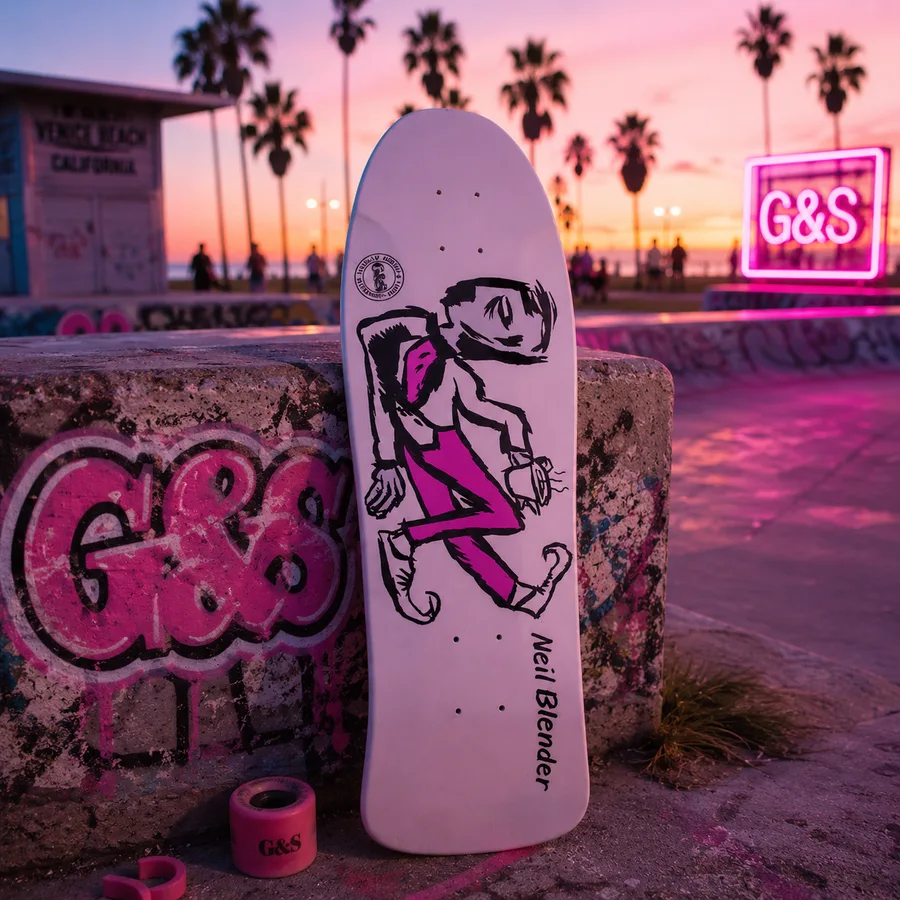
Coffee Break
Brand G&S (Gordon & Smith)
Pro model Neil Blender
Designer Neil Blender
Neil Blender wasn't just a skater — he drew. For his G&S pro model he skipped the standard bestiary of skulls and dragons and drew a character taking a coffee break himself. Dry humor, his own line work, zero epic posturing.
Why it matters One of the first pro graphics made by the skater's own hand. It opened the door to the deck as an auteur work: the lineage that Gonz would follow, and two decades later Fucking Awesome, Polar, and Magenta.
Gator (1986)
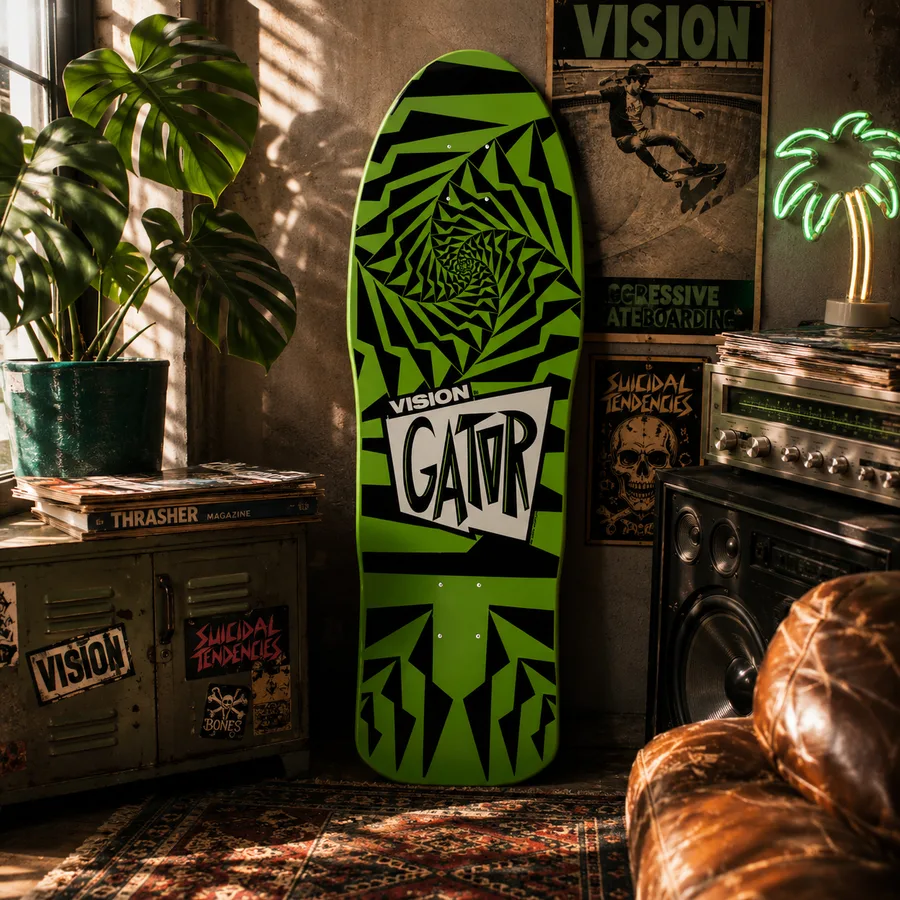
Gator
Brand Vision Sports
Pro model Mark 'Gator' Rogowski
Designer Greg Evans
The first pro deck from Vision Sports for Mark "Gator" Rogowski. Through the second half of the 80s it was one of the best-selling boards in the Vision catalog and Rogowski one of the great vert stars. Everything changed after his conviction for the murder of Jessica Bergsten in 1991 (he is serving life with the possibility of parole after 31 years); Vision pulled the model from the catalog following the trial in 1992.
Why it matters A case study in the legacy of a graphic when the rider collapses morally. Vision pulled all Gator product after the 1992 conviction.
Natas Kaupas at SMA
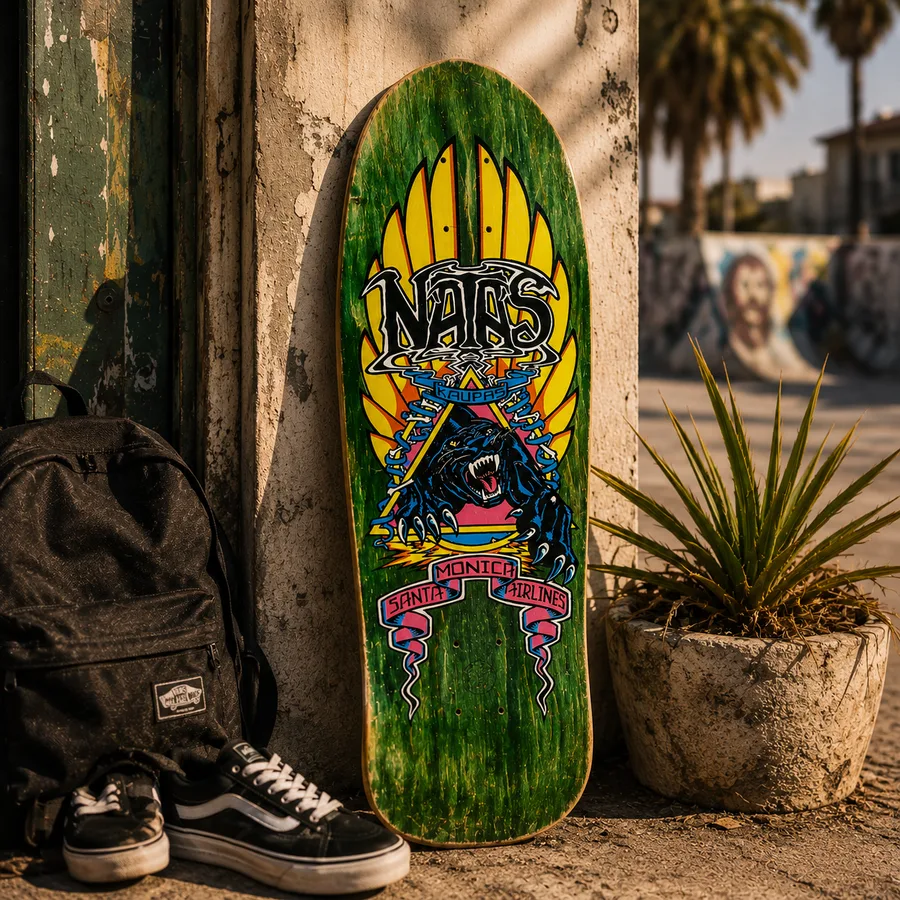
SMA Panther
Brand Santa Monica Airlines (SMA)
Pro model Natas Kaupas
Designer Kevin Ancell
Natas Kaupas's first pro model for SMA (Santa Monica Airlines), released in 1985 when Natas was 15. He appeared on the cover of Thrasher in September 1984 doing a wallride, which helped push the model when it dropped. The original drawing is by Kevin Ancell; later versions were reinterpreted by Buchinsky, Jim Phillips, Wes Humpston, and Forbes. In 1986 SMA signed manufacturing and distribution with Santa Cruz. The panther sold like few boards of the decade.
Why it matters Icon of early street skating. Natas and Gonzales would invent handrail-skating barely a year later (1986), and Natas's pro model for SMA became synonymous with that paradigm shift from vert to street.
When the decade ended, skateboarding was changing at a speed that would have been hard to imagine just a few years earlier.
The big ramps were losing their grip. The street was gaining ground. Videos were gradually replacing competitions as the main cultural engine.
And a new generation of brands was about to capitalise on that shift.
The most important of them all was called World Industries.
See which graphics are winning
93 designs in the catalogue sorted by real votes. Every time someone hits "like", the ranking moves.
See full ranking →- 1 Iron Cross / Screaming Chicken Skull 6
- 2 Flaming Dagger 5
- 3 Nordic Skull 4
1989–1993 — World Industries, Blind and the Steve Rocco revolution
If Powell-Peralta helped professionalise skating and Santa Cruz built some of its most recognisable visual icons, World Industries arrived to blow up the rulebook.
In the late 1980s, skating was going through a difficult moment. The industry was contracting, many parks were closing, and general interest seemed far from the levels reached in the first half of the decade. While some brands tried to hold on by sticking to traditional models, Steve Rocco decided to do exactly the opposite.
His proposition was more irreverent, more provocative and far less respectful of the industry’s unwritten rules.
Rocco understood something others still couldn’t see: the new generation of skaters no longer identified with vert heroes or the corporate messaging of the major brands. Skating’s centre of gravity was shifting to the street, and it needed a different visual language.
To build it, he brought together some of the most influential artists of the ’90s, particularly Marc McKee and Sean Cliver. Together they developed an aesthetic loaded with absurdist humour, satire, cartoon characters, cultural references and provocations that generated as many complaints as they did sales.
What some called bad taste, others saw as exactly what skating needed.
Few brands have been so divisive. And few have left such a deep mark.
Much of World Industries’ identity was built on provocation. Steve Rocco turned parodies, aggressive campaigns and direct attacks on competitors like Powell-Peralta into a marketing tool, generating some of the most memorable controversies in skate history. Many World graphics weren’t simple illustrations — they were weapons in a cultural war between generations of skating.
Devilman / Flameboy / Wet Willy
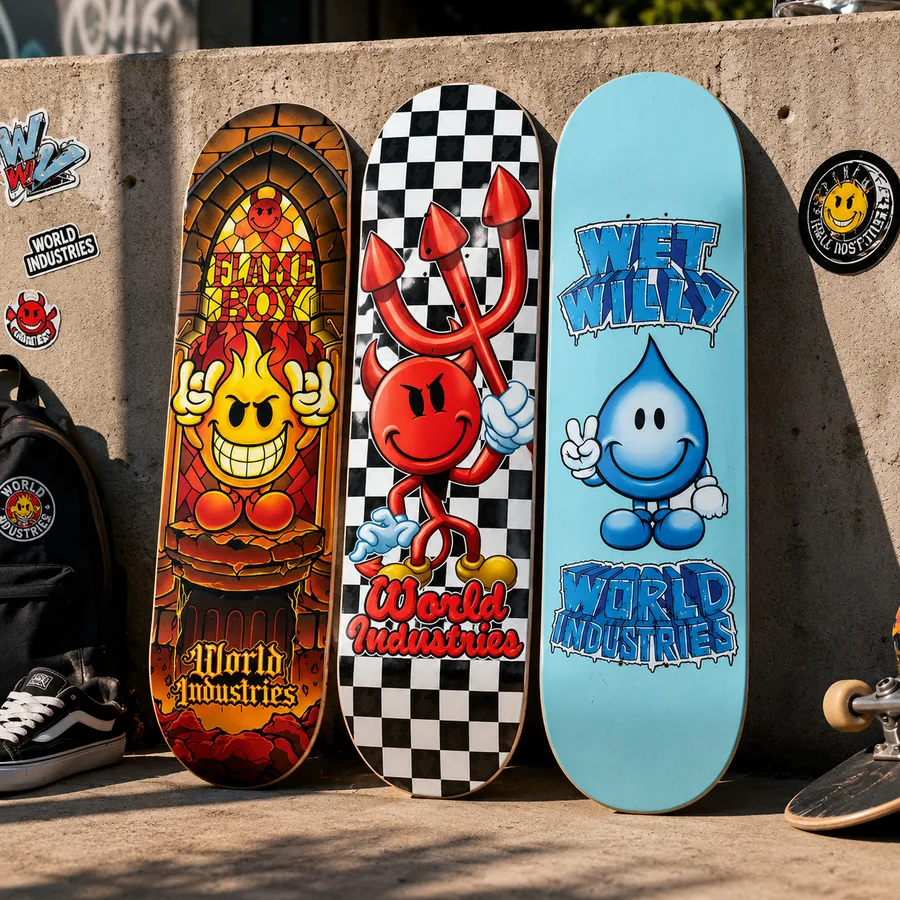
Devilman / Flameboy / Wet Willy
Brand World Industries
Pro model (brand mascots)
Designer Marc McKee
Three creature-mascots. Devilman first, Flameboy as sidekick (Rocco's idea), Wet Willy completing the trio (JT's idea: 'a water drop to go with the flame'). They functioned as World's Mickeys — the merchandising machine that financed the entire brand.
Why it matters They proved that mascots could sustain a skate brand commercially at a Disney-level scale.
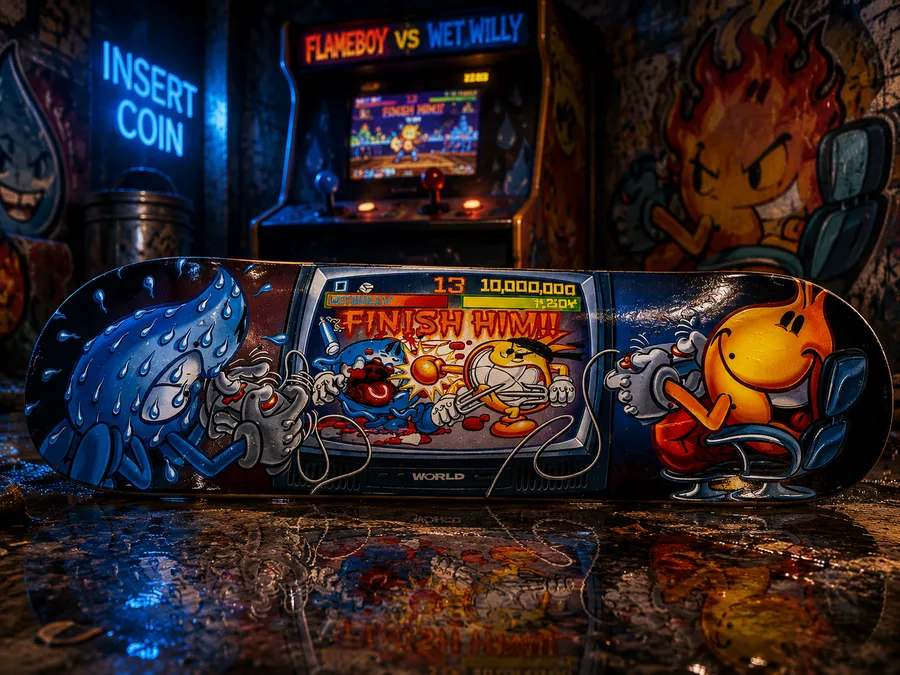
Flameboy vs Wet Willy (cultural phenomenon)
Brand World Industries
Pro model (mascots)
Designer Marc McKee
Marc McKee created Flameboy (the red creature with a flaming head) and Wet Willy (the anthropomorphic water drop) as World Industries mascots in the early '90s. Their rivalry — played as a running gag across boards, apparel, stickers, and ads — became one of the strongest visual phenomena in skating that decade. They also showed up in video games — most notably the Tony Hawk's Pro Skater series — and in mass merchandise both inside and outside the skate market.
Why it matters For an entire generation of '90s kids, Flameboy and Wet Willy were literally the mascots of skateboarding. Their impact on the visual culture of '90s skate is comparable to Powell's Ripper in the '80s, though through a comic-strip lens rather than a heraldic one.
Napping Negro
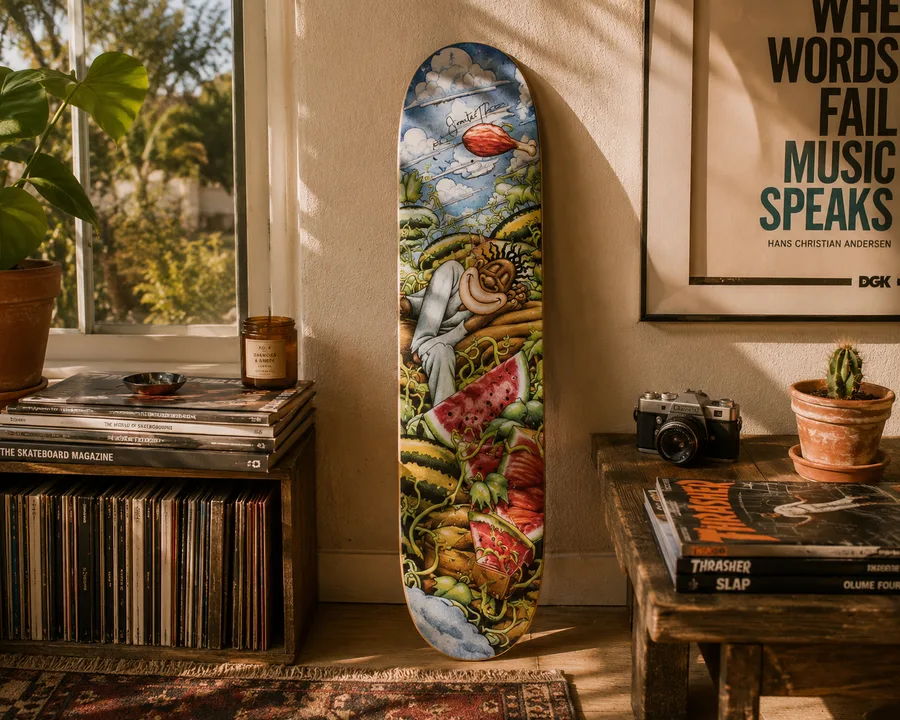
Napping Negro
Brand World Industries
Pro model Jovontae Turner
Designer Marc McKee, sobre concepto de Jovontae Turner
TURNER (an African-American skater) asked McKee for 'old school black slavery stuff' as a satire of white racist nostalgia. Vintage Jim Crow iconography. Part of a series with 'Jovontae at Night' and 'Runaway Slave'. McKee describes it as satire targeting whites nostalgic for the past.
Why it matters A case study in who controls the racial narrative when the concept comes from the Black skater himself. The debate around the piece remains open three decades later, and the model commands high prices in the classic skate collectibles market.
Reaper Logo

Reaper logo
Brand Blind Skateboards
Pro model (brand logo)
Designer Mark Gonzales (él mismo)
When Gonzales left Vision in 1989 to co-found Blind with Steve Rocco (the name itself was a dig at Vision), he drew the stylized Reaper logo himself. It's still in use today.
Why it matters Gonzales encoding that a founder-rider can ALSO be the designer. The template for everything that followed.
Panther (101)
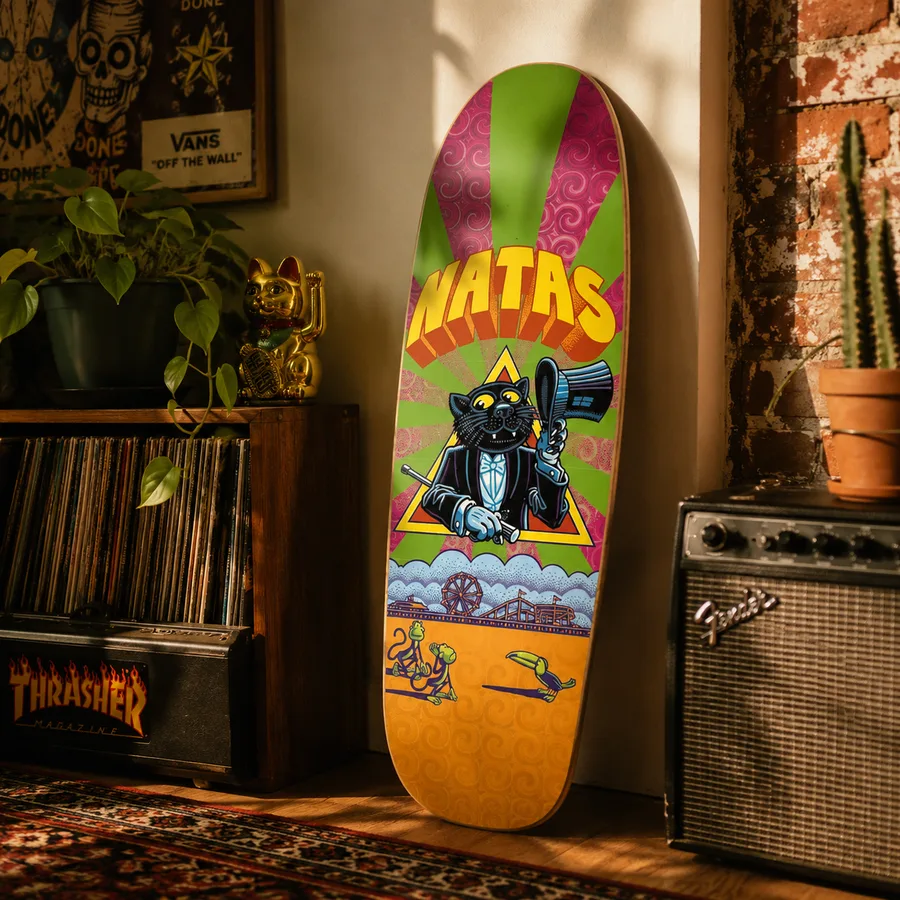
Panther (101)
Brand 101 Skateboards
Pro model Natas Kaupas
Designer Marc McKee
A reinterpretation of the SMA Panther from 1984, done when Natas left SMA and co-founded 101 under World. 101 was a pure street laboratory: Koston, Gino, Dill, Markovich all came through.
Why it matters Continuity of the Natas icon within the new street economy.
Dodo
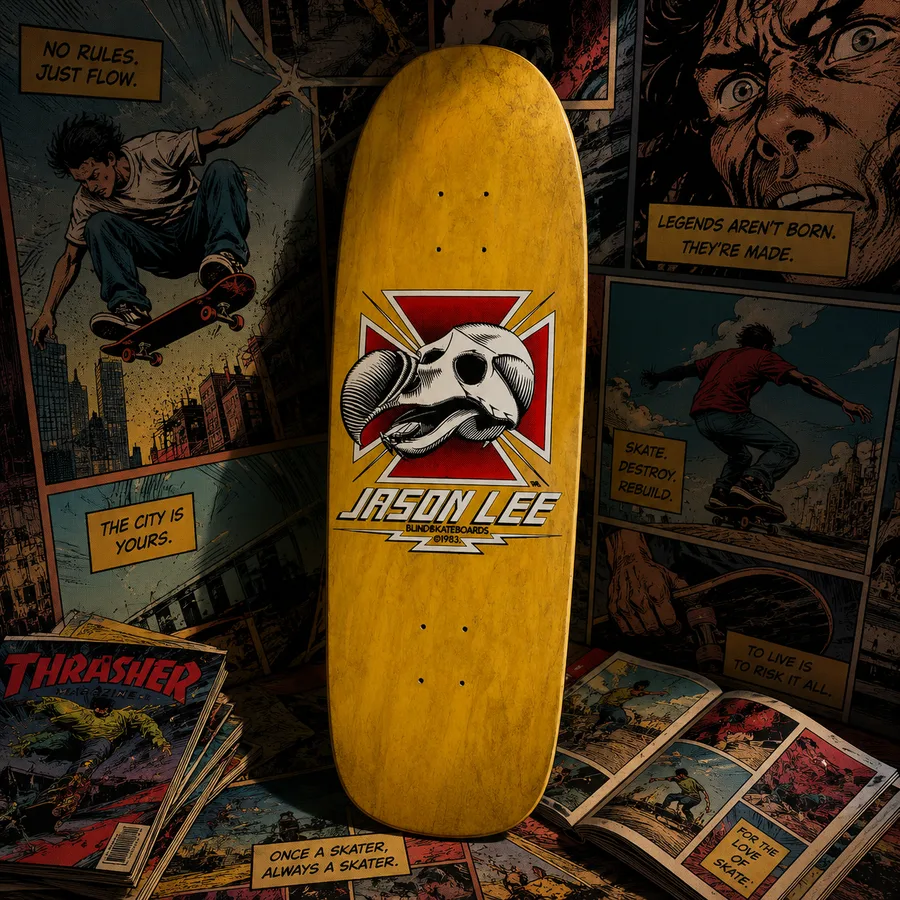
Dodo
Brand Blind Skateboards
Pro model Jason Lee
Designer Marc McKee
Originally conceived for Danny Way (while he was at Blind) as a veiled dig at Tony Hawk — the 'little bird' going extinct. It was considered too personal, and when Danny jumped to Plan B, the graphic ended up on Jason Lee's board.
Why it matters A perfect anecdote of 90s inter-brand dynamics: graphics getting rewritten depending on who's where.
By the early 1990s, skate art had changed completely from the previous decade.
The big epic illustrations still existed, but they now shared space with satire, absurd characters, cultural references, dark humour and messages designed to provoke an immediate reaction.
It was a more street-level, more chaotic aesthetic — and in many cases, much closer to the generation that was redefining skating from plazas, kerbs and handrails.
The next revolution, though, wouldn’t come from a brand or a single artist.
It would come from an idea.
The idea that skating could be a deeply personal project.
And nobody embodied that philosophy better than Ed Templeton, Toy Machine and the generation that finished consolidating modern street skating.
1988–1995 — H-Street, Plan B, Toy Machine, Real and Anti-Hero
If World Industries represented the cultural revolution of the early ’90s, H-Street and Plan B helped define the technical revolution.
During the 1980s, the most popular image of skating was still the rider flying over a giant ramp or pulling impossible tricks in an empty pool. But something different was happening on the streets of California.
Handrails, benches, gaps and kerbs were becoming the new playgrounds. Street skating was moving from a secondary discipline to the centre of the conversation.
Few people had more influence on that shift than Mike Ternasky. First at H-Street and then at Plan B, Ternasky helped bring together some of the most innovative skaters of the era and understood earlier than almost anyone where skating was headed.
Graphics were changing too. Decks were narrower, shapes were evolving, and new generations were looking for an aesthetic different from the great vert heroes.
Matt Hensley — Street Swinger
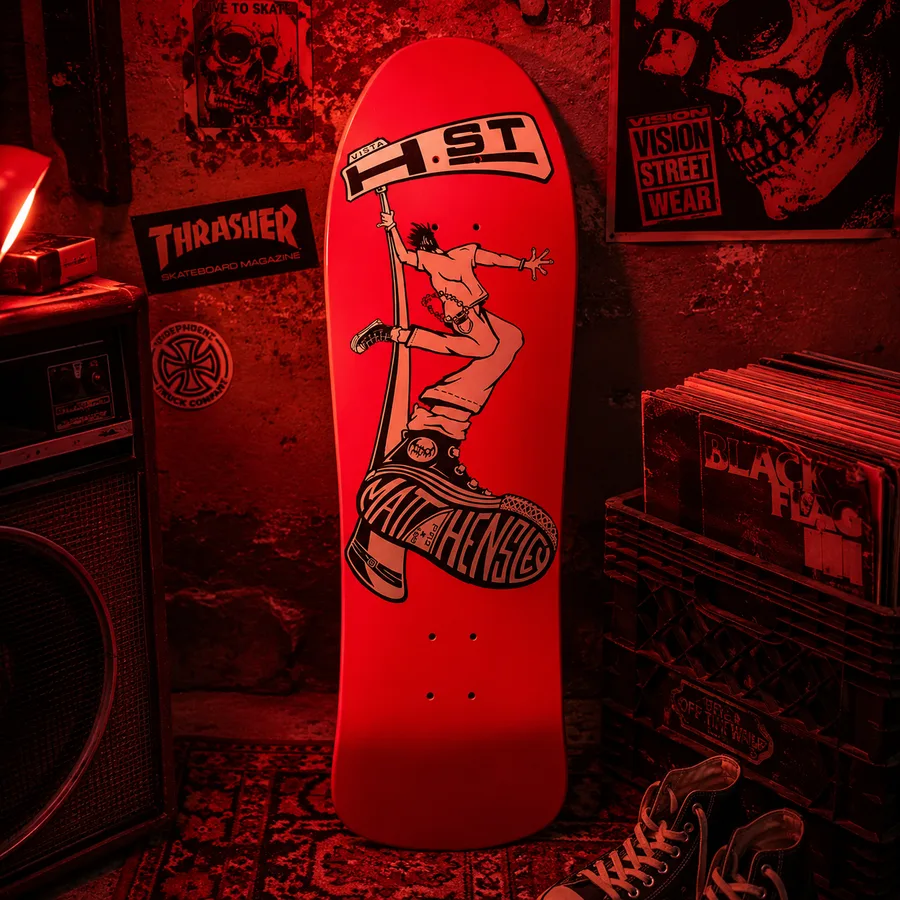
Matt Hensley — Street Swinger
Brand H-Street
Pro model Matt Hensley
Designer Equipo de arte de H-Street
H-Street (Tony Magnusson and Mike Ternasky, 1986) and their star rider Matt Hensley defined late-'80s street skating with the videos Shackle Me Not (1988) and Hokus Pokus (1989). Hensley's Street Swinger is the iconic graphic of that era: thinner, cheaper decks made for the streets.
Why it matters The bridge from vert to modern street. Ternasky would take that DNA to Plan B shortly after. H-Street boards from the Hensley era are grail pieces from the transition.
While H-Street and Plan B were pushing the technical limits of street skating, other skaters were beginning to use their brands as deeply personal projects.
Nobody represents that idea better than Ed Templeton.
Sect / Transistor Sect
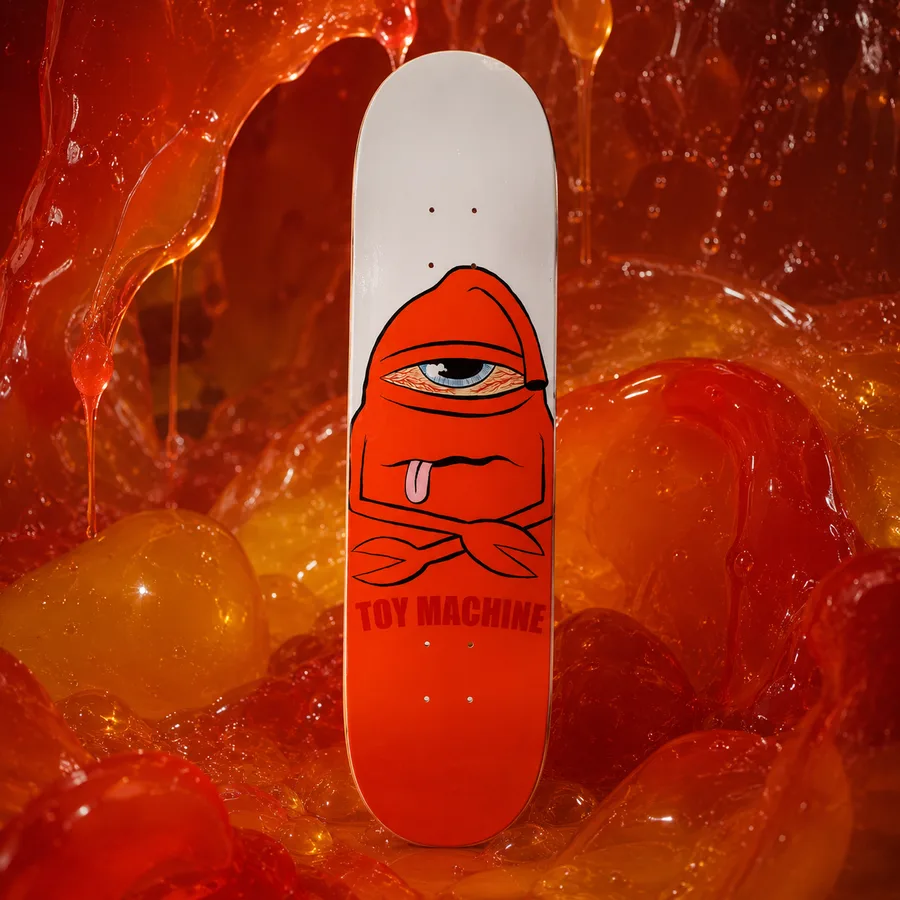
Sect / Transistor Sect
Brand Toy Machine
Pro model (brand logo + team models)
Designer Ed Templeton
The single eye, abstract monster. Templeton founded Toy Machine in 1993 (not 1994) with support from Tod Swank/Tum Yeto. He draws ALL the graphics himself, inspired by Mark Gonzales at Vision/Blind.
Why it matters Templeton established the brand-as-personal-art-project. Today he's a contemporary artist shown in galleries.
Toy Machine Monster
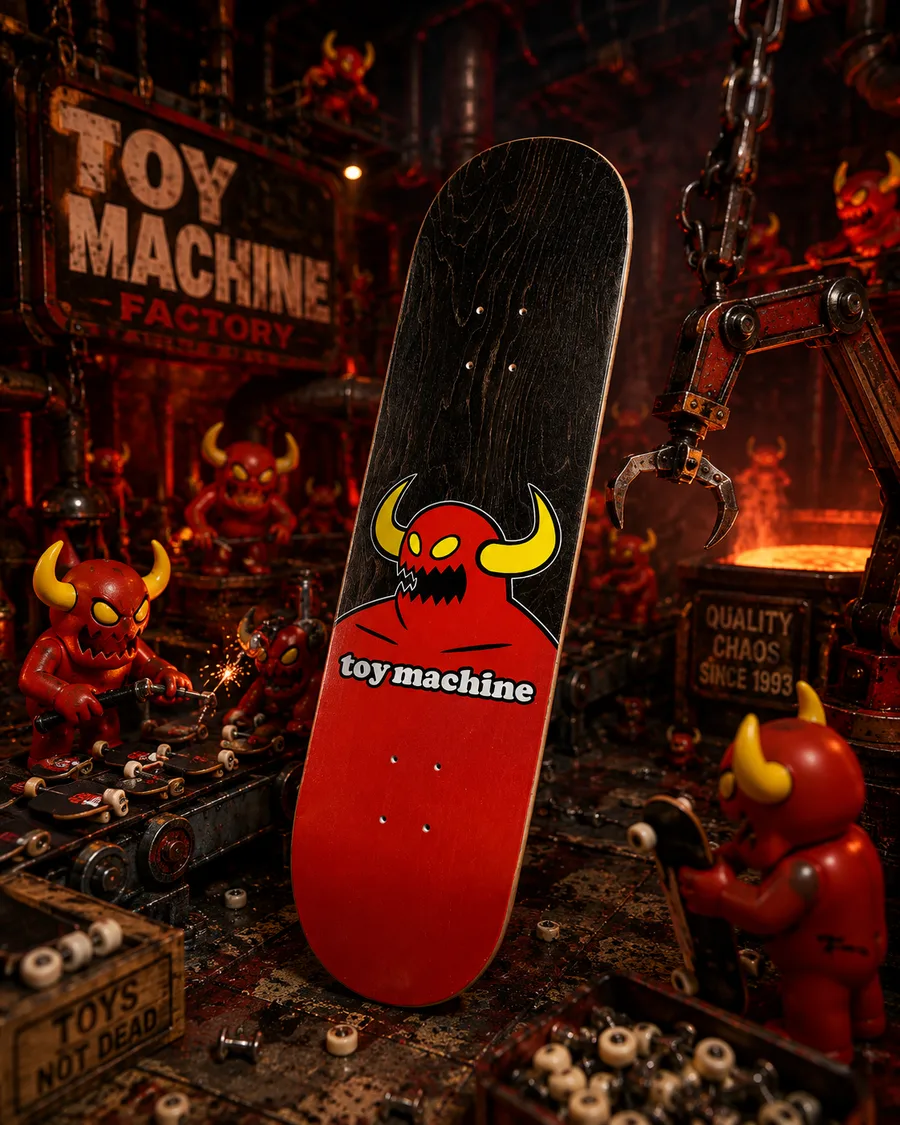
Toy Machine Monster
Brand Toy Machine
Designer Ed Templeton
The Monster appeared in the Toy Machine catalog in the mid-'90s, drawn by Ed Templeton. The creature — a red cyclops with one enormous eye, crooked teeth, and the body of a broken toy — became the brand's unofficial mascot and has appeared on decks, clothing, stickers, and videos ever since. Templeton drew it with the deliberately naïf line style that would go on to define Toy Machine's entire visual language.
Why it matters Arguably Toy Machine's most recognizable graphic, above even the Sect logo. The cyclops iconography shaped the aesthetic of late-'90s European and American street skating and influenced later brands that adopted non-human mascots as a vehicle for identity.
Although the Monster ended up becoming Toy Machine’s most recognisable mascot, Ed Templeton’s visual universe was full of recurring characters that appeared constantly on decks, T-shirts, stickers and videos. Among all of them, few reached the same level of popularity as the Devil Cat.
Toy Machine Devil Cat
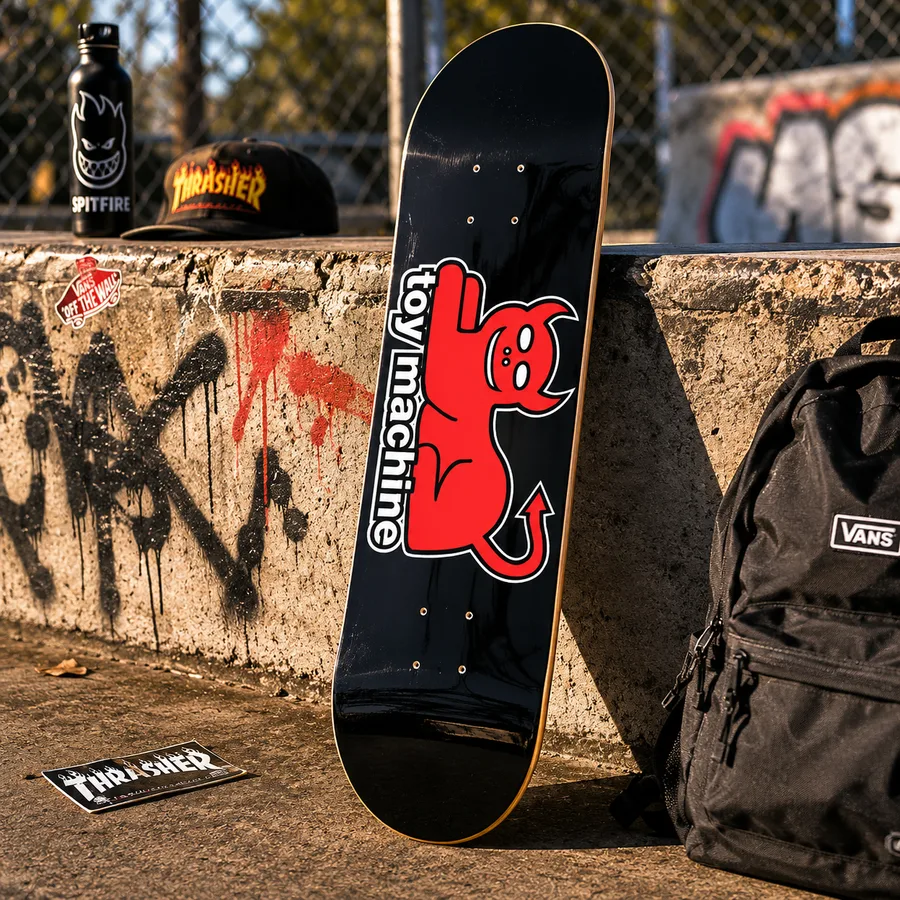
Toy Machine Devil Cat
Brand Toy Machine
Pro model (team series)
Designer Ed Templeton
The Devil Cat emerged in the late nineties as one of the many characters Ed Templeton created to expand Toy Machine's visual universe. With its horns, crooked grin, and deliberately childlike look, the character perfectly captured Templeton's graphic style: seemingly simple drawings, executed with a spontaneous line and loaded with personality. Unlike the aggressive monsters that dominated much of the skate graphics of the era, the Devil Cat projected a strange mix of humor, weirdness, and charm that ended up connecting with multiple generations of skaters. Over the years it became one of the brand's most frequently used characters and continues to appear regularly on boards, clothing, and special collaborations.
Why it matters It is one of the most recognizable mascots in modern skateboarding and one of the best representations of the unique visual language Ed Templeton built for Toy Machine.
While Ed Templeton was developing a Toy Machine universe populated by monsters, impossible creatures and deliberately childlike drawings, another skater was exploring completely different visual territory. Jeremy Klein found inspiration in a source that virtually nobody in the skate industry was looking at at the time: manga and Japanese animation. What started as a personal obsession became one of the most recognisable and controversial visual identities of the late 1990s.
Hook-Ups Anime Girl
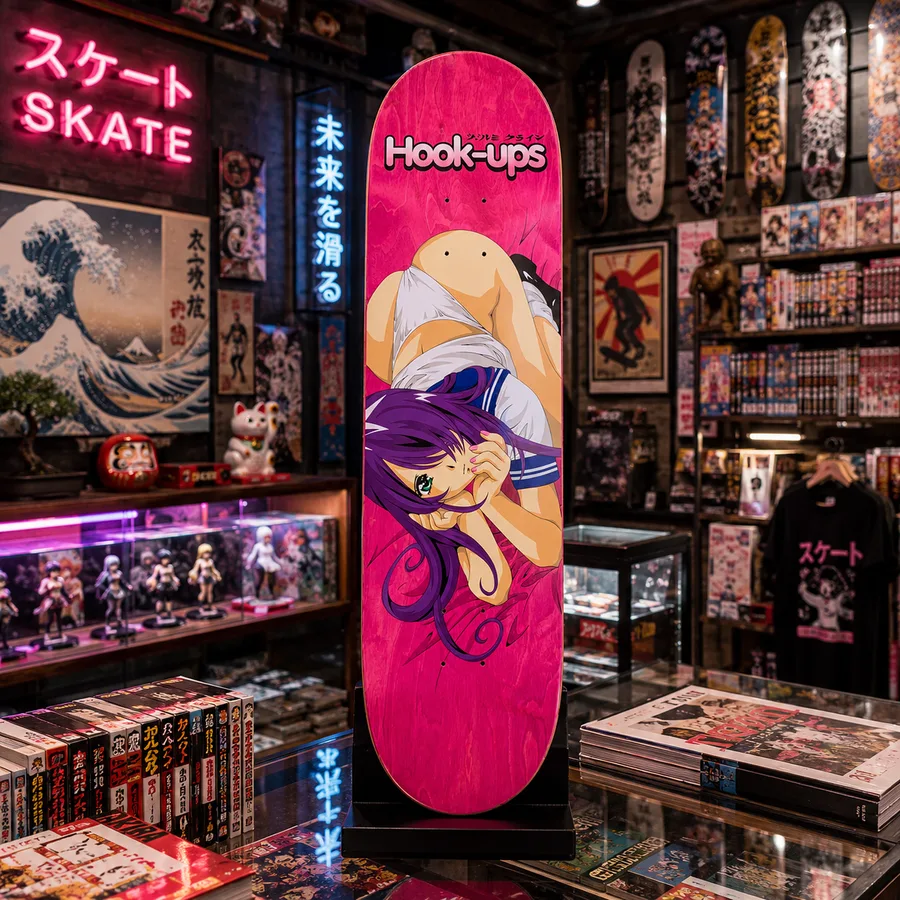
Hook-Ups Anime Girl
Brand Hook-Ups
Pro model (team series)
Designer Jeremy Klein
After leaving World Industries, Jeremy Klein founded Hook-Ups in 1994 and began building a visual identity unlike anything else in skateboarding at the time. Fascinated by manga, anime, Japanese science fiction, and otaku culture long before any of it had gone mainstream in the West, he filled his boards with female characters inspired by Japanese animation, robots, aliens, and constant references to Asian pop culture. The so-called Anime Girls quickly became the most recognizable image associated with Hook-Ups. To some they were provocative. To others, simply different. The fact is that for years nobody in skating looked anything like Jeremy Klein.
Why it matters Introduced anime aesthetics into Western skateboarding decades before it became mainstream. Its influence remains visible in brands, illustrators, and designers who blend Japanese culture, streetwear, and skateboarding.
As Hook-Ups grew, Jeremy Klein expanded his visual world well beyond the early manga protagonists.
Hook-Ups Nurse Series
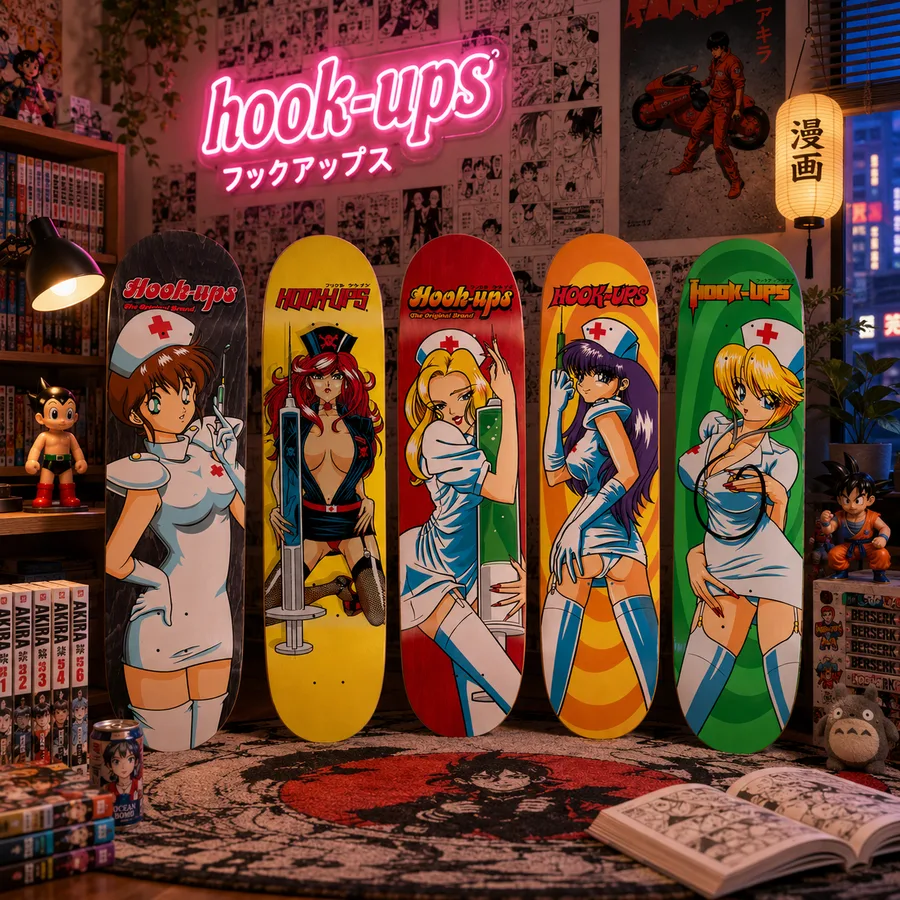
Hook-Ups Nurse Series
Brand Hook-Ups
Pro model (team series)
Designer Jeremy Klein
The Nurse Series represent one of the most remembered chapters in Hook-Ups history. Futuristic nurses, androids, science-fiction anime references, and an aesthetic rooted in cyberpunk manga finished cementing the brand's visual identity. The boards became genuine cult objects within skate collecting circles by the late nineties.
Why it matters One of Jeremy Klein's most recognizable series and the definitive consolidation of the relationship between anime culture and skateboarding.
In the early 1990s, companies also began to emerge that represented a more independent and less spectacular vision of skating. San Francisco became one of the major creative centres of that new current.
One of the first voices of that current was John Lucero, who after leaving Schmitt Stix founded Black Label around 1989 and began developing his own visual universe.
Black Label Jester
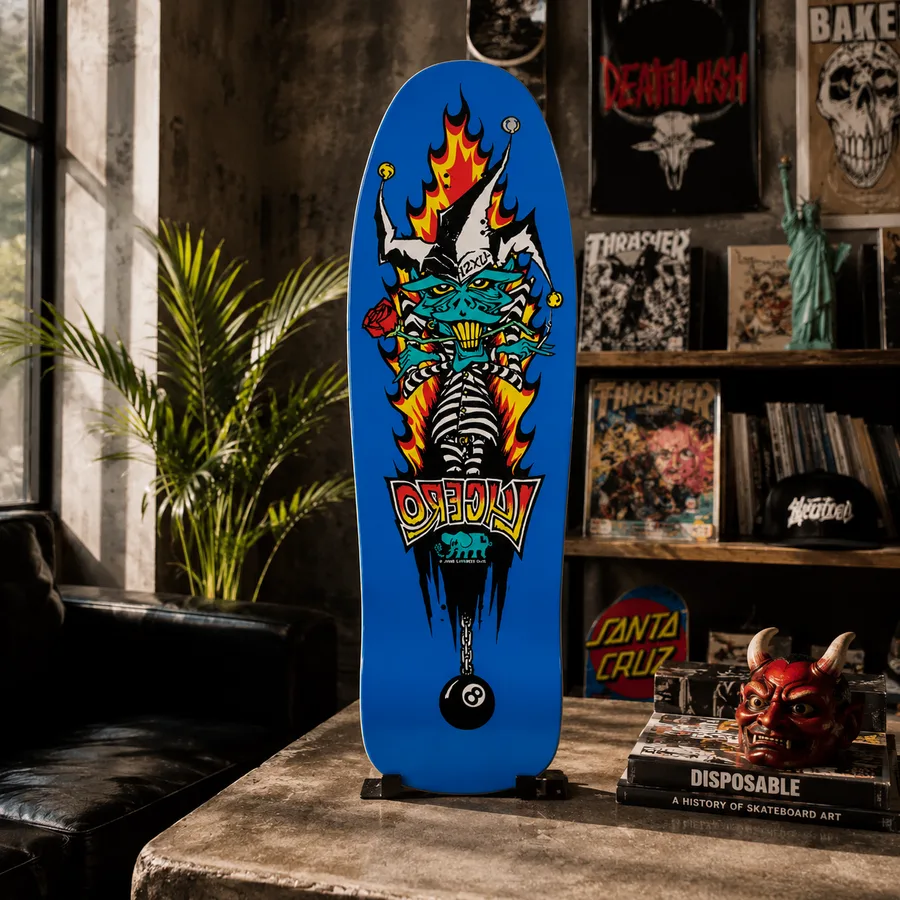
Black Label Jester
Brand Black Label Skateboards
Pro model (brand logo)
Designer John Lucero
Founded by John Lucero after leaving Schmitt Stix, Black Label was born as a declaration of creative independence. Its best-known character was the Jester, an unsettling court fool that perfectly distilled the brand's philosophy: irreverence, punk culture, a DIY attitude, and a flat refusal to follow dominant trends. Over decades the Jester has appeared in countless versions, becoming one of the most recognizable images in independent American skateboarding.
Why it matters One of the longest-running characters in the entire history of skateboarding and one of the clearest symbols of the DIY movement that helped define the nineties.
If the Jester represented the more irreverent and provocative side of Black Label, the next image became something far closer to a manifesto. A simple crutch was transformed into one of the most recognisable symbols of American independent skating.
Black Label Crutch
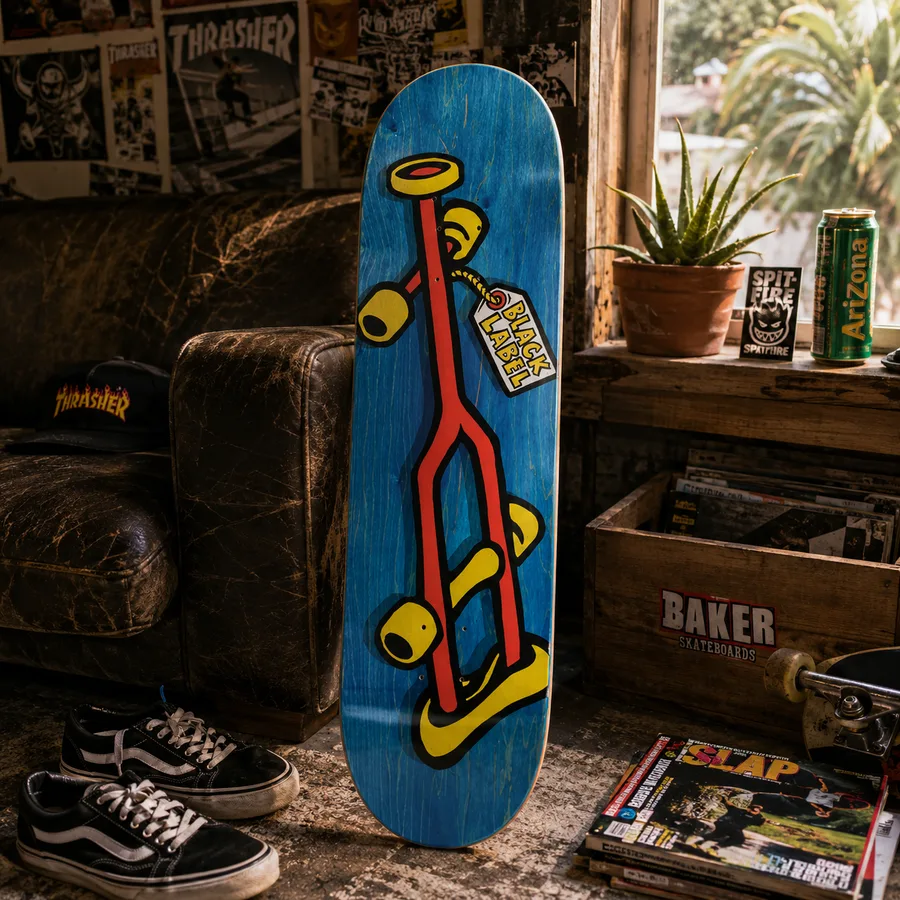
Black Label Crutch
Brand Black Label Skateboards
Pro model (brand logo)
Designer John Lucero
The Crutch — Black Label's signature red crutch — appeared in the brand's early years and quickly became one of its most recognizable symbols. Its minimalist design stood in contrast to the complex characters and illustrations that dominated much of the skate market at the time, but that simplicity was precisely one of its greatest strengths. Over time the crutch took on an almost symbolic meaning within the skate community. Injuries, slams, scars, and the determination to keep skating regardless — all of it condensed into a single image. Decades later it remains one of the visual elements most closely associated with the brand John Lucero founded.
Why it matters It is one of the most original symbols in the entire history of skateboarding and a perfect representation of the DIY, resilient, and independent philosophy that defined Black Label from the beginning.
Hanging Klansman
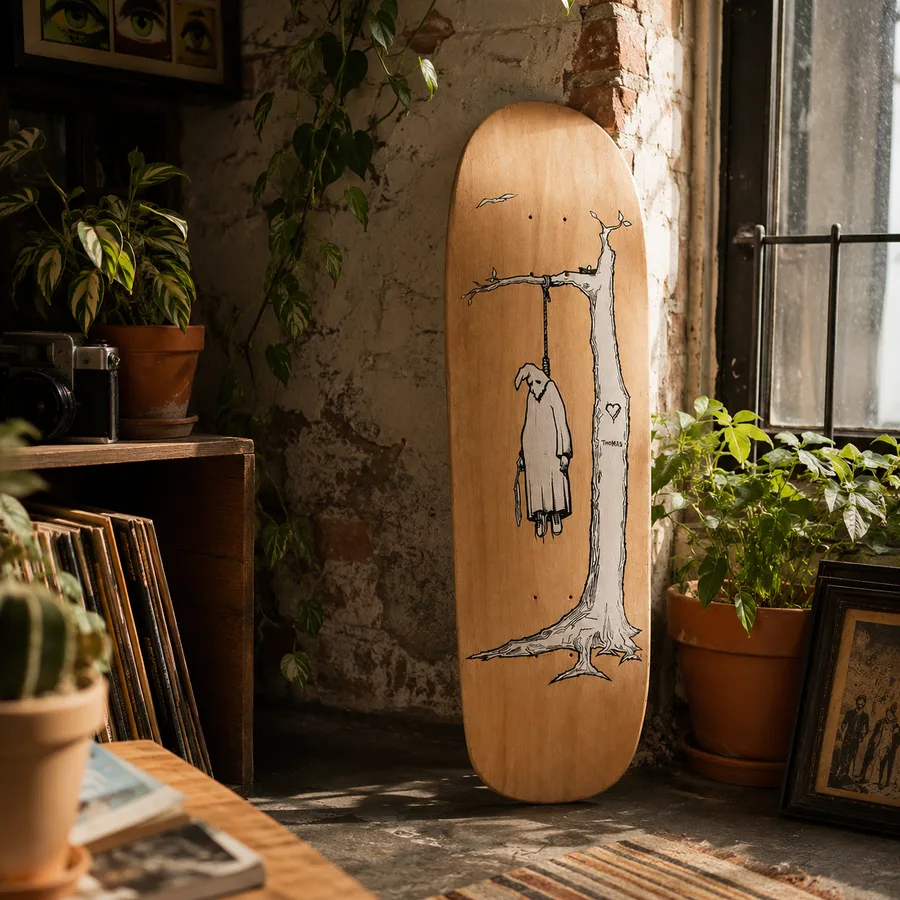
Hanging Klansman
Brand Real / Deluxe
Pro model Jim Thiebaud
Designer Jim Thiebaud (concepto) + Natas Kaupas (dibujo a línea)
Jim Thiebaud's first pro model for Real Skateboards (the brand he co-founded with Tommy Guerrero at Deluxe around 1990). The concept was Thiebaud's: a hooded Ku Klux Klan figure hanging from a noose, tied to the resurgence of KKK marches in the early '90s in the United States. The final line drawing was done by Natas Kaupas as a gift to Thiebaud. Unprecedented on a skateboard for its direct political charge.
Why it matters One of the most important political graphics in skateboarding history. It proved that the deck could be an anti-racist manifesto — not just commercial provocation — and has been reissued ever since. Part of the permanent collection of the Smithsonian National Museum of American History.
Anti-Hero Pigeon
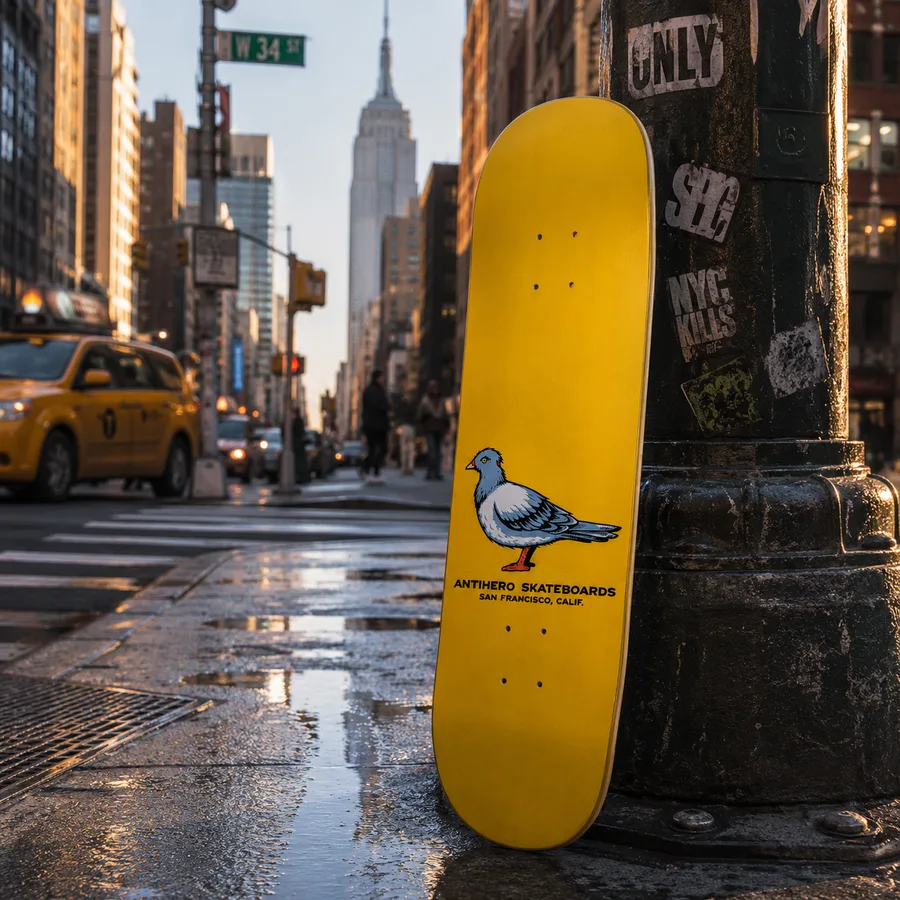
Anti-Hero Pigeon
Brand Anti-Hero Skateboards
Designer Todd Francis
Before the Eagle, Todd Francis drew the urban pigeon as a recurring motif for Anti-Hero in the brand's early years (founded in 1995 within the Deluxe group in San Francisco). The pigeon — rat with wings, the ultimate street animal — fit Anti-Hero's anti-glamour stance and became a complementary image to the Eagle from 1996 onward.
Why it matters To understand Todd Francis's visual language, you have to go through the Pigeon before the Eagle. The pigeon established the brand's editorial tone — acidic, urban, anti-corporate — that carried through everything that came after and remains a defining mark of Anti-Hero to this day.
Anti-Hero Eagle
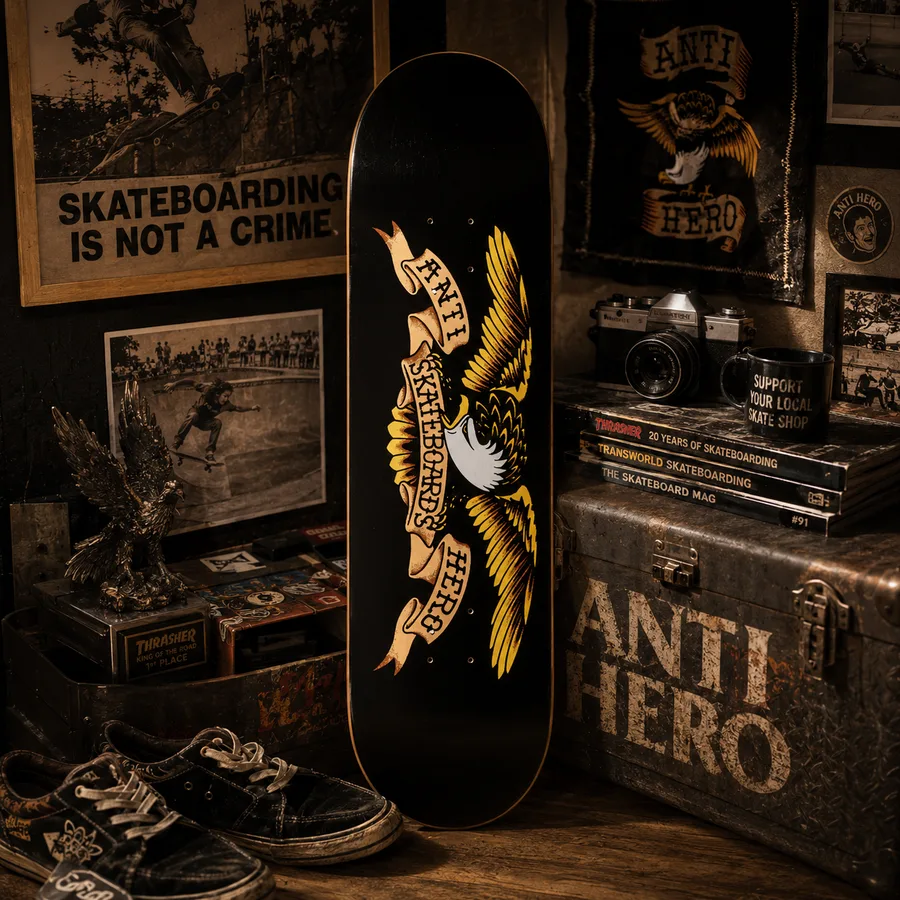
Anti-Hero Eagle
Brand Anti-Hero
Pro model (brand logo)
Designer Todd Francis
Francis joined Deluxe in 1996. His first job: a pigeon 'that life has thrown a bucket of grease on'. Then he drew the fierce eagle, which replaced the pigeon and became the main logo. Aesthetic drawn from American political cartooning, anti-corporate.
Why it matters Patriotic anti-patriotism: uses the American eagle but makes it aggressive, countercultural. Symbol of Deluxe SF and of skate's punk wing. Complex included it in the 50 Greatest Skate Logos.
By the mid-1990s, street was already the dominant language of skateboarding.
Big ramps still existed, but the culture was being built in the streets, in videos and through the new brands constantly appearing. Graphics were changing too. The epic illustrations of the ’80s now coexisted with much more minimal, personal and conceptual proposals.
The next major transformation would come from Girl, Chocolate and Crailtap — brands that proved a deck didn’t need monsters, skulls or provocation to become an icon.
1993–2000 — Girl, Chocolate and the birth of modern skateboarding
By the mid-1990s, skating had changed completely.
The exaggerated aesthetic of the ’80s was coexisting with World Industries-style provocation, but a third path was beginning to emerge. Cleaner. More graphic. Closer to contemporary design than to monsters, skulls or cartoons.
Much of that transformation grew around a small brand founded by Rick Howard and Mike Carroll in 1993. Its name was Girl. And its influence would turn out to be enormous.
Unlike many companies before it, Girl didn’t try to build a visual universe based on creatures, characters or complex narratives. The bet was much simpler: create a clear, coherent and recognisable graphic identity.
To do that they worked with Andy Jenkins, one of the most important figures in the visual history of skateboarding and probably one of the most influential designers of the past thirty years.
What happened next permanently changed the aesthetic of skateboarding.
Girl Logo (Skater Silhouette)
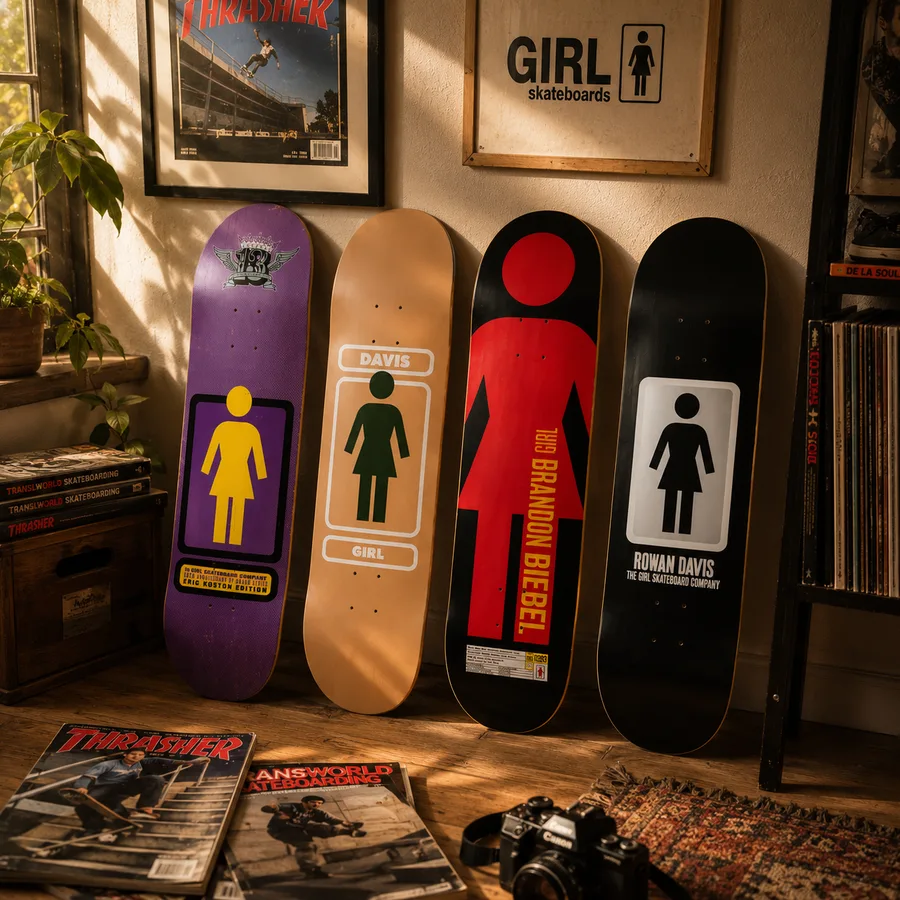
Girl logo (skater silhouette)
Brand Girl Skateboards
Pro model (brand logo)
Designer Andy Jenkins
A silhouette in the style of a women's restroom sign. Rick Howard and Mike Carroll founded Girl Skateboards in August 1993, after leaving Plan B over the pressure the industry was putting on riders' professional careers. The name came from a joke: someone said Howard 'skates like a girl' and they claimed it. (Mike Ternasky, Carroll and Howard's mentor at Plan B, passed away on May 17, 1994, nearly a year after Girl was founded.)
Why it matters A clean, pop counterpoint to World's provocateur baroque. Swiss-minimalist aesthetics in skate. Andy Jenkins founded Art Dump, the creative collective behind the Crailtap distro.
Girl OG Series

Girl OG Series
Brand Girl Skateboards
Pro model (team series)
Designer Andy Jenkins
The first board series released by Girl Skateboards after the brand was founded in 1993 by Rick Howard and Mike Carroll. The art direction of Andy Jenkins — previously art director at BMX Action — committed from the start to simplicity, compositional balance, and typographic design, in deliberate contrast to the graphic saturation dominant across much of the skate catalog in the '90s. The earliest boards featured the female pictogram silhouette as the central element, with clean compositions closer to commercial poster design than to anything else in the market.
Why it matters They marked the beginning of a new way of thinking about graphic design within skateboarding. The Girl aesthetic — minimalism, clear typography, references to contemporary design and urban visual language — directly influenced much of the skate catalog that followed after 1995 and remains the defining signature of the entire Crailtap operation (Girl, Chocolate, Lakai, Royal, Fourstar).
Girl Mouse Series
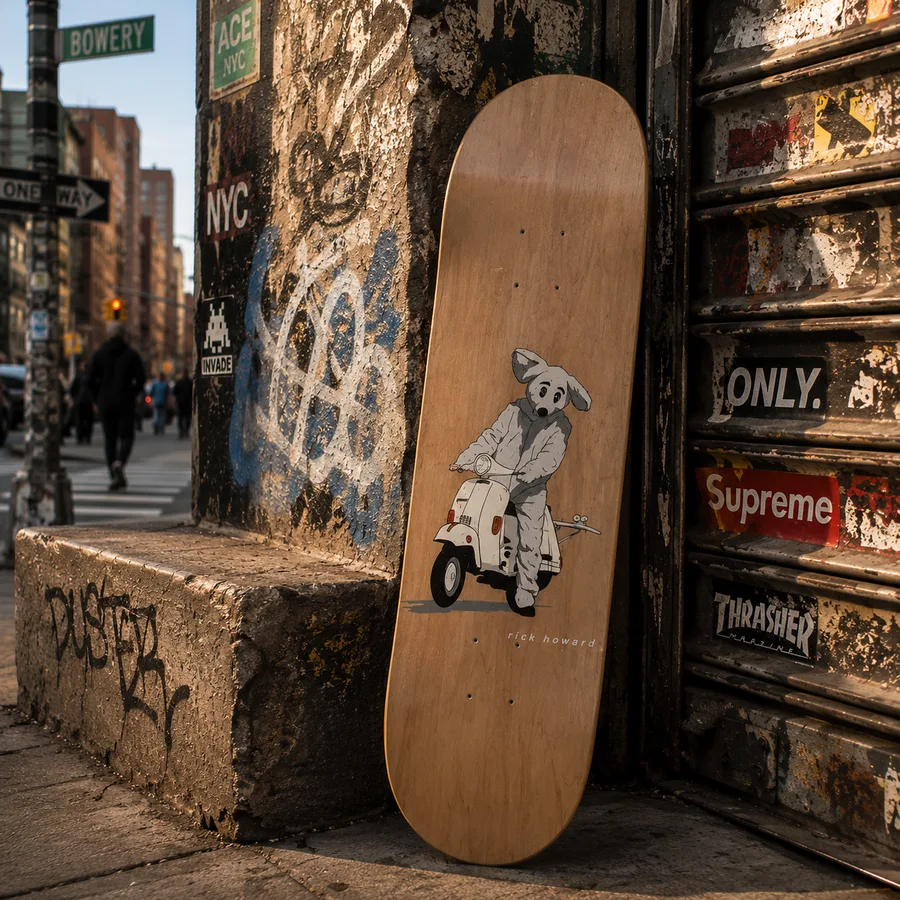
Girl Mouse Series
Brand Girl Skateboards
Pro model (team series)
Designer Andy Jenkins / Eric McKinley
A Girl board series featuring an anthropomorphic mouse as a recurring character, launched in the mid-'90s. Against the minimalism of the silhouette logo, the Mouse Series proved that the brand could develop its own characters without losing identity. The mouse's relaxed tone — with variations playing on poses, clothing, and everyday settings — fit the Girl spirit and expanded the brand's visual language beyond the female pictogram.
Why it matters One of the most remembered Girl series of the '90s. It shows how the brand was able to evolve visually without losing aesthetic coherence, and it opens the line of "Crailtap characters" that would continue appearing in later catalogs.
Chocolate Big Chunk
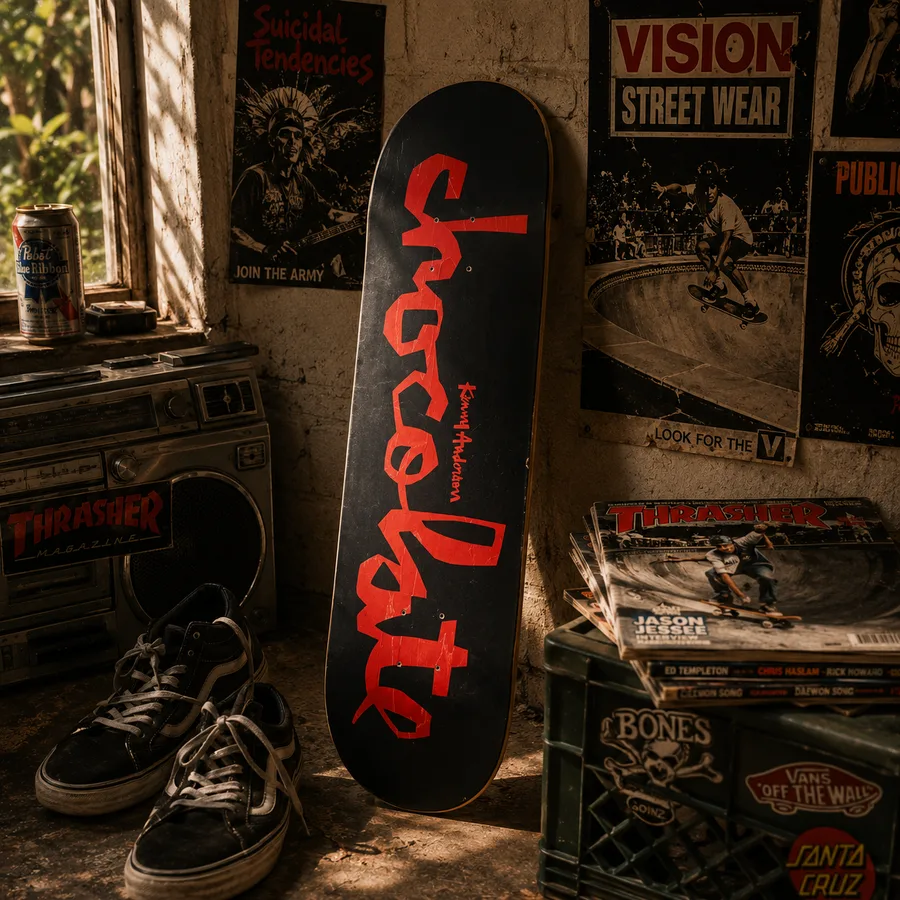
Chocolate (Big Chunk logo)
Brand Chocolate
Pro model (brand logo)
Designer Andy Jenkins
Chocolate was created in 1994 as a sister brand to Girl (founded in 1993 by Rick Howard, Mike Carroll, and Spike Jonze). Andy Jenkins, former art director at BMX Action, joined the Crailtap family to define the visual language of both brands. The Chocolate logotype — its typography and drip motif — reflects that more adult, minimalist approach against the aggressive cartoons that dominated the first half of the '90s.
Why it matters A key brand in the Crailtap axis alongside Girl. Andy Jenkins shaped the aesthetic of the more understated side of '90s and 2000s skateboarding.
Chocolate City Series
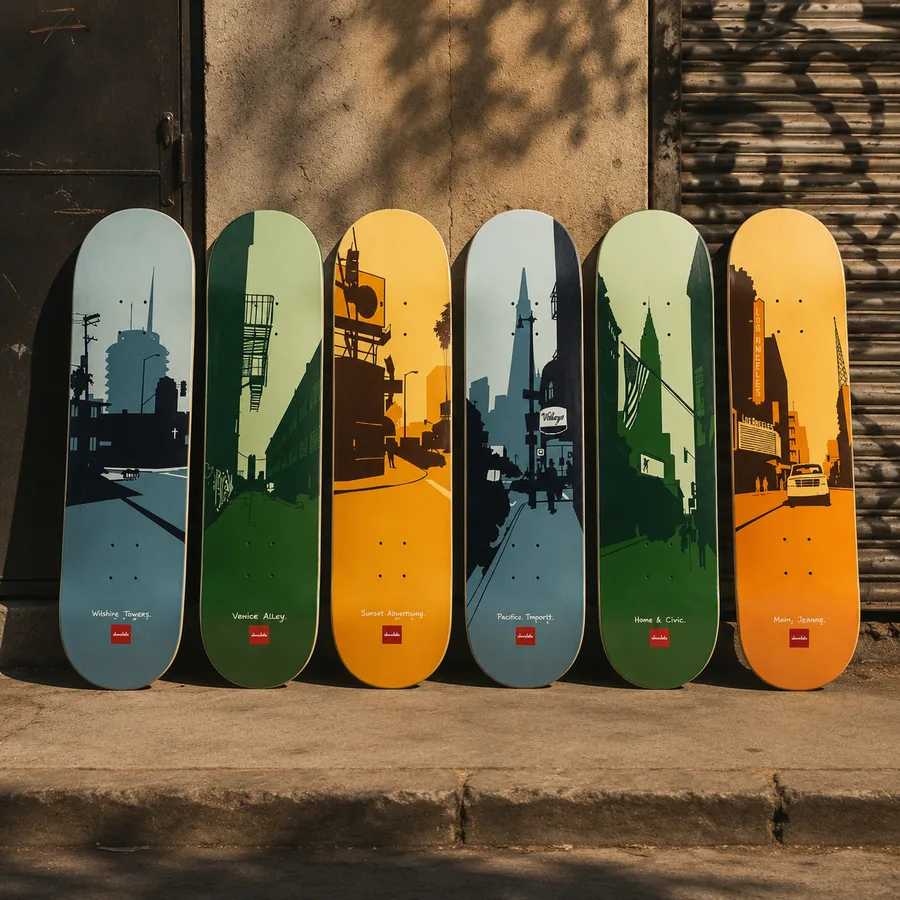
Chocolate City Series
Brand Chocolate Skateboards
Pro model (team series)
Designer Andy Jenkins / Equipo Crailtap
In the late '90s, Chocolate began exploring a visual direction increasingly tied to urban culture, photography, and city narrative. The City Series turned boards into small postcards of city life — architecture, storefronts, street corners, street portraits — and reinforced the connection between the brand and the street skating that was defining the era. Each artist on the visual staff contributed different compositions within the same overall language.
Why it matters One of the best examples of Chocolate's graphic maturity. It helped consolidate the brand's own identity within the Crailtap universe, separating it from Girl's more commercially-minded minimalism and connecting it to the editorial-photographic language of late-'90s street skating.
While Girl and Chocolate were redefining the graphic design of street skating, Tony Hawk was still writing some of the most important chapters in the sport’s history.
Birdhouse Falcon 2
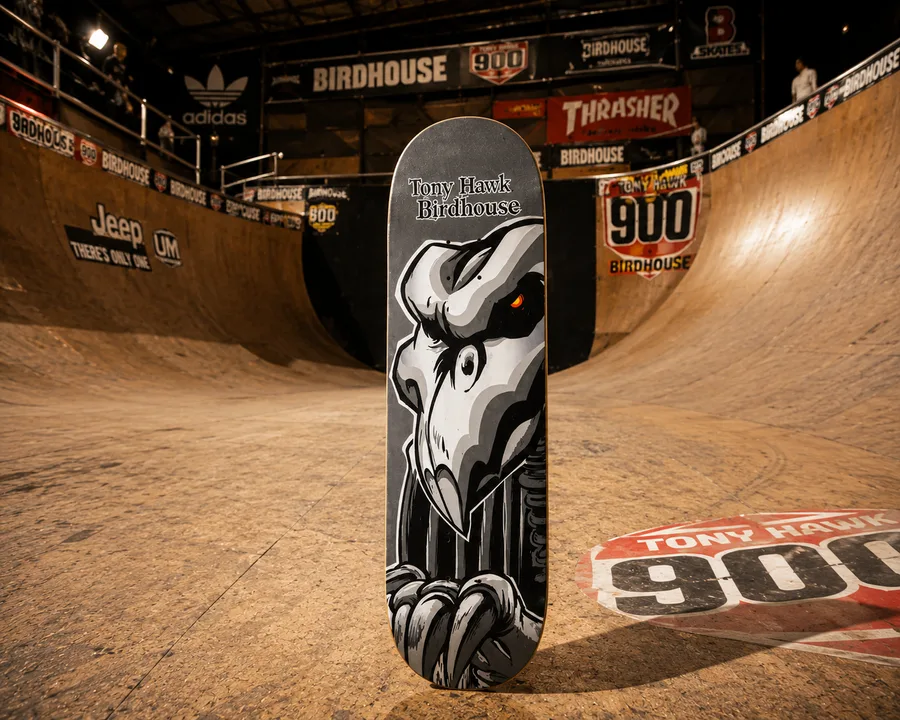
Birdhouse Falcon 2 (900 board)
Brand Birdhouse
Pro model Tony Hawk
Designer Birdhouse in-house
The Birdhouse Falcon 2 Tony Hawk rode to land the first documented 900 in history, at the 1999 X Games. It was auctioned at Julien's Auctions in September 2025 for $1,152,000, doubling the pre-sale estimate and setting the absolute record for a skateboard. A portion of the proceeds went to The Skatepark Project (Hawk's foundation).
Why it matters The most expensive object tied to skateboarding. It combines historical fact (the 900), provenance (Hawk), and a massive televised moment. It confirmed that a skateboard can operate fully in the high-end collectibles market.
Although the Falcon became associated with the most famous moment of Tony Hawk’s career, the image that ultimately defined Birdhouse’s visual identity was quite different.
Tony Hawk Skeleton Bird
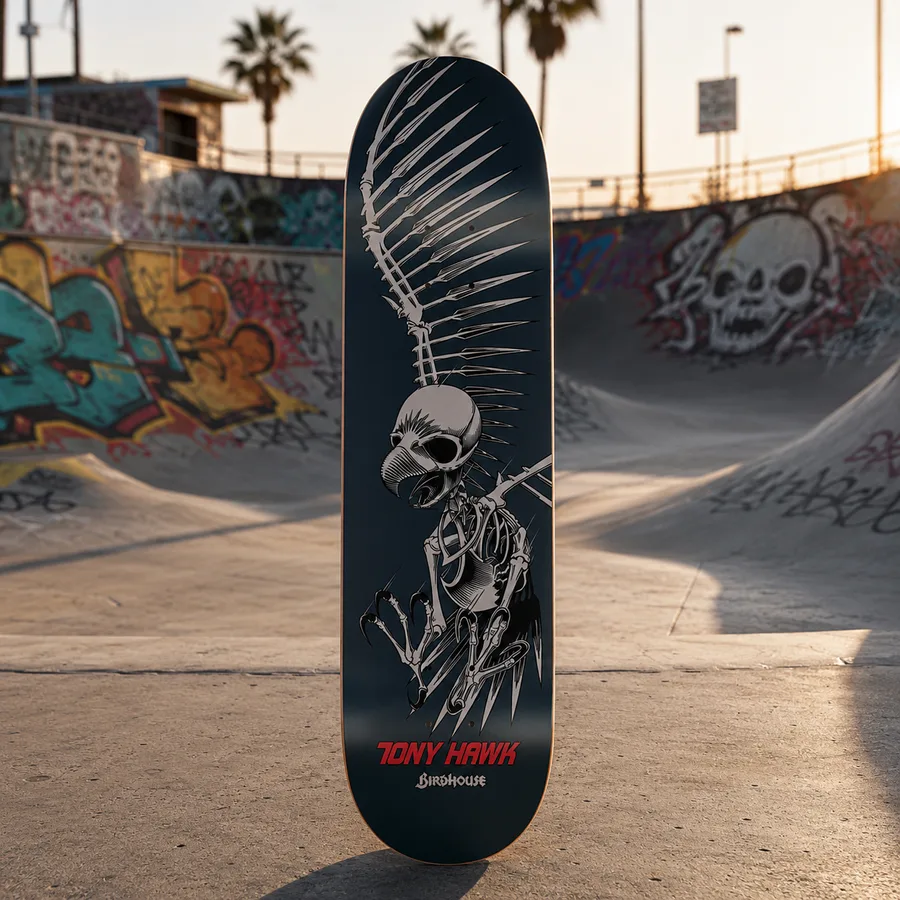
Tony Hawk Skeleton Bird
Brand Birdhouse Skateboards
Pro model Tony Hawk
Designer Birdhouse Skateboards
After leaving Powell-Peralta and co-founding Birdhouse with Per Welinder, Tony Hawk entered a new chapter both athletically and visually. While much of the graphic universe VCJ had built through the eighties was left behind, some of the elements that had defined his career remained intact: birds of prey, wings, and the idea of rising above known limits. The Skeleton Bird became one of the most iconic representations of that transition. The graphic depicts the skeleton of a raptor with enormous wings spread wide, formed by sharp bony feathers — an image that conveys speed, aggression, and freedom simultaneously. The design connects directly to Hawk's visual lineage, built over more than a decade around hawks, talons, and winged creatures. Throughout the nineties and into the early 2000s, the Skeleton Bird appeared in various versions and reissues, cementing itself as one of the most recognizable images associated with Tony Hawk outside the Powell-Peralta era. For many skaters it represents the perfect bridge between the classic Bones Brigade aesthetic and the birth of modern skateboarding.
Why it matters It is one of the most representative graphics from Tony Hawk's Birdhouse era and one of the strongest visual evolutions of the iconography that had followed the skater since his first pro models at Powell-Peralta. Its silhouette is immediately recognizable and belongs to the graphic vocabulary surrounding one of the most important figures in the entire history of skateboarding.
By the late 1990s, skateboarding was unrecognisable compared to a decade earlier.
The street dominated the conversation. Videos had become the primary cultural engine. And brands were beginning to understand they could build solid visual identities without necessarily reaching back to the codes inherited from the ’80s.
But the next transformation would be even more profound.
Because from the 2000s onwards, the deck would stop being solely a tool for skating. It would also begin to become a collectible, a design object and a cultural product capable of transcending skateboarding itself entirely.
2000–2010 — Alien Workshop, Supreme, Baker, Enjoi, Zero, Creature, Foundation, Flip and the cultural expansion of skating
By the late 1990s, skateboarding had found a stability that would have seemed unthinkable just a few years earlier.
The major crises of the ’80s were behind it, street dominated the industry, and a new generation of brands was starting to build visual identities that were very different from one another.
There was no longer a single way to design a deck.
Some companies bet on conceptual art. Others on humour. Others on provocation. And some understood that a graphic could become much more than an image associated with skating. It could turn into a cultural object.
Few brands better represent that diversity than Alien Workshop, Supreme, Baker, Enjoi, Zero, Creature, Foundation and Flip.
Alien Workshop Alien Logo
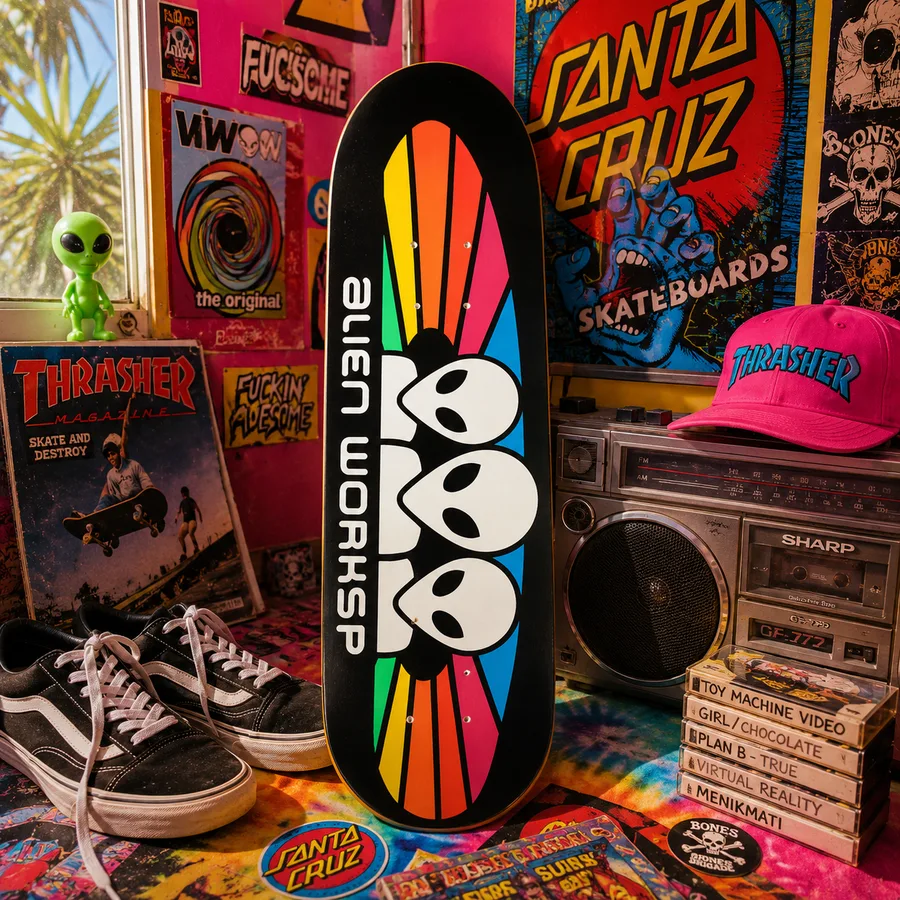
Alien Workshop (logo)
Brand Alien Workshop
Pro model (brand logo)
Designer Mike Hill
Alien Workshop was founded in Dayton, Ohio in 1990 by Chris Carter, Mike Hill, and Neil Blender, with the idea that the brand would be driven by artists rather than managers. The logo — an alien head in profile — was drawn by Mike Hill and remained the brand's defining mark until its closure in 2014, when DC Shoes shut down the operation.
Why it matters A reference point for underground skateboarding through the '90s and 2000s, with the art director as the central figure of the project.
Alien Workshop Abduction Series
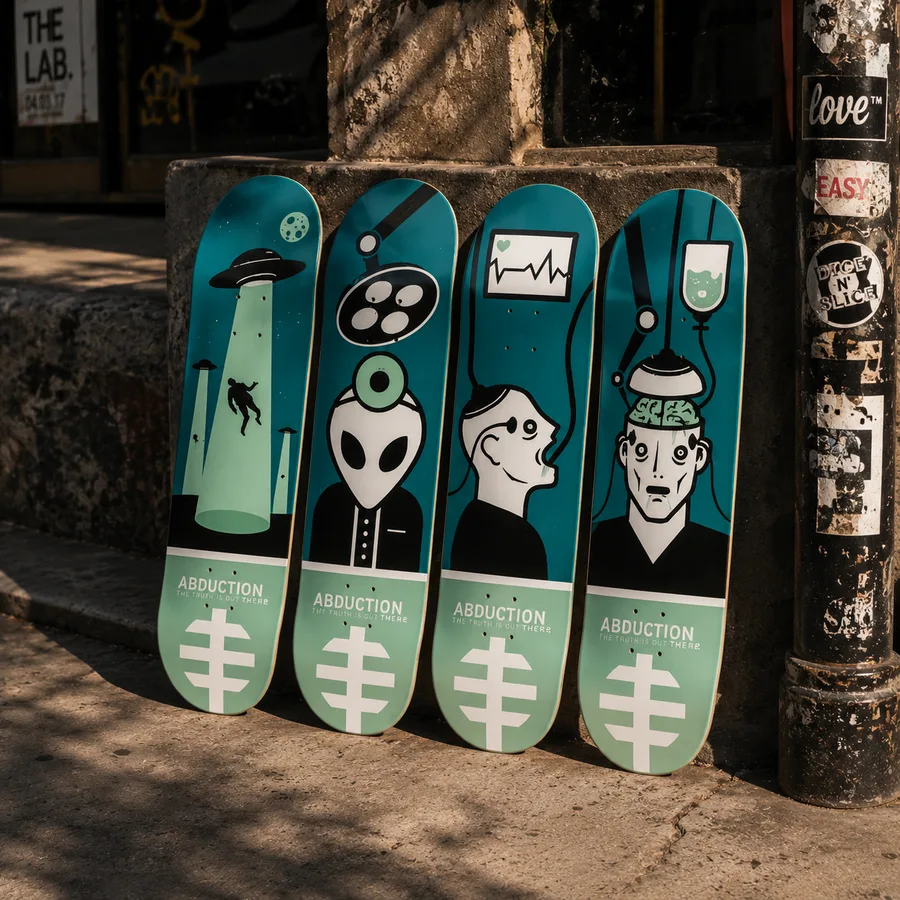
Alien Workshop Abduction Series
Brand Alien Workshop
Pro model (series)
Designer Mike Hill
A series of conceptual pro models that Alien Workshop produced in the late '90s built around UFOs, medical scans, esoteric geometries, and human figures arranged as abduction subjects. Mike Hill ran the line out of Dayton, Ohio, working with sci-fi vocabulary, conceptual paranoia, and New Age symbolism. The series has been reissued frequently ever since.
Why it matters Probably the most remembered series in Alien Workshop's catalog. It defined the "arty + conceptual paranoia" DNA that would distinguish the brand throughout its entire run (1990–2014) and that later carried over into Quasi Skateboards under Chad Bowers.
But if there’s one image capable of summarising the entire Alien Workshop philosophy in a single symbol, it’s probably the Visitor.
Alien Workshop Visitor
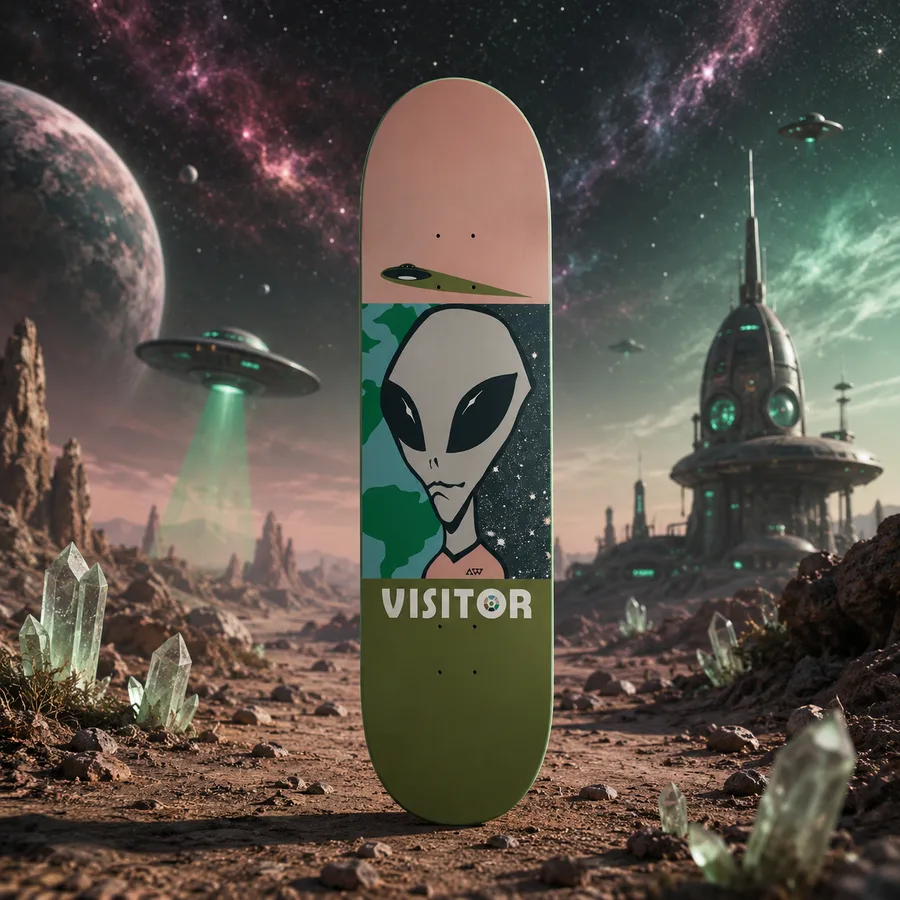
Alien Workshop Visitor
Brand Alien Workshop
Pro model (team series)
Designer Mike Hill
The Visitor emerged as a natural evolution of the extraterrestrial iconography Alien Workshop had been developing since the early nineties. The large-headed humanoid figure with simplified features became the character most associated with the brand and appeared repeatedly on boards, clothing, stickers, and promotional material for more than two decades. Its minimalist design contrasted with the complexity of many graphics of the era and helped solidify Alien Workshop's unique visual identity.
Why it matters Arguably the most recognizable character in alternative skateboarding from the late nineties and early 2000s.
Supreme Box Logo Deck
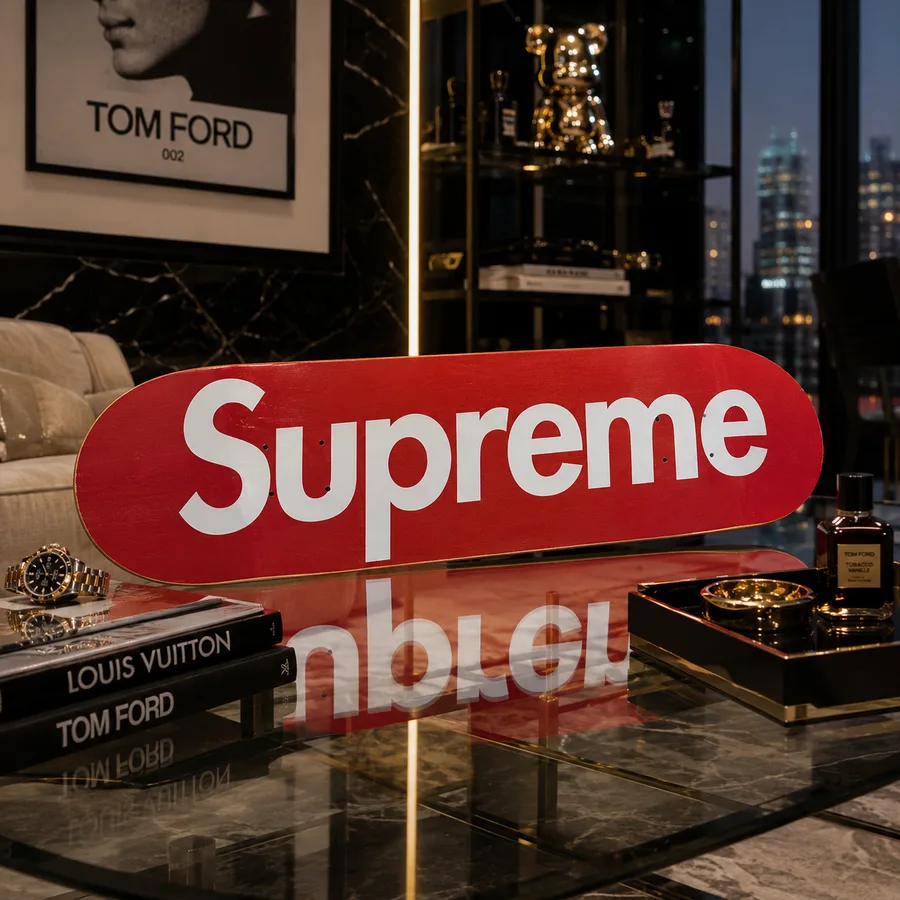
Supreme Box Logo
Brand Supreme
Pro model (brand logo)
Designer James Jebbia (adaptado de Barbara Kruger)
Red box with Futura Heavy Oblique in white. Directly inspired by the work of Barbara Kruger. Supreme opened on Lafayette Street, Manhattan, in April 1994 with a layout designed so you could skate right in. First artist collab: Rammellzee (1994). VF Corp bought Supreme in 2020 for $2.1B; EssilorLuxottica reacquired it in 2024 for $1.5B.
Why it matters Turned the deck into an auction object. KAWS x Supreme sets have sold at auction for $55,700. A paradigm shift: skate → luxury streetwear.
Baker Logo Deck
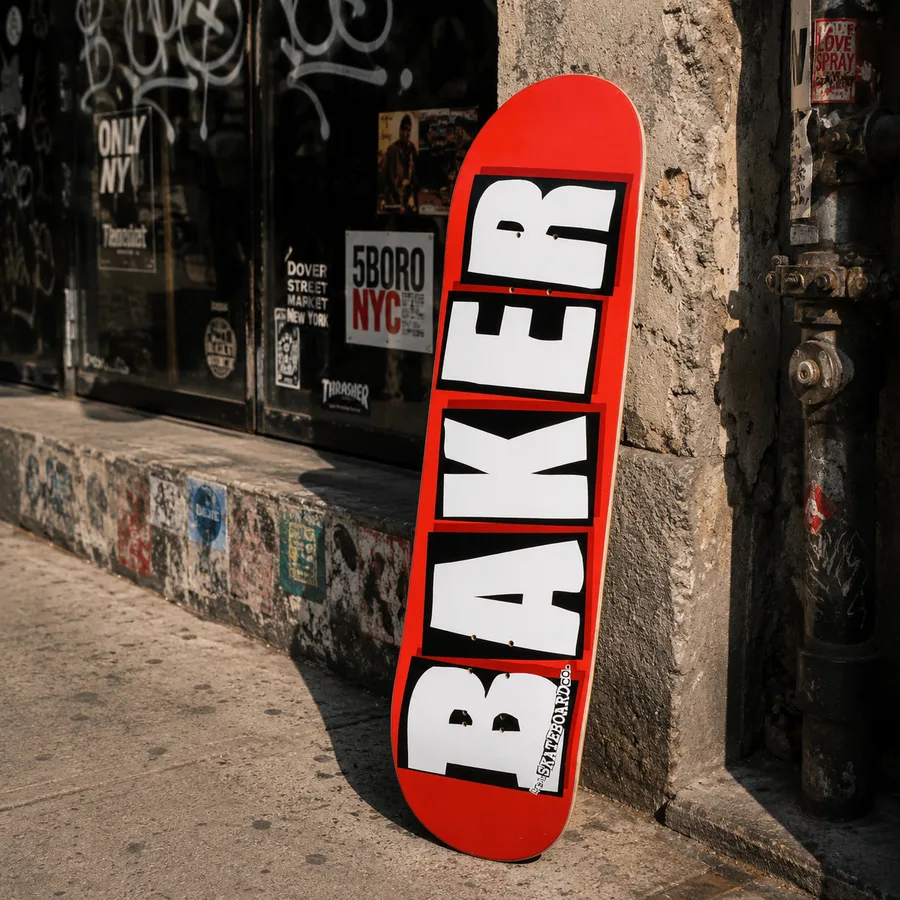
Baker Logo Deck
Brand Baker Skateboards
Pro model (brand logo)
Designer Andrew Reynolds y equipo Baker
In the early 2000s, while many companies were still leaning on complex illustrations, Baker found much of its visual identity in something far simpler: its own name. Decks carrying the massive BAKER wordmark became a symbol for an entire generation of street skaters and helped cement the brand — founded by Andrew Reynolds in 2000 — as one of the most influential companies of its era.
Why it matters Turned a simple logotype into one of the most recognizable symbols in 2000s skate. Captured the spirit of early-decade street skating perfectly — punk, direct, no frills — and paved the way for the entire generation of skater-owned brands that followed (Deathwish, Shake Junt, and company).
Creature Logo
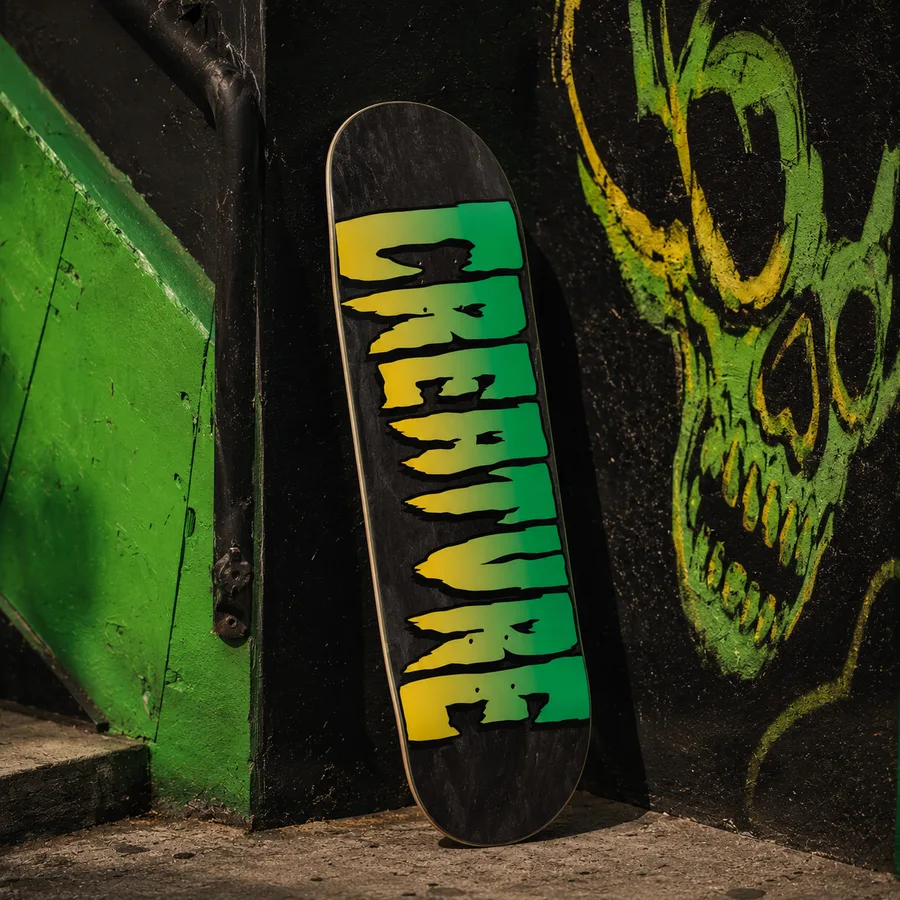
Creature Logo
Brand Creature Skateboards
Pro model (brand logo)
Designer Equipo Creature / NHS
The Creature logo — dense gothic typography with the word CREATURE in all caps, typically accompanied by an inverted cross or pentacle symbol — draws direct inspiration from heavy metal iconography, classic horror, and underground culture. It has ridden alongside multiple generations of skaters from the early 2000s to the present and remains one of the most recognizable logos in the NHS catalog.
Why it matters One of the most solid and consistent visual identities in modern skateboarding. Few brands have maintained such a coherent graphic language for so long without losing cultural relevance.
Element Tree
Element Tree / Triple Eight
Brand Element
Pro model (brand logo)
Designer Johnny Schillereff
Three circles forming a triangle (the four elements: earth, fire, water, air) plus a tree with roots. Eco-naturalist aesthetic. Element was probably the commercially most successful skate brand of the modern era, until its bankruptcy within the Liberated Brands group in February 2025.
Why it matters The first major skate brand with environmentalist iconography. Embodies the 'corporate' wing of 2000s skate — polished, mainstream, accessible.
Element Section
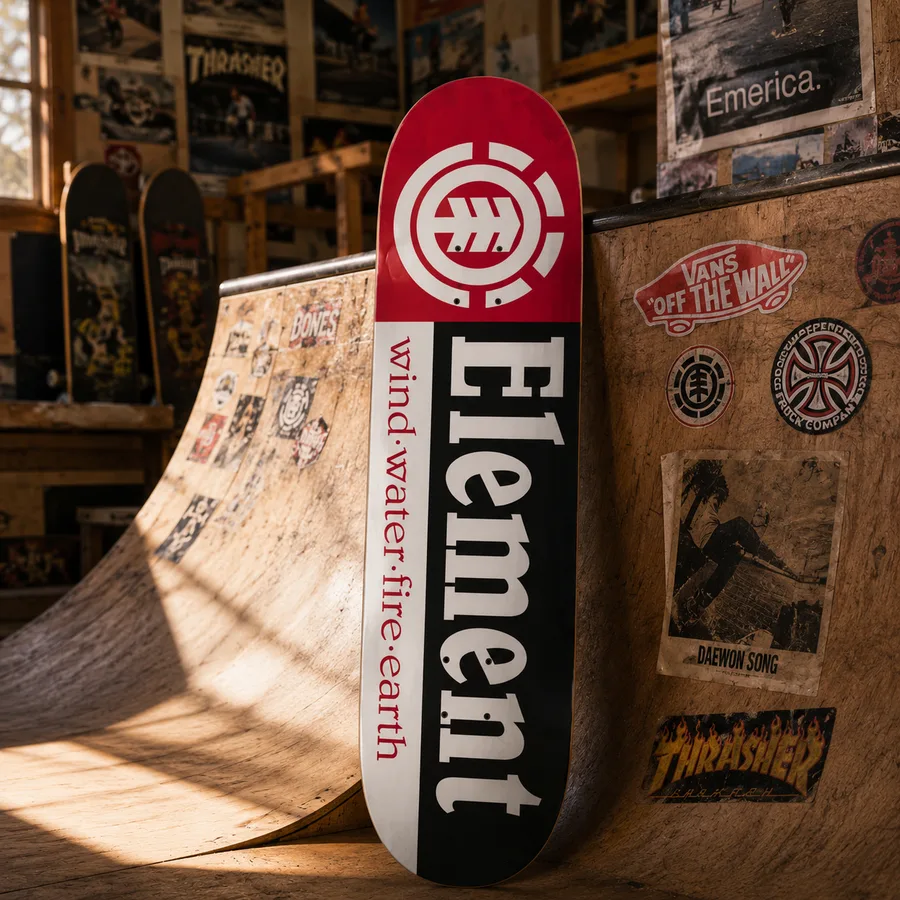
Element Section
Brand Element Skateboards
Pro model (brand logo)
Designer Equipo Element
The Section Logo distilled Element's identity into four geometric elements: tree, water, fire, and wind. Its clean, easily reproducible design helped drive the brand's international expansion during the 2000s.
Why it matters Represents skateboarding's shift toward visual identities increasingly aligned with contemporary branding.
Flip HKD Logo
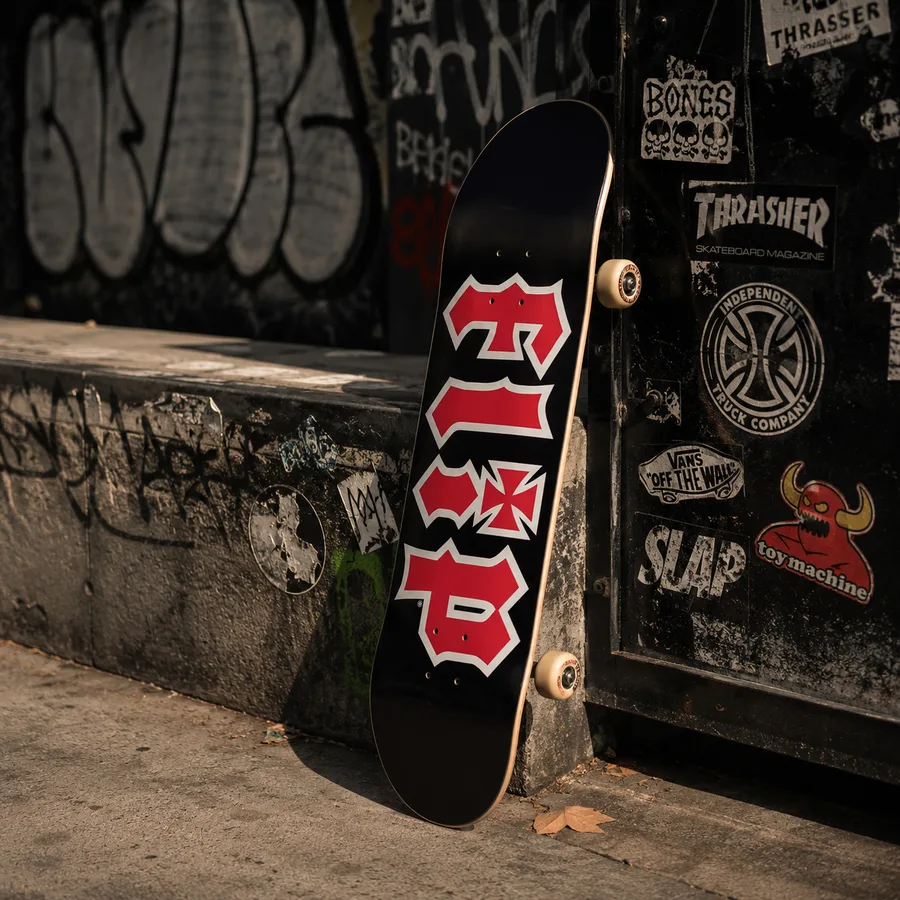
Flip HKD Logo
Brand Flip Skateboards
Pro model (brand logo)
Designer Equipo Flip
Flip Skateboards relaunched in the United States in 1994 following the brand's origins in the UK (Deathbox, founded by Jeremy Fox and Ian Deacon). The HKD logo — clean typography with the acronym integrated into the Flip wordmark — solidified throughout the nineties and early 2000s as the brand's official face. Flip's golden era coincided with a legendary team: Geoff Rowley, Tom Penny, Arto Saari, Rune Glifberg, Ali Boulala, Bastien Salabanzi, and the videos Sorry (2002) and Really Sorry (2003), absolute benchmarks of street skating from that period.
Why it matters One of the most influential brands of the transition between the nineties and the 2000s. The HKD logo accompanied one of the most celebrated generations of European-American street skating and remains instantly recognizable to any skater who lived through that era.
Enjoi Panda
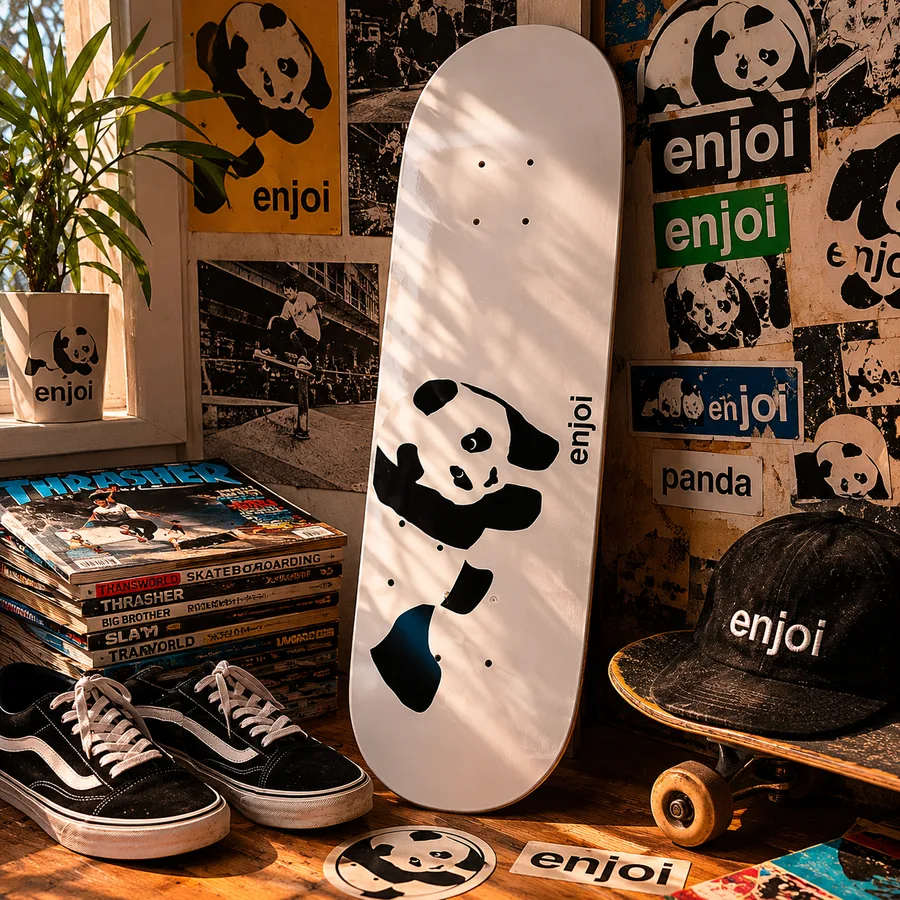
Enjoi (panda)
Brand Enjoi Skateboards
Pro model (brand logo)
Designer Marc Johnson / equipo Enjoi
Enjoi was founded in 2000 under distributor Dwindle, with Rodney Mullen, Marc Johnson, and Louie Barletta among its most visible faces. The brand's mascot — a panda with a clumsy expression — accompanied the humorous tone that set Enjoi apart from the rest of the technical street skating scene of the 2000s.
Why it matters One of the most recognizable logos in 2000s skate, associated with a brand with an explicitly comedic identity.
Zero Single Skull
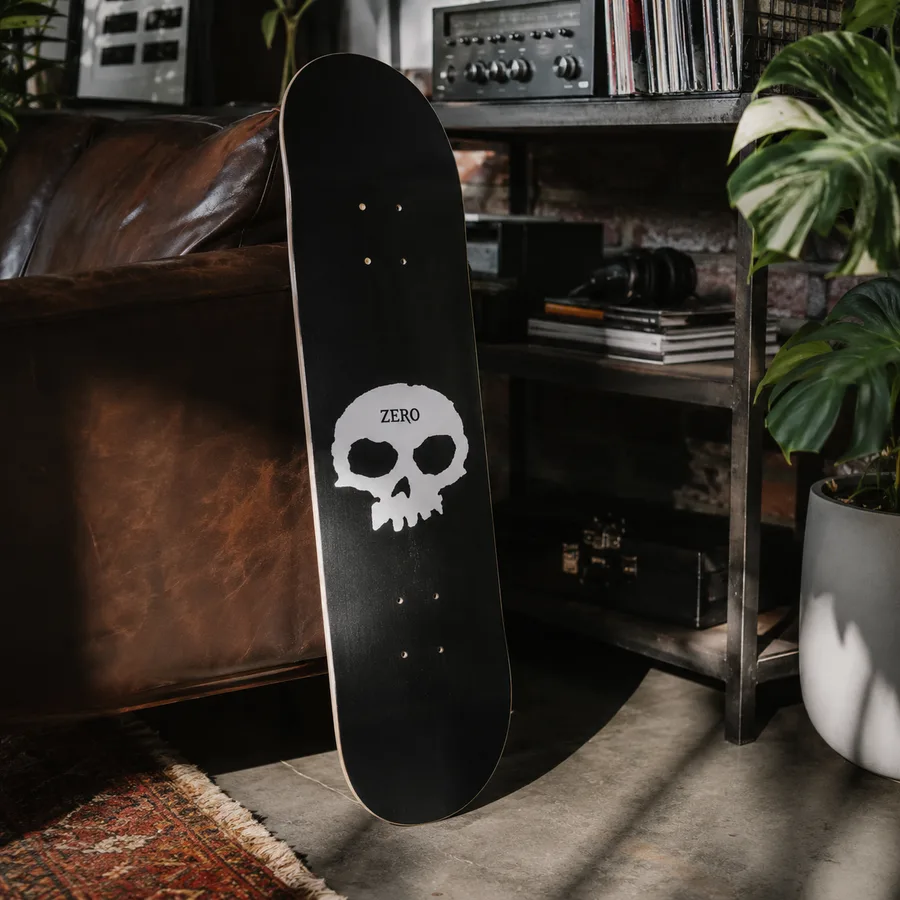
Zero Single Skull
Brand Zero Skateboards
Pro model (brand logo)
Designer Jamie Thomas
Jamie Thomas founded Zero Skateboards in 1996 after leaving Toy Machine. The Single Skull, drawn by Thomas himself, became the brand's central emblem from the late '90s onward and dominated Zero's visual identity throughout the first half of the 2000s. Its success isn't explained by the design alone, but by everything the brand represented at that moment: street skating pushed to the limit, video parts built on hammers (Misled Youth, 1999; Dying to Live, 2002), and a hardcore aesthetic directly connected to the California punk scene.
Why it matters One of the most recognizable visual icons for an entire generation of skaters. The Zero skull appeared on boards, T-shirts, stickers, backpacks, and nearly every surface imaginable during the early 2000s, at a scale comparable to the Enjoi Panda or the Baker logo within the same period.
Zero Three Skulls
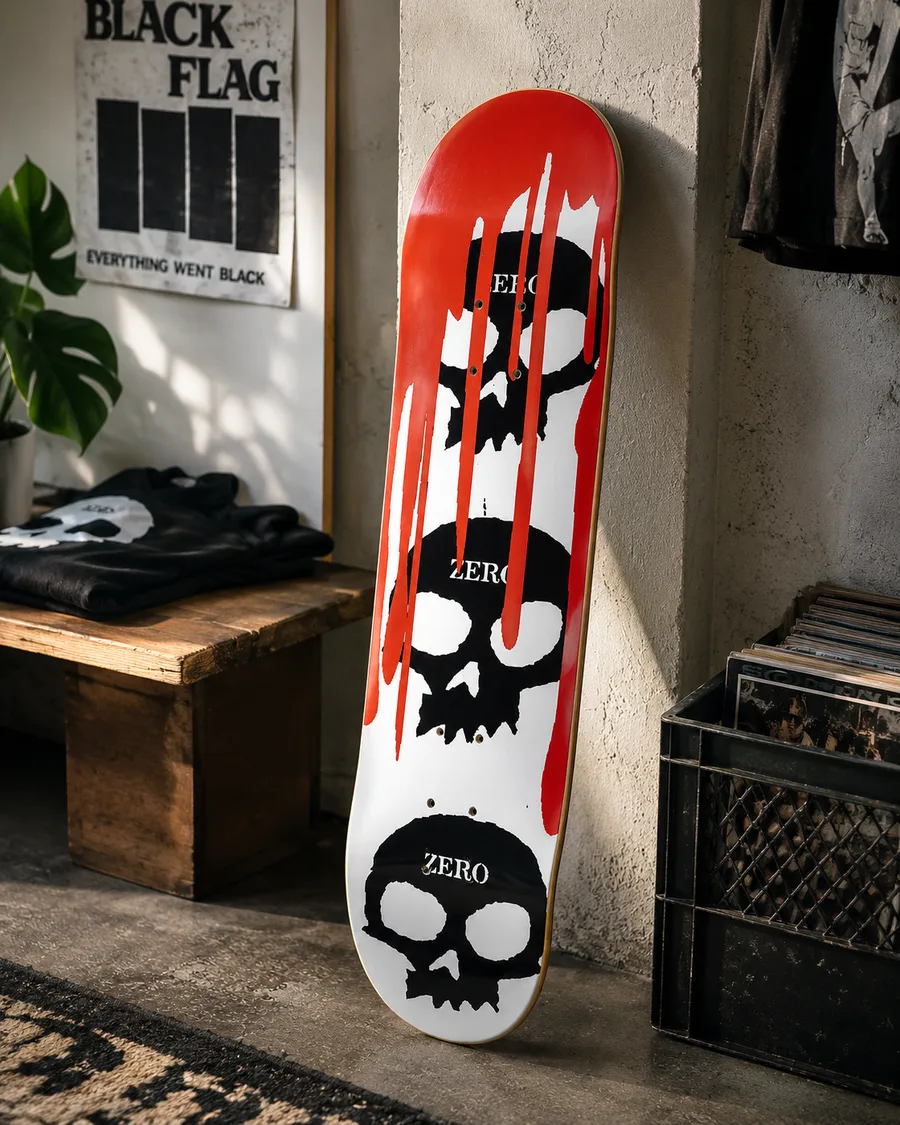
Zero Three Skulls
Brand Zero Skateboards
Pro model (brand logo)
Designer Jamie Thomas
A variant of the Zero skull with the image tripled in horizontal composition, launched in the early 2000s. The repetition created an image even more aggressive and recognizable than the original Single Skull, and it became one of the most popular versions in the brand's entire history. It has been reissued frequently and still appears across much of Zero's current merchandise.
Why it matters It represents Zero's moment of maximum cultural influence within street skating. For many skaters who grew up during the 2000s, this image is as immediately identifiable as any other logo from the Baker / Deathwish / Toy Machine generation.
While Zero represented the more aggressive, hardcore side of 2000s street skating, other brands were exploring far more surrealist directions. No artist better symbolises that pursuit than Don Pendleton.
Foundation Moon & Star
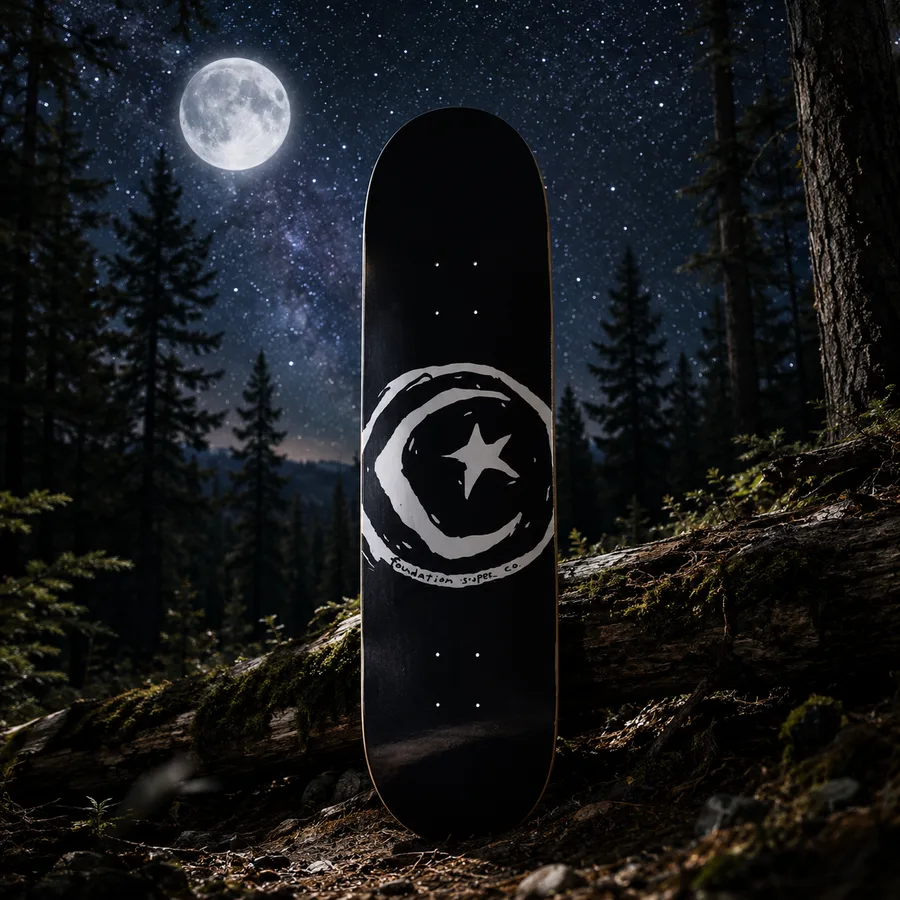
Foundation Moon & Star
Brand Foundation Skateboards
Pro model (brand logo)
Designer Foundation Skateboards
The combination of a crescent moon and a star became one of Foundation's most recognizable images throughout the nineties and into the early 2000s. Its straightforward design stood apart from the complex illustrations that dominated much of the market and helped build an immediately identifiable visual identity for multiple generations of skaters. It appeared on boards, t-shirts, stickers, and promotional material, accompanying the growth of one of the most influential brands in modern street skating. Over time, Moon & Star came to function as a symbol of belonging for an entire community of riders tied to the Foundation universe.
Why it matters It is one of Foundation's most recognizable images and one of the most enduring symbols of late-nineties and early-2000s street skating. Its simplicity proves that a graphic doesn't need to be complex to become an icon.
As the 2000s progressed, the boundaries between skating, design, fashion and art were starting to blur.
Graphics no longer lived exclusively in skate shops. They appeared in galleries. In museums. In private collections. And in collaborations with artists from all over the world.
The next chapter in this story would be defined by exactly that mix of skating and contemporary art.
And few names are more important for understanding it than Mark Gonzales, Krooked and the generation that turned spontaneous drawing into a form of visual identity.
2000–2025 — Krooked, DGK, Deathwish and the era of visual identity
As the 2000s rolled on, skating was no longer just a subculture.
It was still a relatively small community compared to other sports, but its influence on fashion, graphic design, photography and urban culture was growing steadily.
Brands were changing too. Some bet on a carefully crafted, coherent visual identity. Others preferred to build complete graphic universes. And some simply reflected the personality of their founders.
Few companies better represent that last idea than Krooked.
Founded by Mark Gonzales in 2002, the brand recovered something that had been gradually disappearing over the years: spontaneous, imperfect and deeply personal drawing.
It didn’t look like it had been designed by a marketing department. It looked like Gonz had drawn it. And that was precisely the point.
While some brands were going minimal, others were building visual identities deeply connected to the reality of the neighbourhoods where they’d been born. Few represent that idea better than DGK.
DGK Money Series
DGK Money Series
Brand DGK
Pro model (team series)
Designer Equipo DGK
DGK — Dirty Ghetto Kids — was founded by Stevie Williams in Philadelphia with the goal of representing a reality that was barely reflected in the commercial skateboarding of the time. The Money Series used bills, symbols of wealth, and direct references to social mobility as their central visual element. The series quickly became one of the most recognizable images in the DGK catalog and helped cement the identity of one of the most influential brands in modern street skating.
Why it matters Broadened cultural representation within skateboarding and built a visual identity inseparable from Stevie Williams's personal story and East Coast urban culture.
Krooked Eyes
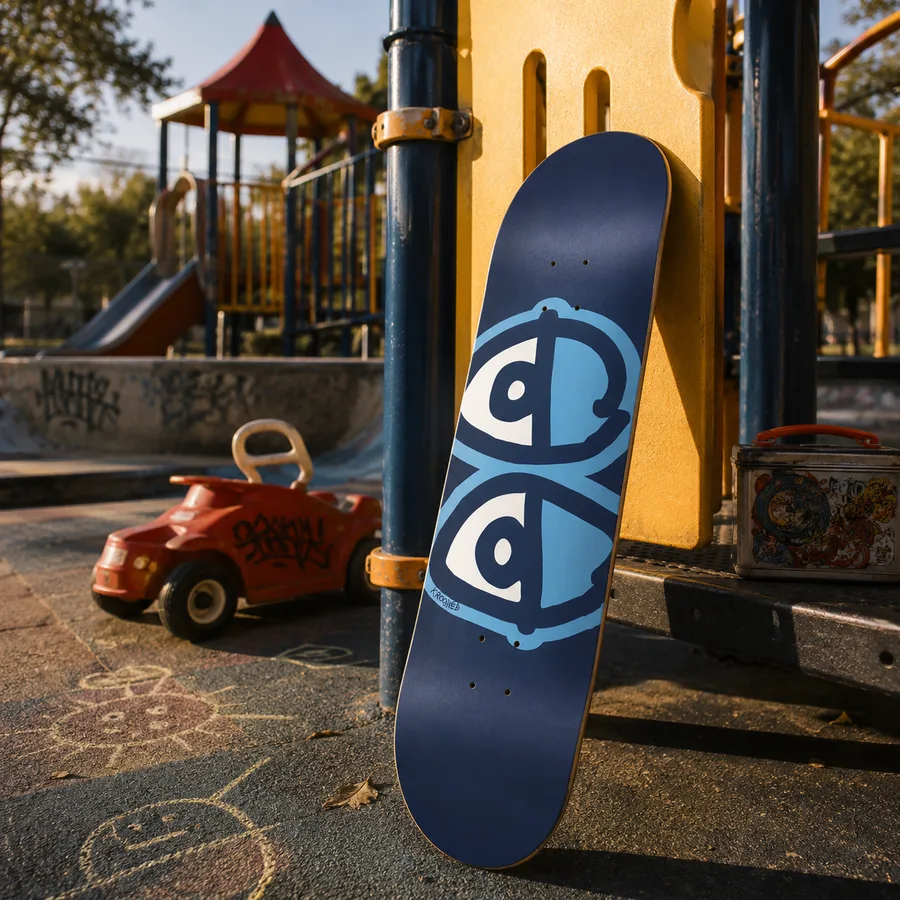
Krooked Eyes
Brand Krooked Skateboards
Pro model (recurring motif)
Designer Mark Gonzales
Two asymmetrical eyes, somewhere between mischievous and melancholic. They show up on hoodies, caps, boards. They embody Krooked's goofy/absurdist humor.
Why it matters Krooked's second icon. A model for how a brand can have identity without a single formal logo.
Deathwish Gang Logo
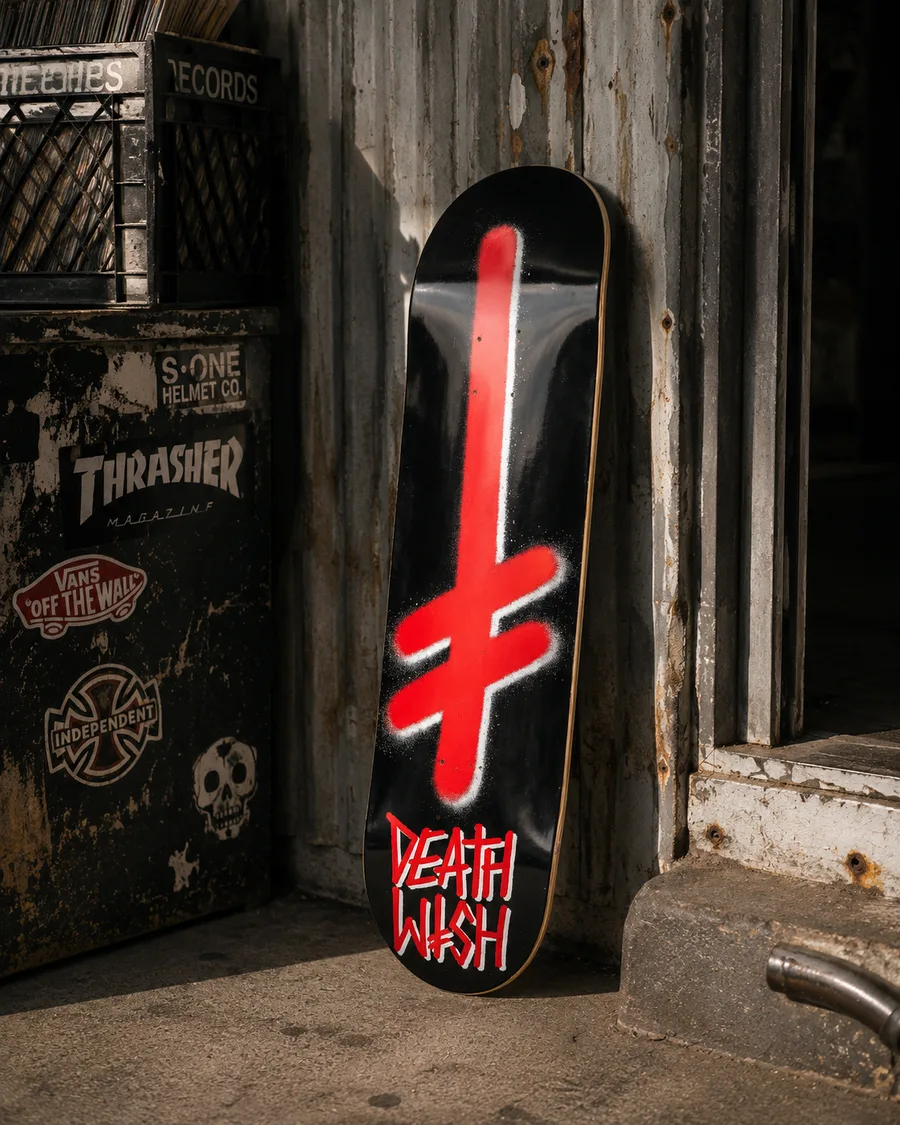
Deathwish Gang Logo
Brand Deathwish Skateboards
Pro model (brand logo)
Designer Equipo Deathwish
Deathwish Skateboards was founded in 2008 as a sister brand to Baker, with Erik Ellington, Jim Greco, and Andrew Reynolds at the core of the project. The Gang Logo — gothic type spelling DEATHWISH alongside two hands forming the brand's signature gang sign — quickly became one of the most recognizable emblems of the post-Baker generation.
Why it matters It represents the natural evolution of the Baker spirit into the next generation: rawer, more aggressive, and less polished. It defines an entire current within American skating from the late 2000s through the 2010s.
Palace Tri-Ferg
Palace Tri-Ferg
Brand Palace Skateboards
Pro model (brand logo)
Designer Fergus Purcell
Palace Skateboards was founded in London in 2009 by Lev Tanju. The logo — three triangles forming a larger triangle, known as the Tri-Ferg — was designed by Fergus Purcell (hence the name), a London-based artist with a long history working with brands including Marc Jacobs and Lucien Pellat-Finet. Launched in 2010, the Tri-Ferg quickly became one of the most recognizable skate logos of the 21st century and one of the central symbols of global streetwear from the mid-decade onward.
Why it matters It demonstrates how far skate graphic design has reached into global fashion. Few skate brands have managed to cross so clearly from skateboarding into mainstream culture, with collaborations with Adidas, Reebok, Stella Artois, Polo Ralph Lauren, and half a dozen luxury houses.
Polar Stroke Logo
Polar Stroke Logo
Brand Polar Skate Co.
Pro model (brand logo)
Designer Pontus Alv
Polar Skate Co. was founded in Malmö, Sweden, in 2011 by Pontus Alv, following several earlier projects — including the video The Strongest of the Strange. The brand's stroke logo, hand-drawn by Alv with a thick line and deliberately imperfect feel, connects directly to the naïf current that Mark Gonzales opened up at Krooked. At a time dominated by highly elaborate graphics, Polar found strength in simplicity.
Why it matters It represents Europe's growing influence within modern skate graphic design. The Polar aesthetic — hand-drawn illustration, reduced palettes, compositions closer to underground poster art — shaped the visual language of European skating in the 2010s and exported itself into the American market.
Cliché Hand
Cliché Hand
Brand Cliché Skateboards
Pro model (brand logo)
Designer Jérémie Daclin / equipo Cliché
Founded in Lyon, Cliché helped prove that Europe could develop a fully original visual identity within skate. Its characteristic hand symbol accompanied some of the continent's most influential videos and catalogs for years.
Why it matters One of the most important icons in European skateboarding and a direct precursor to the creative explosion that would follow with Magenta and Polar.
Magenta Leaf / M
Brand Magenta Skateboards
Pro model (brand logo)
Designer Soy Panday
A leaf plus an 'M' in an elegant, calligraphic stroke — almost Japanese-bandes-dessinées. Founded in 2010 in Bordeaux by Soy Panday and the Feil brothers. No middlemen: Soy draws everything, Vivien runs the business, Jean handles shipping.
Why it matters European 'living street' aesthetic. Together with Polar, redefined the idea that you can run a skate brand without ever raising your voice.
Jart Logo
Jart Logo
Brand Jart Skateboards
Pro model (brand logo)
Designer Equipo Jart
Founded in the Basque Country, Jart became one of the most successful European companies in the history of skateboarding. Its simple and recognizable visual identity accompanied the brand's international growth through the 2000s and 2010s, making it a reference point for several generations of European skaters.
Why it matters One of the most recognizable symbols in European skateboarding and a testament to the international success of a brand born in Spain.
Supreme Louis Vuitton Deck (2017)
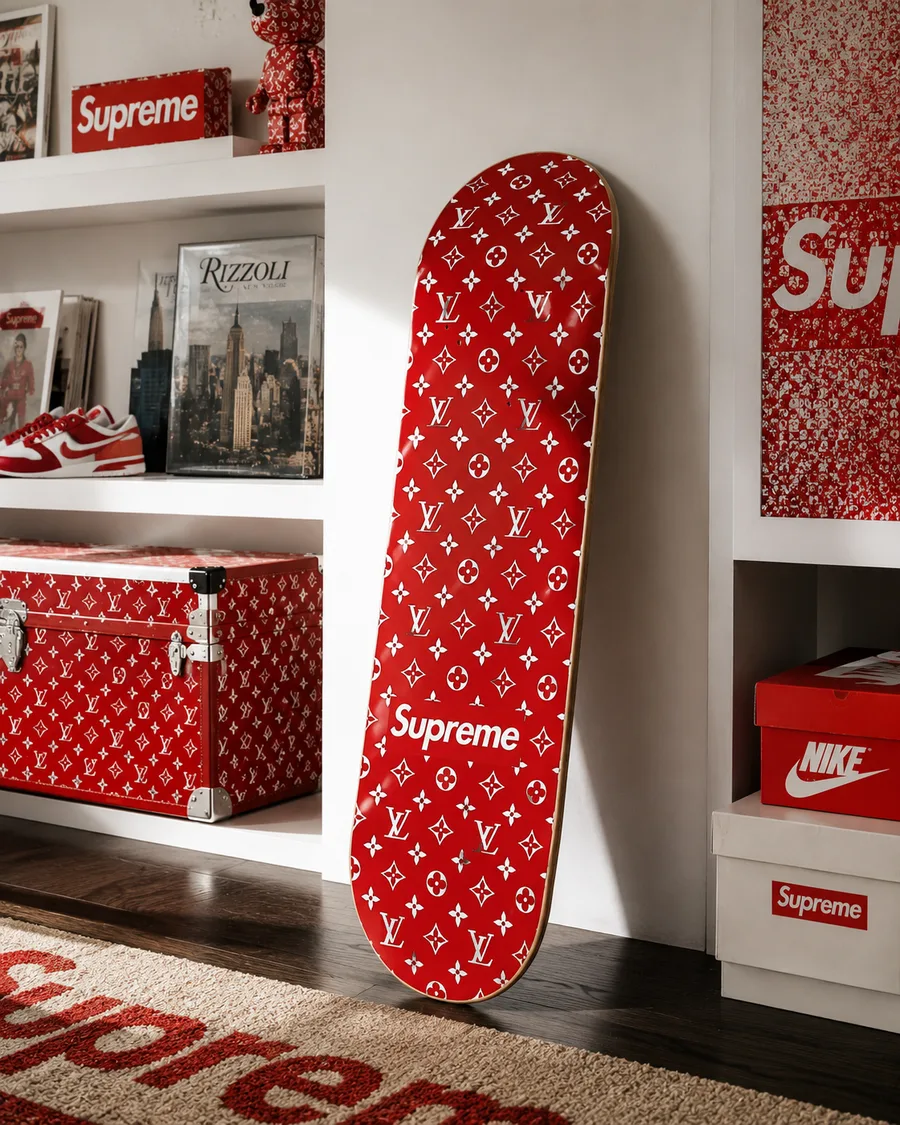
Supreme x Louis Vuitton Deck
Brand Supreme / Louis Vuitton
Pro model (collection)
Designer Supreme + Louis Vuitton
The Supreme x Louis Vuitton collaboration was presented at Paris Men's Fashion Week, Fall/Winter 2017. Part of the drop was a run of skate decks carrying the LV monogram combined with the Supreme red wordmark. The moment marked the first time a skate brand and one of the oldest luxury houses in the world presented a collection together on the runway. Resale prices on the decks reached several thousand dollars per unit.
Why it matters It symbolizes the moment skateboarding entered the global mainstream without entirely losing its identity. It closes the arc opened by Supreme in 1994 with the Box Logo and makes clear that the skate deck has established itself as an object of design, luxury, and collecting — not just a piece of sports equipment.
Toy Machine Charred Cross (2025)
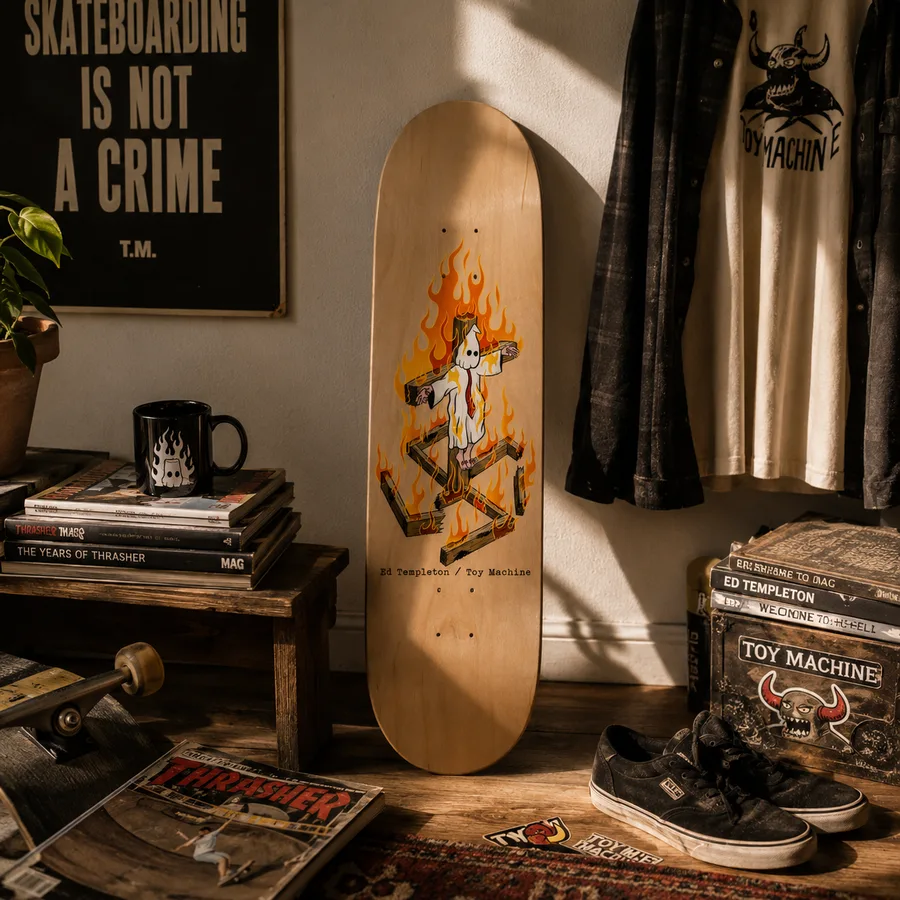
Charred Cross
Brand Toy Machine
Pro model (graphic manifesto)
Designer Ed Templeton
A hooded KKK figure crucified and burning over a broken swastika. An antracist manifesto. It polarized: applauded by much of the community, attacked by KKK sympathizers and by critics who argued that 'the message is right but it shouldn't be sold as a product.'
Why it matters Toy Machine and Templeton remain the political conscience of skate, 30+ years on.
Cross-industry logos: when the graphic escapes the deck
Some designs from the skate world achieved mass visibility far outside the sport itself — as streetwear or youth iconography. Thrasher Magazine introduced its flaming wordmark and Skate and Destroy motto in the early ’80s; the Independent Trucks cross (introduced in the late ’70s by NHS) and the Spitfire Wheels Bighead rank among the skate logos most tattooed on skin to this day.
Thrasher (flame logo / Skate and Destroy)
Brand Thrasher Magazine
Pro model (slogan/identity)
Designer Thrasher / Kevin Thatcher (revista, 1981)
Thrasher launched in 1981 (Kevin Thatcher, Eric Swenson, Fausto Vitello). The Gothic flame wordmark and the Skate and Destroy motto became the most imitated visual identity in skate: from magazine cover to patch, tattoo, and — decades later — runway tee.
Why it matters Probably the most bootlegged logo in skate culture. It transcended the magazine to become a symbol of attitude — and, ironically, a mainstream fashion item that Thrasher itself called out.

Independent Cross
Brand Independent Truck Company
Pro model (brand logo)
Designer Jim Phillips
Phillips designed the cross for Independent (founded 1978 by Vitello, Swenson, Novak, Shuirman). Original concept: a 'surfer's cross,' a variant of the German iron cross rooted in the surf/skate connection. Initially rejected for its association with Nazism, Phillips pushed back by pointing to its use in the cross of Pope John Paul II. In 2022 the brand redesigned the logo with an explicit statement of distance.
Why it matters Together with the Spitfire Bighead, the most tattooed logo in skate history. Its 2022 redesign was a cultural event.

Spitfire Bighead
Brand Spitfire Wheels
Pro model (brand logo)
Designer Kevin Ancell
Stylized face with a flaming head, narrow black eyes with a white gleam, exaggerated white-toothed grin, all in vivid red on black. First appeared as an ad in May 1992. Spitfire was founded in 1987 by Jim Thiebaud under Deluxe.
Why it matters One of the most reproduced images in skate history. Sewn onto hoodies, tattooed, painted on DIY bowls worldwide. Embodies the DLXSF energy.
DC Star Logo
Brand DC Shoes
Pro model (brand logo)
Designer Damon Way / Ken Block (equipo fundador)
Founded in 1994, DC Shoes grew into one of the most visible companies in the entire skate industry through the late nineties and early 2000s. Its logo — the distinctive star alongside the DC lettering — appeared on shoes, clothing, contests, video games, and ad campaigns that reached an audience far beyond traditional skateboarding. For several years it was practically impossible to walk into a skatepark without seeing the DC logo repeated dozens of times.
Why it matters Few skate logos achieved such global visibility during the 2000s. It represents the moment when skateboarding became a mainstream international industry.
Etnies "E"
Brand Etnies
Pro model (brand logo)
Designer Pierre André Sénizergues
Etnies' distinctive stylized E logo accompanied the worldwide expansion of one of the most important footwear companies in the history of skateboarding. Throughout the nineties and early 2000s it appeared on millions of shoes, T-shirts, and advertisements.
Why it matters Represents the global professionalization of skate footwear and one of the most influential brands of all time.
Live ranking of the most voted
See which graphics are winning
93 designs in the catalogue sorted by real votes. Every time someone hits "like", the ranking moves.
See full ranking →- 1 Iron Cross / Screaming Chicken Skull 6
- 2 Flaming Dagger 5
- 3 Nordic Skull 4
Five designers who defined the visual language of skateboarding
Vernon Courtlandt Johnson (VCJ) — lead designer of the Powell-Peralta catalogue from 1978 to 1991. Works in ink on paper. Studied illuminated medieval manuscripts and esoteric symbolism. Left Powell in 1991, returned in 2011. Sells original prints at vcjart.com.
Wes Humpston — co-founder of Dogtown Skates with Jim Muir. Credited as the first person to draw by hand on mass-produced decks, from 1976 onwards. Has run Bulldog Skates since 1995.
Jim Phillips — art director at Santa Cruz from 1975. Background in ’60s psychedelic rock poster art. Creator of the Screaming Hand and much of the Santa Cruz bestiary. Three books published between 2003 and 2007. Inducted into the Skateboarding Hall of Fame in 2017. His son Jimbo Phillips continues the work.
Marc McKee — lead artist at World Industries and Blind through the ’90s. Background in BMX flatland (Skyway). Designed the Devilman, Flameboy and Wet Willy mascots. Published The Art of Marc McKee in 2011.
Sean Cliver — artist working alongside McKee at World/Blind. Published Disposable: A History of Skateboard Art (Gingko Press, 2004), considered the field’s definitive reference work. Later produced Jackass, Wildboyz and Bad Grandpa with Jeff Tremaine.
Mark Gonzales — pro skater since 1984 (Vision). Co-founder of Blind (1989) and Krooked (2002). Named most influential skater in history by Transworld Skateboarding in 2011. Parallel career as a contemporary artist: zines, books published with Drag City, exhibitions in Tokyo, San Francisco, New York, Paris and Berlin. Has designed for Supreme since 2011.
The technical evolution of printing
The technique for printing a graphic on a curved deck has changed considerably across the five decades this article covers. The timeline below maps the major milestones:
-
Plain wood + stickers / metal logo
Logan, Sims, Hobie decks. One-color silkscreen at most. The deck is sports equipment, not a graphic object.
-
Image transferred by heat
Degraded quickly with use. Powell-Peralta used it until the mid-decade before switching to stable silkscreen.
-
2-4 spot color silkscreen
The modern visual language of skate develops here. 10-inch+ decks with full-bottom composition. Thin lines and black masses adapted to the technical limits.
-
Full-color silkscreen
Highest level reached for silkscreen on curved wood. Coincides with the end of the pre-crash era.
-
Limited silkscreen on narrow format
Decks thin out to 7.5-8 inches. Ends wear out on each slide, so graphics center and cartoons replace heraldic compositions.
-
Digital heat transfer
Allows full-color photographic images, but with lower durability than traditional silkscreen.
-
Lithography + premium silkscreen + alternative woods
Limited editions, art gallery collaborations, bamboo and Baltic birch. The deck fully enters the collectible market.
Reading and sources
- Cliver, Sean. Disposable: A History of Skateboard Art. Gingko Press, 2004.
- Phillips, Jim. The Skateboard Art of Jim Phillips. Schiffer Publishing, 2007.
- McKee, Marc. The Art of Marc McKee. Gingko Press, 2011.
- VCJ interviews in Juice Magazine.
- Editorial coverage in Jenkem Magazine and Thrasher for periods after 2010.
If you want to keep pulling the thread, the skate dictionary defines the technical terms that appear here (deck, pro model, slide, popsicle, vert), and the full history of skateboarding provides the chronological context for the discipline.
This list is not definitive
By this point it should be obvious that the history of skate graphics hasn’t ended.
New brands, new artists and new ideas keep appearing every year. Some will disappear over time. Others will become classics. And twenty years from now there will probably be debates just as passionate about today’s graphics as the ones that exist today around Powell, Santa Cruz or World Industries.
That’s why this list can never be considered definitive. It’s simply our selection of some of the graphics we like most, that have influenced us most, or that seem most important within the evolution of skateboarding.
Now it’s your turn.
Is there something essential missing? Leave it in the comments and help us keep building this story.
Comments
Which graphic do you think should be on this list and isn't? Anything to correct? Say it here. Your comment goes live instantly.
Conversation
Your name will be public. Your email stays private. Comments are reviewed before publishing.